

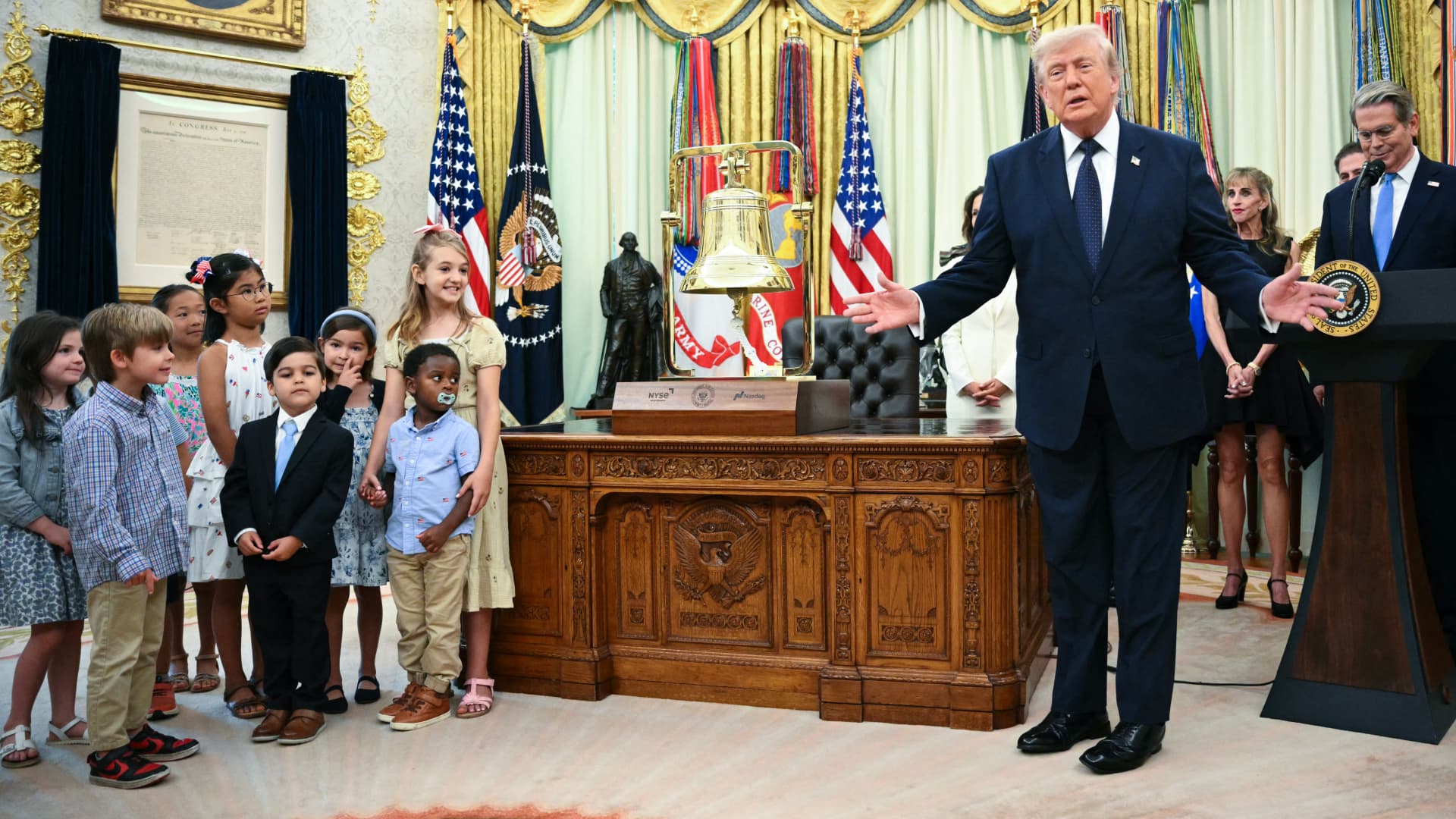
President Donald Trump speaks at the Trump Investment Account Opening Ceremony in the Oval Office of the White House on July 6, 2026 in Washington.
Mandel Gunn | AFP | Getty Images
A massive promotional campaign preceded the official launch of the Trump account on July 4, with more than 6 million American children signing up, according to the U.S. Treasury Department’s latest tally.
In the days that followed, $50 million was poured into the new investment vehicle in direct donations and gifts from family and friends, according to New York Mellon Bank, which officially manages the original account.
Funds in tax-deferred Trump accounts, also known as 530A accounts, are intended for long-term retirement savings rather than education expenses, but the funds can be withdrawn penalty-free at age 18 to cover higher education costs.
Trump account assets can also affect a student’s eligibility for need-based college aid, based on how income and balances are reported on the Free Application for Federal Student Aid.
FAFSA calculation
The FAFSA uses a calculation called the Student Aid Index to estimate how much your family can afford to pay for college.
The calculation includes both parent and student assets (such as money in savings and investment accounts) and income, including IRA distributions. Students’ assets are generally weighted more heavily on the FAFSA because students are expected to contribute more to pay for their education.
“The Trump account will be reported on the FAFSA as student assets,” said higher education expert Mark Kantrowitz. He said if this were treated as an investment account, eligibility for need-based assistance could be reduced by 20% of the asset value. For example, if your account balance is $10,000, your need-based grant could be reduced by up to $2,000.
The account includes a one-time $1,000 pilot program contribution from the U.S. Treasury for infants born between 2025 and 2028, which could reduce eligibility for college aid even for families who don’t make additional contributions.
“The government gives with one hand and takes back with the other,” Kantrowitz said.

Alternatively, these accounts could be subject to “IRA-like rules once the growth phase is over,” said Kalman Chaney, a financial aid consultant and author of the Princeton Review’s “Paying for College.”
Once the Trump account owner reaches the age of 18, the standard rules for traditional IRAs apply. “And currently, funds in IRAs and other retirement accounts are never considered assets that must be reported on the FAFSA,” Chaney said.
Official guidance from the Department of Education on how Trump’s account should be reported on the FAFSA is still pending. Despite some uncertainty, experts generally recommend signing up and taking free money when it’s offered.
“If the child meets the eligibility guidelines, it would certainly make sense to ask Uncle Sam for a $1,000 initial seed deposit,” Chaney said. “In the worst case scenario, you won’t lose more aid than the value of the account funded by that seed money.”
Students who intend to use this account to pay for college tuition may also have tax implications. Per Treasury guidance, withdrawn earnings are taxed as ordinary income, and a student’s income can also affect future aid. Although the FAFSA formula protects a portion of a student’s income, income above that threshold can be assessed at up to 50%.
How to plan a Trump account for college
Chaney says careful financial planning can help in this case.
For example, because financial aid decisions are based on “year-to-date” tax data, or family income from two years ago, students can receive distributions from their Trump accounts after Jan. 1 of their sophomore year and that income will no longer be factored into aid calculations, Chaney said.
“Get out of the financial aid forest and then take your distribution,” he said.
529 Alternatives
Alternatively, when it comes to financial aid, a parent-owned 529 college savings plan has better treatment than student-owned assets.
In this case, the percentage of the student’s assets is 20%, while the parent’s assets count up to 5.64%.
Additionally, when you withdraw money from your 529 plan, the funds are tax-free if they are used for qualified education expenses. Trump accounts may have a mix of pre-tax and after-tax contributions, so distributions will still be partially taxed.

“Trump Accounts and 529 plans are complementary, not competing. While 529s are aimed at households with education expenses, the Trump Account represents a historic leap in flexibility, allowing all Americans to save, invest, and build wealth over the long term,” a Treasury Department spokesperson told CNBC in an email.
Experts often consider 529 plans to be the best way to save money when paying for college due to their tax benefits and increased contribution limits.
This year, individuals can gift up to $19,000 per child, but those gifts will not count toward the lifetime gift tax exemption. There is also a “loophole” that allows grandparents to fund their grandchildren’s college savings without affecting their financial aid eligibility.
For comparison, annual contributions to the Trump account are limited to $5,000 per child.
Subscribe to CNBC on YouTube.
