

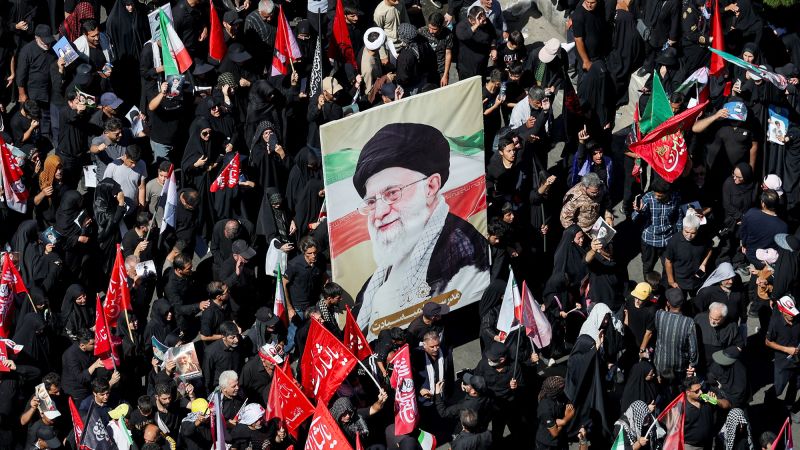
As mourners filled the courtyard of Tehran’s huge mosque to see the body of slain Iranian supreme leader Ali Khamenei for a final time, a mysterious man wearing clerical robes stood at a distance, watching the historic ceremony unfold from a balcony.
The man appeared in a grainy video flanked by a small group of people, which went viral on social media and fueled suspicions that he was Mojtaba Khamenei, the Ayatollah’s son and Iran’s new supreme leader.
Although his face was not clearly visible in the video and he was wearing a robe similar to those worn by many other Shiite clerics at the ceremony, there was nothing to identify him as Khamenei. Iranian cleric Reza Mousavi Baez later said on social media that the man in the video was him.
But the fact that this video went viral tells its own story. Many supporters were more focused on searching for any trace of Mojtaba than on a grand ceremony to honor the longest-serving and perhaps most influential leader in the Islamic republic’s 47-year history.
The new supreme leader, who is believed to have been wounded in a February attack by Israel and the United States that killed his father, mother and wife, has remained in hiding since the war began, communicating with supporters only through written statements and never showing his face or speaking out loud.
Meanwhile, Iranian officials have sought to downplay Khamenei’s injuries and project an image of full recovery, claiming he directed Tehran’s negotiations with Washington and building a narrative of respect for the young leader on the streets and in the Islamic Republic’s Newspeak.
His attendance at the funeral marked Khamenei’s first known public appearance since he was appointed as Iran’s new supreme leader following his father’s assassination.
Ahead of the event, Israel had also made threats against the younger Ayatollah Khamenei, with Defense Minister Israel Katz saying the new supreme leader was “sentenced to death.”

“Given the extent of the Islamic Republic’s intelligence failures during the war, Mojtaba’s public appearance could put him at risk of assassination,” said Mohsen Milani, a professor and author of “Iran’s Rise in the Middle East and Conflict with the United States.” This would jeopardize “both the successor and the Iranian government’s ability to negotiate with the United States or manage a new conflict,” he added.
Despite the threats, his absence from the funeral has heightened the intrigue, raising questions ranging from whether Khamenei was really running the country to the extent of his injuries during the attack.
The week of Ali Khamenei’s ceremony, an AI video claimed to show Mojtaba Khamenei in disguise bidding farewell to his father as he walked among mourners in Tehran. Pro-regime journalists predicted that he was among the crowd at Mosala, Tehran’s main mosque, but that he was “not in hiding” due to “excellent coordination” with the Revolutionary Guards. Others shared photos of a beardless man wearing a black hat and claimed it was the Republic’s new Grand Ayatollah in disguise.
Hours before their father was buried in Mashhad, mourners called out to the new supreme leader and recited the Declaration of Allegiance: “Mojtaba, I am your servant.”
Despite expectations and rumors, he did not appear to lead the throngs of supporters in the six-day binational memorial service for his father, mother and wife as Iran’s new supreme leader, nor did he appear to stand beside his brothers Mostafa, Massoud and Maysam to bury his father in his burial site in Mashhad.
Israel’s Foreign Ministry mocked Khamenei’s absence from his father’s funeral in a sarcastic social media post. “Mojtaba’s passionate presence at his father’s funeral in Iraq,” the newspaper wrote, along with a photo of mourners taking part in one of Iraq’s funeral processions holding posters of the new supreme leader.
Last month, President Donald Trump said the younger Khamenei was “more rational” than his father before implicitly acknowledging that the new leader was alive but “pretty seriously injured.” Iranian medical officials said Khamenei was not seriously injured in the attack. In May, U.S. intelligence agencies assessed him as playing a key role in developing war strategy with senior Iranian officials.

Mr. Mojtaba’s absence from his father’s burial may strengthen the belief among the Islamic Republic’s opposition that he is incapacitated and that his appointment is meant to shift decision-making responsibility to someone whose physical absence may make it impossible to remove Mr. Mojtaba.
But even among Iran’s most ardent supporters, Khamenei’s absence could raise doubts and open up space for once-taboo criticism amid an internal dispute over diplomacy with the United States, which Iran’s most hardliners oppose.
Some conservative channels within the Islamic Republic have accused the Western negotiators of defying Khamenei’s orders, and some fringe groups have even suggested that the negotiators had staged a coup, an accusation that led to stones being thrown at Foreign Minister Abbas Araghchi and President Massoud Pezeshikian, who attended the funeral procession.
Khamenei’s absence could widen these rifts and expose regime officials to further attacks.
His appearance is momentous and will help establish his new reign. Ironically, his late father, in a 2005 speech, mocked American leaders for their “disappearances” after the 9/11 attacks, declaring at the time that “if a bad experience should happen to Iran…we ourselves are ready to put on combat uniform and make the sacrifice.”
Ali Baez, director of the International Crisis Group’s Iran project, told CNN: “[Khamenei’s]absence suggests either severe paranoia about his safety or a serious injury that has not healed well enough for him to perform in public.”
However, despite the rumors, the decision not to attend the funeral was definitely a calculated one. By appointing another Ayatollah Khamenei, the Supreme Leader could achieve the continuity the Islamic Republic sought to establish and protect its most important figure, now targeted for elimination by Israel and the United States.
The concept the regime is trying to protect is “Velayet e-Faqih,” or guardianship. It is at the heart of the Islamic Republic, with the supreme leader positioned as the authority to rule the country until the return of the Hidden Imam, a Shiite Muslim sage who will emerge at the end of the era to bring justice to the world.

Baez said the role of the supreme leader is to serve both as the external leader of the Islamic Republic and as the internal overseer of the regime itself.
From a practical standpoint, the most important task now facing the young Ayatollah Khamenei is maintaining unity behind the scenes among the Islamic Republic’s core operators as they struggle to preserve a ceasefire with the United States and a deal that would unleash a flow of wealth to Iran.
“While his continued absence may raise some questions about the regime’s core supporters, just as important is his role behind the scenes as a mediator between political and security elites who may disagree on domestic and foreign policy issues,” Baez said.
Even without a physical presence in the public sphere, the idea of Khamenei ruling from the shadows helps protect his authority, even if it means exposing the new supreme leader to rumors that he is dead or even cardboard cutouts, according to the meme.
“Being invisible doesn’t mean not being responsible,” Baez added. “Either because of the power he wields in principle or because it may be lacking in practice.”
