

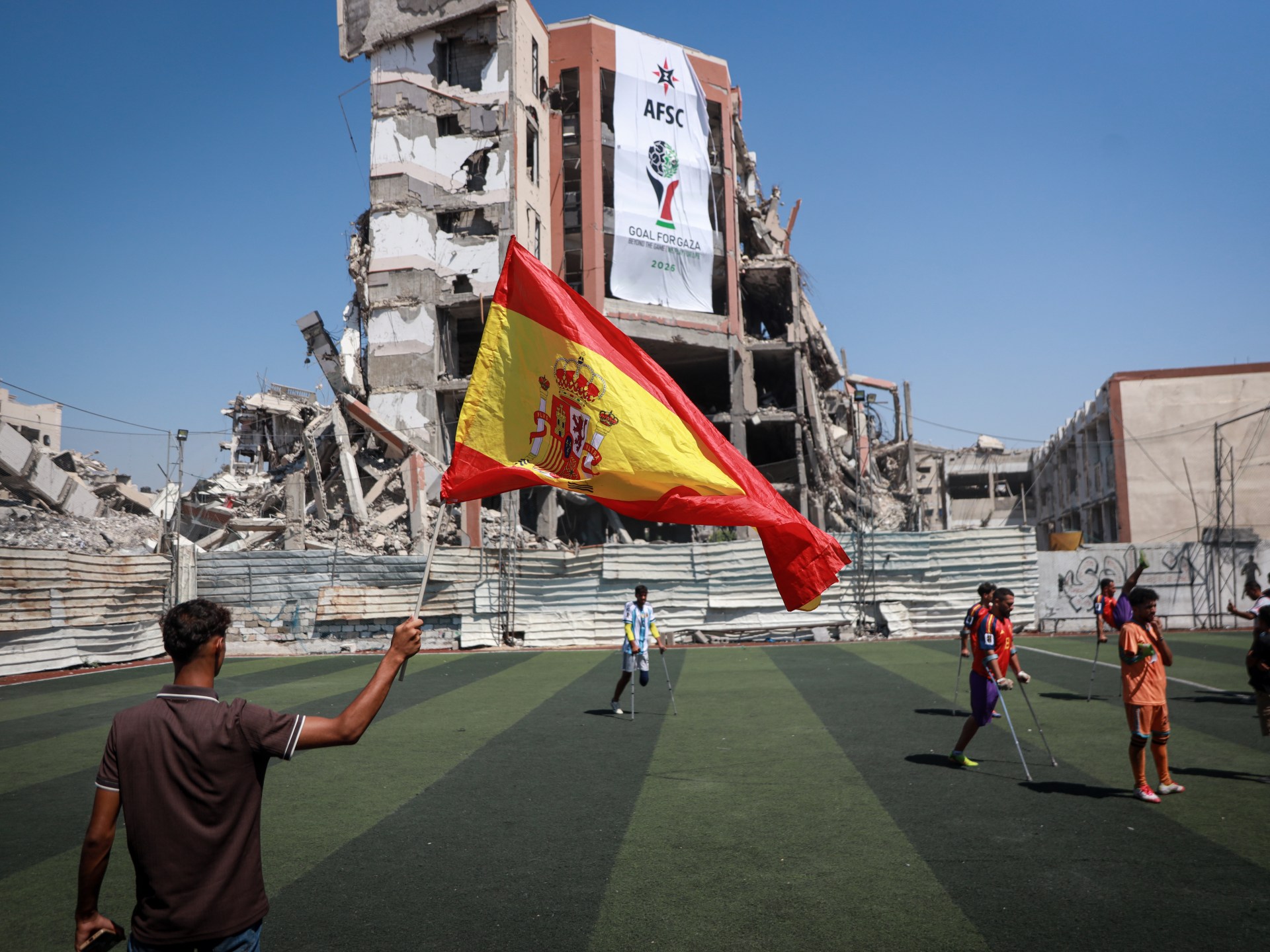
GAZA CITY, Gaza Strip – Ahmed Al Bozum knows exactly which team he will be rooting for in the World Cup finals.
“I fully support Spain because Spain stood up for Palestine,” the 33-year-old Palestinian said before Sunday’s match between La Roja and Argentina.
Recommended stories
list of 3 itemsend of list
This is a view held by many in the Gaza Strip, in part due to the Spanish government’s position during Israel’s genocidal war against the Palestinian people and public expressions of support by Spanish sporting figures, including Barcelona star Lamine Yamal.
“We love you from Palestine,” al-Bozum said in a message to Yamal, who waved a Palestinian flag at an open-top bus parade in Barcelona after winning La Liga in May.
“We are rooting for you wholeheartedly and hope that you will lift the World Cup trophy and also raise the Palestinian flag,” he added.
Excitement is also spreading in Gaza as global anticipation builds ahead of the final, even though more than two years of Israeli attacks have made it increasingly difficult for the tournament to continue.
Adnan al-Afifi, a former soccer player and stadium manager, said: “People can only watch the match if electricity happens to be available, but the generators have stopped because fuel is scarce and too expensive.” “Ordinary Palestinians are paying the price.”

In an effort to revive the sense of sporting life that was all but lost during the war, Afifi has been organizing World Cup-themed exhibition matches at the Palestine Sports Club in Gaza City. The club is still in operation and is the only soccer club on the Strip that is accessible to players.
On Thursday and Saturday, the club held two mock World Cup matches between the Palestinian and Spanish national teams.
The event featured referees and the iconic Video Assistant Referee (VAR) system to give players a taste of professional international competition.
“The atmosphere was full of passion and positivity, and it was the biggest expression of support for the Spanish national team,” said Al Afifi, 37.
“These gestures mean a lot.”
In May 2024, the Spanish government officially recognized the Palestinian state.
Prime Minister Pedro Sánchez said the move was aimed at supporting a two-state solution in the Israeli-Palestinian conflict and helping end the humanitarian crisis in Gaza, while also calling for a ceasefire and the provision of humanitarian aid.

Several players and coaches from Spain’s national team also expressed solidarity with the people of Gaza, including Yamal and former Manchester City manager Josep Guardiola, an act that symbolizes more than football for Palestinians.
“The whole Palestinian people wants Spain to win the World Cup,” said Hatem al-Maghribi, head coach of Gaza’s amputee soccer team, Gaza al-Irada (Gaza Determination).
Almaghribi added: “Although the players lost their legs and arms, they have not lost their words of gratitude, love and appreciation for those who stood by the Palestinians.” He also thanked Egyptian coach Hossam Hassan for his public support of the Palestinians during the World Cup.
“These gestures mean a lot to us,” Al-Afifi agreed.
“They make us feel like someone sees what we’re going through.”

A former player said despite the devastation of the war, football in Gaza is gradually showing signs of recovery, but obstacles still remain.
“All the main stadiums in Gaza are unusable due to displacement and the security situation,” Afifi said.
He recalled playing in Gaza’s major stadiums over the past 25 years, from Rafah in the south to Beit Hanoun in the north, and lamented that many had been destroyed or converted into shelters for displaced families.
For now, soccer in Gaza is limited to five-a-side pitches, with the Palestinian Football Association hosting small local tournaments to keep players involved in matches.
Despite war, destruction and a deepening humanitarian crisis, soccer remained an important part of daily life in Gaza during the World Cup, providing a rare escape from the realities of war, even if only for 90 minutes.
“Everyone wants to see the big match, especially the final,” said Al-Afifi, expressing hope that local organizations and community initiatives will organize public screenings of Sunday’s match across Gaza.
“Spain supported the Palestinian cause and raised international recognition. We hope they will be rewarded by winning the World Cup,” Afifi added.
Al-Afifi stressed that despite his excitement for Spain, this should not be interpreted as hostility towards Argentina, despite statements of support for Israel by Argentine President Javier Millei and comments that have sparked criticism among Palestinians.
“We respect all national teams, regardless of their origin,” Al-Afifi said. “Argentina is a great footballing country and school of football in terms of talent and performance. Supporting Spain does not mean that we are enemies of the Argentine team. We also wish them success.”
Meanwhile, Al Maghribi is expecting a tough final.
“Argentina might have a better chance thanks to Lionel Messi,” he said of the reigning world champions’ captain.
But Al Bozum was more bullish on Spain’s chances.
“I predict Spain will win 3-1 after extra time,” he said. “I think it will end 1-1 in regular time until Spain scores twice in extra time.”

