

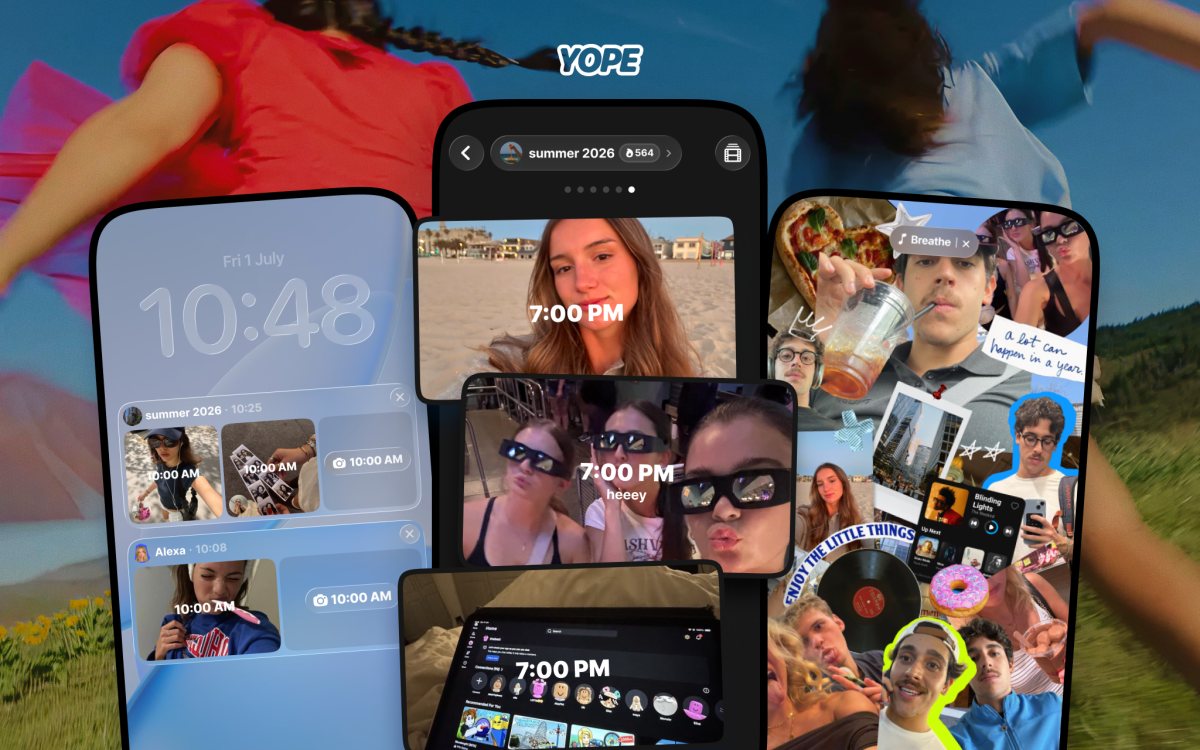
As social media evolves from a place to connect with friends to a massive entertainment platform, a startup called Yope is quietly building what it believes will be the future of online connectivity: social networking without algorithms, ads, or public content.
Yope’s app, currently backed by a $12.3 million round led by Northzone, is taking on big tech companies like Facebook, TikTok, Snapchat, and Instagram by building a social platform centered around what it calls “microcommunities,” small groups of friends and family who interact privately, share photos, videos, messages, and, soon, play games.
The idea of building private, algorithm-free social media is not new, but few apps have been able to scale it without adding creator content to keep users engaged. Yope wants to change that by facilitating connections between real-world friends and making it as much a communication tool as a place to share photos and life updates.
On Yope, accounts are private by default and there is no algorithmic feed. It is also not supported by ads, instead focusing on developing premium subscription-based experiences for power users.

Bahram Ismailau, London-based co-founder and CEO of Yope, said his team recognized the potential for a new type of social network after leveraging AI tools to conduct more than 100,000 interviews to better understand how young people around the world use social networks. They found that about 30% were using what they called photo dump or “spam” accounts. On this account, users share more candid photos with a small number of real-life friends.
On the other hand, many people don’t share anything publicly and instead rely on messaging to keep up with friends.
“If[young people]are not ready to become influencers, they have no place to express themselves,” Ismailou pointed out in an interview with TechCrunch. But teens still want to do it. They just want more privacy.
“We saw this huge opportunity to create a new space for young people to be social. We named it Yope, an AI-native social platform for young people and the next generation.”

He made it clear that his team does not believe in using AI to create content. Rather, AI is seen as a tool that helps us build better connections. This includes the ability to use AI to create mini-games that you can play with friends, and this feature is expected to be released in about a month. It also aims to leverage AI to help users meet up in real life, such as buying tickets to an event or finding a restaurant or bar to watch a football game.
Yope allows users to create their own profiles by sharing photos and turn them into cutout stickers. Rather than being organized into albums, photos are displayed in an almost chaotic arrangement, collage-like, along each user’s “wall.” Soon, Yope users will be able to further customize their space by adding their own interests, favorite music, mini-games, and customize the look and feel with their favorite colors and wallpapers.

The idea is reminiscent of Myspace, which once allowed users to carve out their own place on the web, customizing it to reflect their personality.
The app also borrows heavily from existing social platforms, offering now-standard features like in-app messaging, a summary of your best moments (Yope is created by AI), and a lock screen widget that showcases your friends’ photos. During onboarding, the app guides users through setting up various features, grants them permissions to access photos and search for friends, and prompts them to add connections and start private chats.

The combination of these features seems to work well. Yope currently has nearly 15 million registered users who collectively share 10 to 20 million pieces of content each week, including personal photos, videos, and stickers. These indicators suggest regular use. Ismailau claims that more than 50% of Yope’s users open the app at least five days a week, effectively making them power users.
It’s not just young people who are adding friends. Ismailou said about 20% of active users invite older family members to the app.

Ismailaw said Northzone approached the company because its usage caught the attention of investors, not the other way around. Northzone, which is behind other consumer apps like Spotify and Klarna, led the $12.3 million round with participation from Inovo, Redseed, and Geek Ventures. This round brings the company’s total funding to $20 million. (Yope is the result of two previous pivots. TechCrunch covered an early version of the company. The current version has been in development for about two years.)
“Yope is a fresh, empowering, and safe social media that gives users full control over their experience, in contrast to predatory practices like Meta, TikTok, and X,” Northzone partner Per Jørgen Persson said in a statement. “We are very excited to partner with Bahram, Paul (Rudkouski, co-founder) and their team to build a service that far exceeds the 500 million moments shared with millions of users today.”
The funding will be used to further develop the product, expand the team (currently around 35 people) and establish an office in the US.
Yope is free to download on iOS and Android.
Correction: Users exchange 10-20 million pieces of content every week, not every day. The founder made a mistake. I’ve updated the post accordingly.
If you buy through links in our articles, we may earn a small commission. This does not affect editorial independence.
