

Rapid Action Force (RAF) members fire tear gas to disperse supporters of the Cockroach Janta Party (CJP) during a protest demanding the resignation of India’s Education Minister Dharmendra Pradhan over allegations of NEET exam fraud in New Delhi on July 20, 2026. On July 20, Indian police fired tear gas and charged with batons at demonstrators who tried to march on parliament in New Delhi to demand the resignation of the education minister over corruption scandals. In major exams. (Photo by Arun SANKAR/AFP via Getty Images)
Arun Sankar | AFP | Getty Images
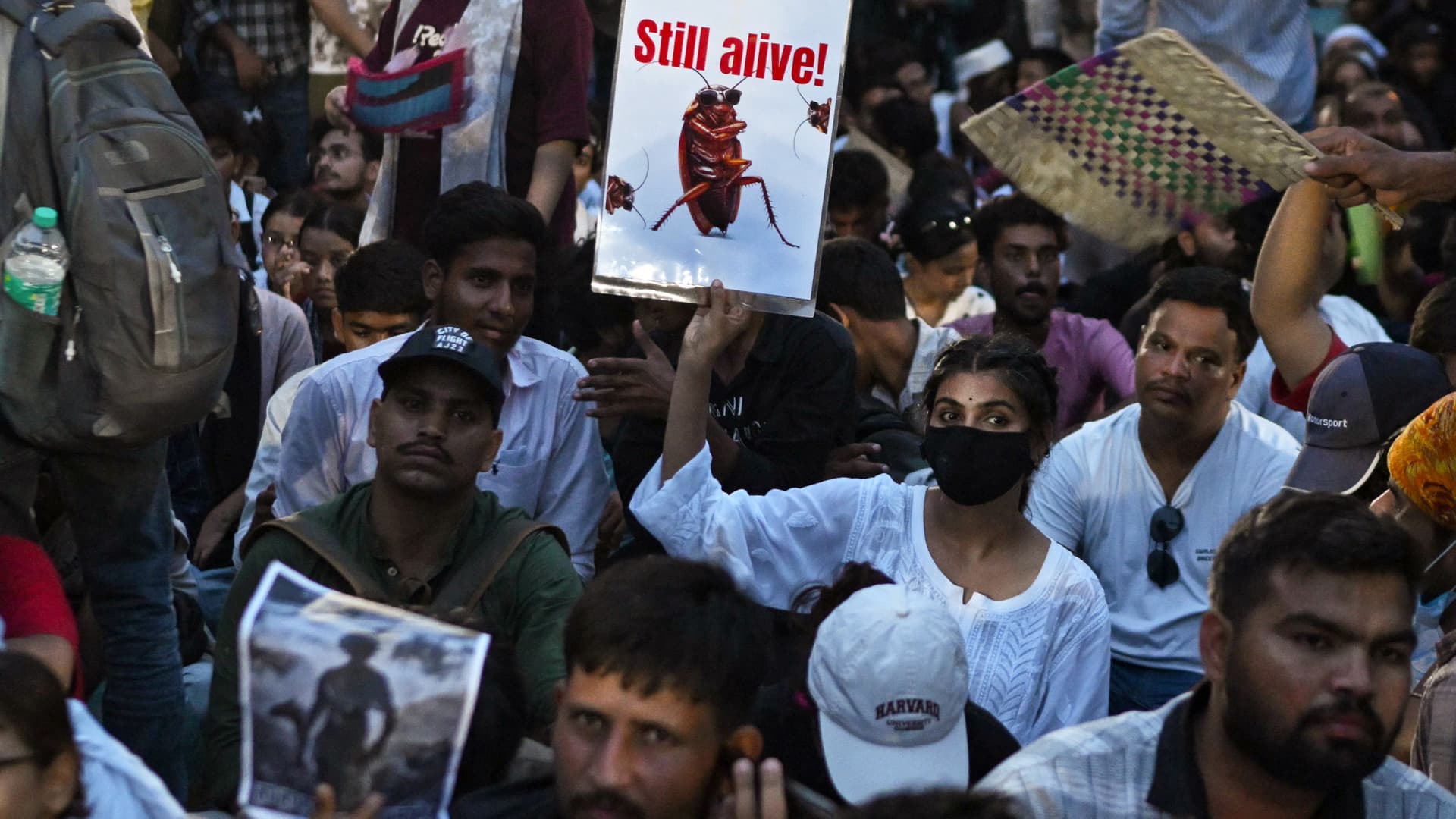
Thousands of Gen Z student protesters, led by the quasi-political group Cockroach Janta Party (CJP), continued to gather in New Delhi on Wednesday despite authorities cracking down on the movement.
India has the world’s largest youth population, and experts say the protests are a result of Gen Z anger stemming from youth unemployment and lack of economic mobility.
Atman Trivedi, a partner at Washington-based DGA Albright Stonebridge Group, told CNBC that “the ongoing demonstrations may represent the most significant public challenge to the government since the 2020-2021 farmer mobilization.”
Trivedi added that CJP started as an “online political satire” but has now turned into a “serious real-world protest movement”.
The student movement began on June 6, demanding the resignation of India’s Education Minister Dharmendra Pradhan, who was held responsible for the leaked exam questions in May. This drew support from activist and educator Sonam Wangchuk, who has been on a hunger strike for 25 days and is undergoing treatment.
Demonstrations intensified this week after students broke through security barricades surrounding the protest site as they marched to parliament on Monday, and were tear gassed and beaten by Delhi police. Police said more than 100 staff members were injured in the “violent protests.”
Lavanya Singh, who attended the July 20 protest, told CNBC that police appeared to have used violent methods not to disperse the crowd, but to “inflict the maximum amount of damage possible.” The 26-year-old returned to the protests on Wednesday and plans to take part “every day”.
“The leak (of the exam papers) is an example of how the government has failed us over and over again,” Singh said, adding that the protesters were motivated by a mix of “feelings of betrayal, anger and helplessness.” Although the CJP is not “perfect”, it strives to deliver justice and listens to the voices of the youth of our country, Singh said.
India’s Ministry of Home Affairs did not respond to CNBC’s request for comment.
mounting pressure
CJP was launched on May 16 by Abhijeet Dipke, a political communications strategist and Boston University student, after India’s Chief Justice Surya Kant called those who attack facilities “parasites” during a court hearing and compared some unemployed youths and activists to “cockroaches.” The CJI later said his oral opinion had been “misquoted”.
Since then, CJP has gone viral on social media, amassing more than 22 million followers, but the account was deleted on Wednesday after Mr. Dipke criticized Prime Minister Narendra Modi in a post on X.
Mr Modi’s political opponents have also increased pressure on the government to meet the students’ demands, demanding action against those who assaulted the protesters.
Rahul Gandhi, the Indian opposition leader who was briefly detained on Tuesday for protesting outside the prime minister’s office in solidarity with students, claimed that there have been around 152 exam question leaks in the past decade, affecting more than 75 million students.
The ruling Bharatiya Janata Party announced that the government would investigate claims made by Mr. Gandhi, who said at a press conference on Wednesday that “India’s education system is rigged.”
In May, the National Eligibility and Entrance Examination, an important test for admission to medical schools, was canceled due to an alleged paper leak, affecting millions of students. A retest was held in June.
In a post on X on Wednesday, the country’s education minister said the government will “continue to give 100% of its efforts” to discuss the leaked exam questions and “address all genuine concerns of young people on the floor of the House of Commons.”
Indian students deserve far better than being “used as props in political campaigns” and “certainty over chaos, solutions over slogans, and accountability over chaos.”
Does anxiety spread?
The CJP said the protests had spread to multiple cities in India and said “the country has woken up”.
Angad Chhabra, a 17-year-old student protesting in Bengaluru, India’s technology hub, who is about to complete his engineering degree, said students’ grievances “cannot be kept silent any longer” and that the CJP was providing a platform for young people to come together.
NEW DELHI, INDIA – JULY 20: A large crowd marches towards Parliament from Jantar Mantar on July 20, 2026 in New Delhi, India. Demonstrators were seen breaking through police barricades and scuffling with security guards as authorities tried to stop the march.
Hindustan Times | Hindustan Times | Getty Images
India is ranked as the ‘most risky country’ on the global risk analysis firm Verisk Maplecroft’s civil unrest index. Reema Bhattacharya, head of Asia research at Verisk Maplecroft, said in a note on Wednesday that while the scale of complaints is growing and the average number of participants in protests has more than doubled over the past year, unrest is now geographically dispersed across India.
“After 10 years in office, it is difficult to attribute the employment slump to traditional factors alone, and the strongest anti-incumbency argument seen during his 12 years in power is gaining momentum ahead of the 2029 election,” he added.
The CJP’s protest has also received support from various regional political parties and farmers’ organizations. Prominent farmers’ union leader Rakesh Tikait pledged support to the students’ protests.
Pramit Pal Chaudhuri, head of South Asia at the Eurasia Group, told CNBC that the CJP serves as a lightning rod for almost everyone dissatisfied with the government, but he also warned that this was making the movement “increasingly chaotic”.
