

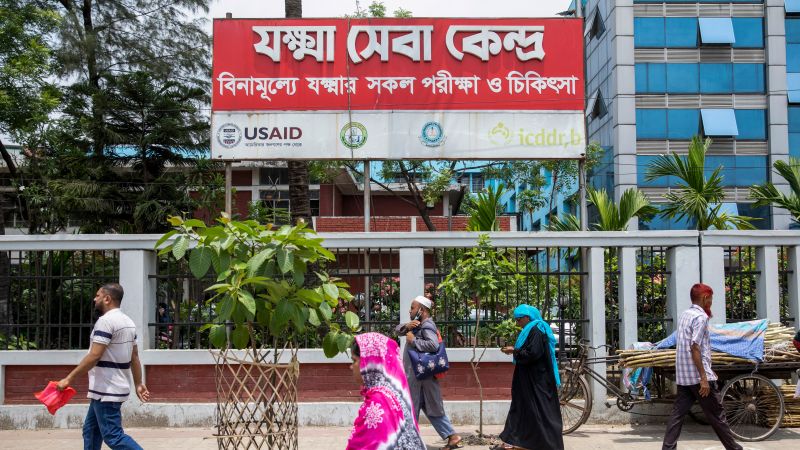
The Trump administration plans to redirect $2 billion in funding meant for global health programs to the cost of shutting down the United States Agency for International Development (USAID), according to a copy of the notice obtained by CNN.
Two federal health policy experts told CNN that the money would come from funds appropriated by Congress for health programs that address malaria, tuberculosis, maternal and child health, nutrition, global health security, and HIV/AIDS. Approximately $1.2 billion that was originally scheduled to be earmarked for overseas development assistance will also be redirected.
Instead, the administration aims to use the billions to pay for legal fees, outstanding bills, and asset sales associated with USAID’s abrupt dissolution.
Last year, the Trump administration temporarily froze nearly all foreign aid and canceled thousands of aid contracts while dismantling USAID and eliminating the few remaining programs under the State Department.
The U.S. government has told Congress that it is retaining a total of more than $19.1 billion to pay for USAID closure costs, much of it from previously terminated USAID contracts, according to a notice sent on April 20 and obtained by CNN.The notice to Congress was first reported by Devex.
A group of 17 Senate Democrats is calling on the administration to rescind the budget proposal and “redirect the funds to their intended purpose, to save lives and advance American interests, as Congress directed last year.”
“The Administration should immediately begin leveraging these foreign aid funds to deliver results for the American people. There is no reason that this fiscal year 2025 funding should be withheld to cover the wasted costs the Administration has incurred by choosing to dismantle USAID,” the senators argued in a letter to Secretary of State Marco Rubio, Office of Management and Budget Director Russell Vought, and Acting USAID Administrator Eric Welland.

CNN has reached out to the State Department and OMB for comment on the proposed funding. A State Department spokesperson acknowledged that CNN had asked questions, but did not respond.
Health policy experts told CNN that redirecting funds to global health programs could result in tens of thousands of deaths and thousands more getting sick.
An analysis by the Academy of Health and Safety Policy think tank based on current funding plans suggests that with $2 billion in funding cuts, the estimated number of preventable deaths from tuberculosis could reach 121,000 and the number of deaths from malaria could reach at least 47,600. These are just two of many program areas that will face substantial cuts.

Substantial funding cuts to nutrition programs could lead to the loss of lifesaving nutrition for 22.9 million children under five and safe childbirth facilities for more than 5.7 million women, one official who reviewed the numbers told CNN.
The redirection of funds comes after a year of deep cuts in global humanitarian aid by the United States and other donor countries. A study published in February in The Lancet found that if current funding trends continue, global aid cuts to date could result in at least 9.4 million more deaths by 2030.
Health policy analysts say the administration is spending about $1.7 billion more than Congress has already approved for the nation’s flagship HIV/AIDS program.
The HIV program, called the President’s Emergency Plan for AIDS Relief (PEPFAR), was established by the Bush administration in 2003 and is credited with saving more than 26 million lives and preventing millions of infections, primarily in Africa.
Although the budgeting process for PEPFAR funds is complex and Congress has given a five-year window to spend much of the money, analysts say the current rate of spending on the program has lagged significantly compared to previous years. One official called this “funds being held in an unprecedented manner.”
Budget documents show that as of the end of last fiscal year in September, the program had an estimated $976.5 million in unused balances from funds authorized by Congress the previous year (fiscal year 2024). Another $700 million earmarked for the Centers for Disease Control’s PEPFAR division has not yet been sent to the CDC, a health policy analyst told CNN.
Budget analysts and advocates for preserving these global health programs have expressed concern that the Trump administration will seek to cancel the funds currently held in these accounts or simply hold them in place until the end of his administration.
CNN has asked the State Department for comment on the lack of funding for HIV/AIDS programs.
The announcement comes just as figures on progress in HIV/AIDS programs have been released showing that the number of people on antiretroviral treatment for HIV has remained roughly constant, a result that senior State Department official Jeremy Lewin called “very positive.”
But health policy experts are warning that the number of people getting tested for HIV has fallen significantly, and fewer people are newly diagnosed with HIV and are receiving treatment.
The number of PEPFAR-funded HIV tests decreased by 14 million, or 17%, in 2025 from the previous year, according to data analysis by amfAR, the Foundation for AIDS Research.
“When you see fewer people getting tested…that suggests people are being missed. They’re not being diagnosed,” said Jennifer Kates, director of global and public health policy at KFF, arguing that PEPFAR’s overall results appear to be mixed.
“That would be consistent with the disruption that happened last year,” Cates said, referring to the Trump administration’s 2025 aid freeze and cutoff of many subsidies. He added that the decline in HIV testing is also consistent with the administration’s focus on HIV/AIDS treatment rather than prevention.

“All the evidence we have shows there was a significant drop in coverage from January to mid-last year, and that’s going to make people fed up,” said Charles Kenny, a senior fellow at the Center for Global Development think tank. “Some people may stop taking the drug forever.”
Kenney and other analysts also expressed concern that nearly 70,000 community health workers were laid off last year and many specialized outreach services were closed, according to a PEPFAR data release.
“The people who will suffer the most from it are the ones who are the most difficult to reach: men who have sex with men, adolescent girls, pregnant women and especially young pregnant people, people who use drugs. Reach for these groups will stop and infection rates will likely rise,” Kenney said. Experts say these groups are less likely to seek testing and treatment at government-run clinics.
Dawee Nel, director of South Africa’s LGBTQ+ organization OUT, said she had already seen hundreds of HIV patients drop out of treatment after one USAID-supported health program ended last year.
“The numbers show that we can’t go back to treatment and that trust is already broken,” Nel said. “It’s a picture with a very dark atmosphere.”
Experts warn that reducing local health workers will also affect preparedness for other future pandemics.
Brian Hornerman, amfAR’s deputy director of public policy, warned that the fight against the HIV epidemic is “fragile, and any shake-up in the system could quickly erode progress.” He added: “Broken data systems are increasing the real risk that this resurgence of HIV will go undetected and undiagnosed.”
This concern is echoed by other experts, as the Trump administration did not release any official data on its HIV/AIDS program from the first quarter to the third quarter last year.
“If PEPFAR funding is taken away, people will die,” said Asia Russell, executive director of the advocacy group Health Gap. “What they (the regime) are doing now is cloaking their actions in secrecy, refusing to invest in life-saving technology, and shifting the burden onto countries. And they’re saying, ‘Good luck, bye.'”
