

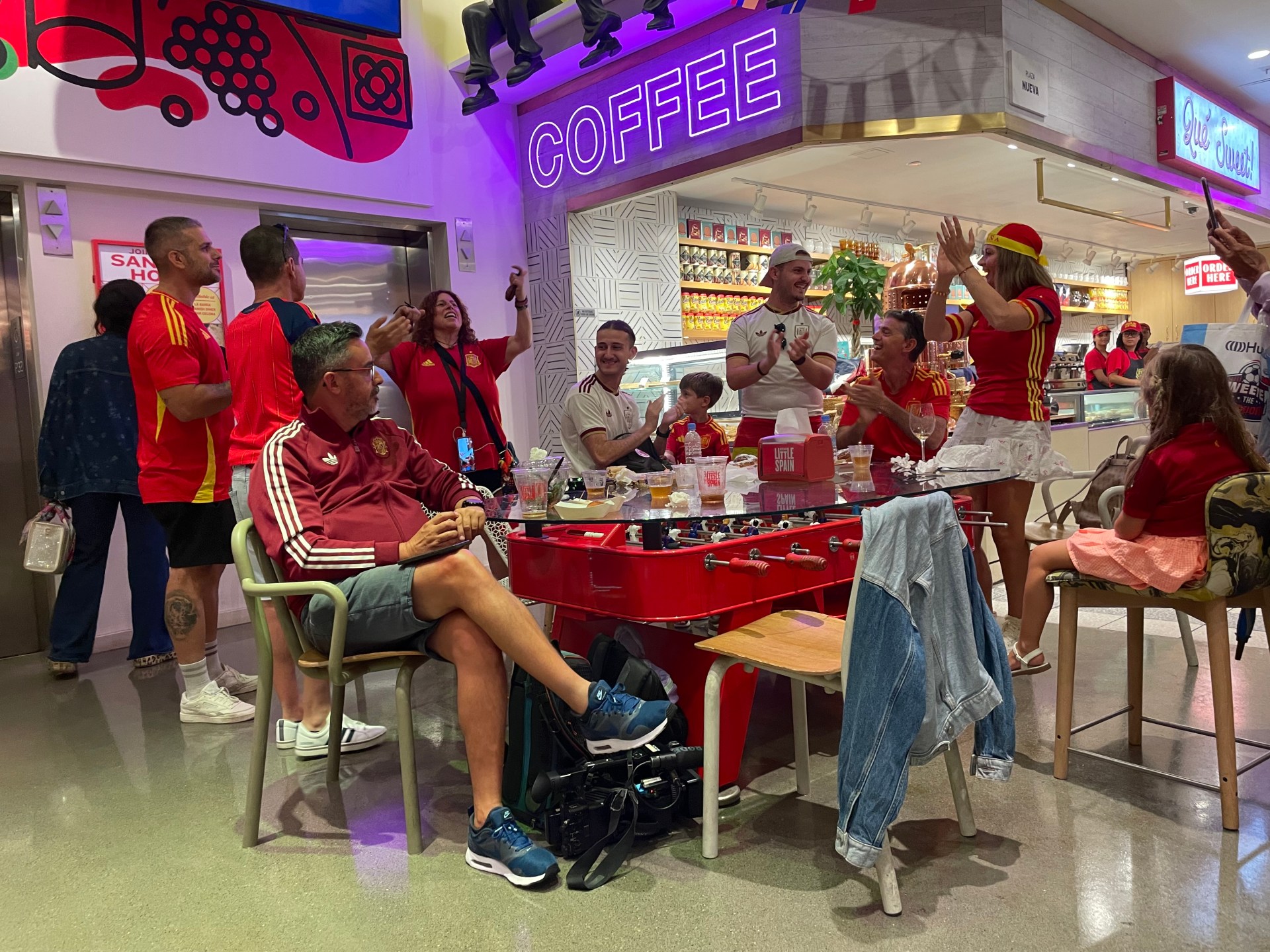
NEW YORK CITY, USA – Robert Sanfis is fielding recent “VIP” requests to attend a World Cup final viewing party at the Spanish nonprofit he oversees in Manhattan’s Chelsea neighborhood. He’s already fully booked and doesn’t know if he’ll be able to get additional space.
It is a fitting finale to a six-week tournament in which, as in previous editions, the Spanish Benevolent Association and its attached restaurants, collectively known as La Nacional, are packed with La Roja supporters every night.
Recommended stories
list of 3 itemsend of list
The 57-year-old partially credits Spain’s victory in 2010 with contributing to the revival of the organization, which was originally founded 150 years ago to help newly arrived Spanish immigrants start a new life in the city.
Although the Spanish enclaves that once existed in the area have all but disappeared, “we are still there for the Spaniards who miss their homeland,” he said.
Samfis described the tense atmosphere ahead of the 2010 final against the Netherlands in South Africa, when fans gathered in the streets to watch through the windows as Spain won their first, and so far only, championship.
Strong and consistent performances from Spain’s current squad, led by 19-year-old striker Lamine Yamal, and coach Luis de la Fuente’s team-first approach, have helped keep him calm.
Still, he plans to distract himself during the finals.
“Do you know what I do during the match? I just sit there directing traffic and making sure no one gets attacked,” Samfis told Al Jazeera. “I do this unconsciously because my biggest stress is the game itself.”

On the eve of the World Cup finals, Spain’s red may not be as ubiquitous across New York City as Argentina’s white and blue, but local die-hard fans feel the passion is unparalleled.
On Saturday, crowds gathered at Midtown’s Mercado Little Spain, a Spanish restaurant founded by Spanish chef Jose Andres, visible in a sea of red.
“I’ve been a Spain fan all my life, so this is unbelievable,” said Javier Bris, 38, who traveled from Chicago to watch the final in person.
“Being a Spain fan for that long means you know the pain,” he said. “There’s always this feeling that it can’t happen. But they kept winning.”
“They’re really consistent in vision, approach and style,” he added, referring to a distinctive team strategy that prioritizes positional advantages over relying on the abilities of specific players.
“They never wavered from the Spanish style.”
A new coalition of supporters
In the final stages of the tournament, Spain also proved a welcome home for New York City’s World Cup “orphans,” neutral fans whose first- or second-choice teams had their dreams dashed in previous knockout rounds.
Their success is helping to build a new coalition of supporters.
Spain’s colonial history has caused friction with supporters of many Latin American teams in the past. But Argentina’s controversial football is becoming increasingly non-grata for fans in the region.
“A lot of Mexican fans hate Argentina,” said Rolando Sanchez, 26, who lives in the Bronx. He mainly supported the Mexican national team before they were eliminated by England in the Round of 16.
“But for me, it’s up to the players,” Sanchez said. “I don’t mind seeing (Argentine No. 10 Lionel) Messi finish at the top, but the Spanish players are the future.”
Yamal’s paternal ties to Morocco and the Spanish government’s recognition of a Palestinian state have also boosted support for the team among the city’s Arab enclaves like Brooklyn’s Little Palestine.

At the same time, support is particularly visible among New York City’s West African community, due to Spain’s tradition of star athletes and the country’s large African population.
Yamal’s mother is from Equatorial Guinea. Winger Nico Williams’ parents are from Ghana.
Positive perceptions of Spain were further strengthened by the Spanish government’s rejection of the hardline approach taken by many European countries towards African immigration.
In contrast, Spain has pursued greater labor integration and the legalization of those living in the country without documents.
“They give them a chance, and it’s very exciting and very motivating,” said Usman Saho, 34, coach of Bronx-based Hunters FC. Hunts FC is a local club supported by Bamba Sports, a non-profit organization that aims to bring sport to underserved African communities in the city.
Gambian-born Saho wanted to see his first-choice team, Senegal, go all the way. But he hopes Spain’s young players, including Yamal, 24-year-old Williams and 21-year-old midfielder Gabi, will taste international glory for the first time.
“I hope we win this, because it gives us motivation,” he said. “Messi has already won every tournament. He has proven that he is the greatest.”
Mamadou Diabaté, 36, coach of Bronx-based Los Espanyol FC, said he was proud of his native Ivory Coast and its performance in the group stage. This included an overwhelming 1-0 victory over Ecuador.
However, the Spanish national team has always held a special place for him.
“Spain is one of the teams where you can see how beautiful soccer is and how teamwork works,” Diabaté said.
“Spain has offered it to the whole world.”
