

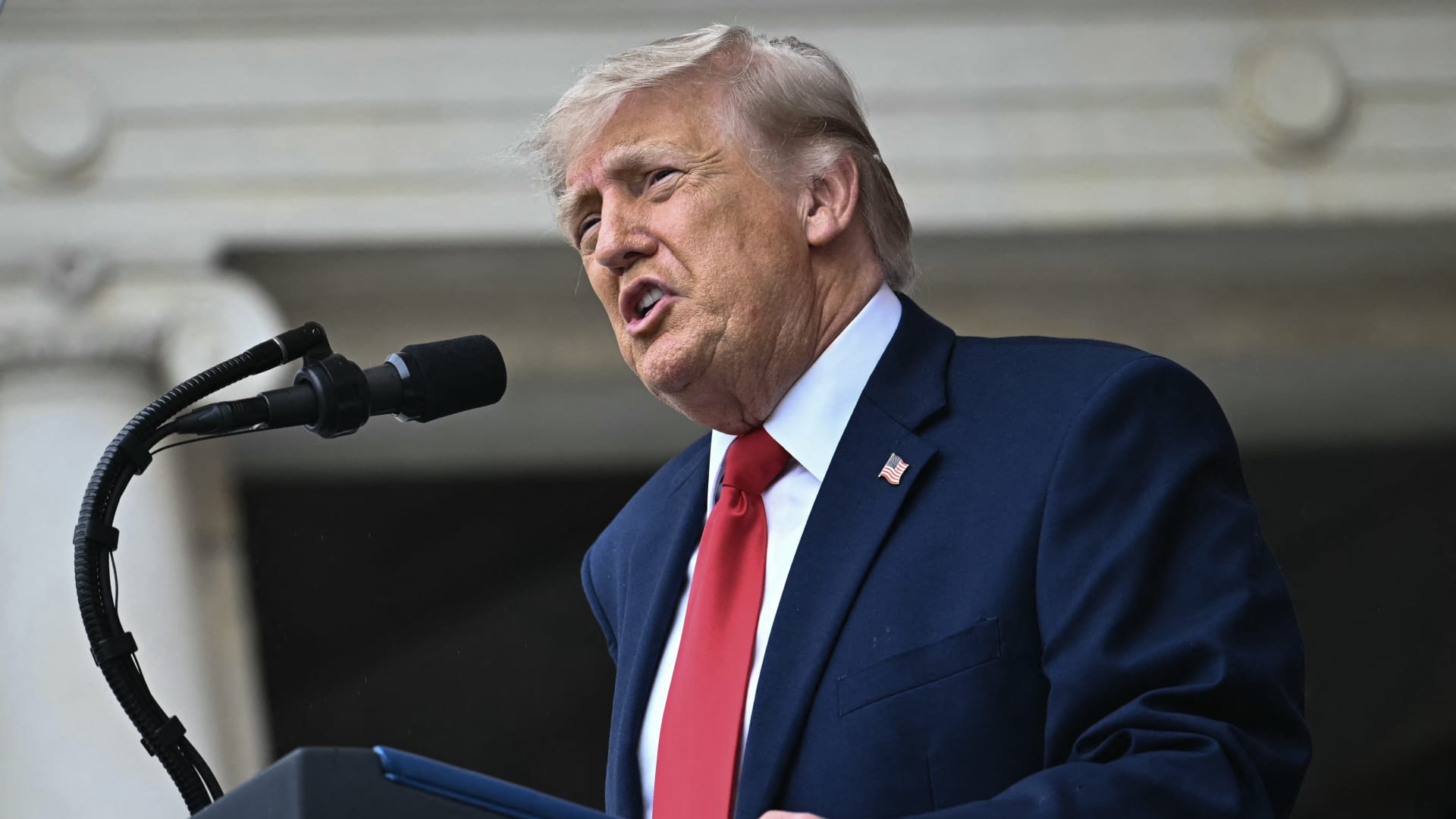
US President Donald Trump waves as he returns to the White House in Washington, DC, after playing golf at Trump National Golf Club in Sterling, Virginia, on May 31, 2026.
Brendan Smialowski AFP | Getty Images
US President Donald Trump on Monday slammed critics as the possibility of a deal with Iran remained elusive, saying Iran “really wants a deal” and that it would be a good deal for the US and its allies.
His comments came as airstrikes between the United States and Iran resumed over the weekend, with both sides claiming to have hit military targets near the strategically vital Strait of Hormuz. The Strait of Hormuz is a waterway that typically handles about 20% of the world’s oil shipments.
“Iran really wants a deal, and it would be a good deal for the United States and our partners,” Trump said in a post on Truth Social.
“But don’t Democrats and various seemingly unpatriotic Republicans understand that it’s much more difficult to do my job properly and negotiate whether I should move faster or move slower or go to war or not go to war or whatever, while political hacks continue to ‘squeal’ negatively over and over again at levels never seen before?” Trump said.
“Just sit back and relax, everything will work out in the end, it always does!”
U.S. Central Command announced Monday that Iran launched two ballistic missiles overnight targeting U.S. troops in Kuwait.
These attacks followed what was described as a US “self-defense attack” on Iranian radar and drone command and control facilities on Gork and Qeshm islands last weekend. Meanwhile, Iran’s Revolutionary Guards said it had targeted the air base used in the US attack in retaliation.
As Israel expands its ground offensive against the Iranian-backed Hezbollah group, Iran says any deal to end the war must include guarantees for a ceasefire in Lebanon. Israeli Prime Minister Benjamin Netanyahu welcomed the capture of the strategic Beaufort Castle in southern Lebanon over the weekend.
Iranian Foreign Minister Abbas Araghchi said on Monday that the United States and Israel were responsible for the consequences of ceasefire violations. “It is clear that the ceasefire between Iran and the US is a ceasefire on all fronts, including Lebanon. A violation of the ceasefire on one front is a violation of the ceasefire on all fronts,” Araghchi said in a post on X.
According to an Axios report released Saturday, President Trump has requested several modifications to the latest terms the envoys agreed to with Iranian officials. The report cited two anonymous U.S. officials as saying Trump’s request hinged on several issues, particularly Iran’s nuclear material. CNBC could not independently verify this report.
A ship anchored in the Strait of Hormuz, seen from Musandam, Oman, on May 29, 2026.
Stringer | Reuters
Kuwait, located in the northwest corner of the Persian Gulf, reported on Monday that its air defenses were intercepting missile and drone attacks. In a statement posted on social media, Kuwait’s Foreign Ministry condemned the Iranian attack, calling it a “dangerous escalation” to the country’s security and “undermining efforts aimed at de-escalation” in the region, according to a translation.
The US president has repeatedly said Washington and Tehran are close to a deal since the ceasefire took effect in early April, but talks have made little progress in recent weeks.
crude oil price
Oil prices rose on Monday morning. international benchmark brent Crude oil futures for August delivery rose 3% to $93.91 per barrel, matching previous gains, while the U.S. west texas intermediate Futures for July delivery rose 3.6% to $90.51 a barrel.
Brent and WTI fell 11.1% and 9.6% respectively last week, marking their worst weekly performance since mid-April.
Guntram Wolff, a senior researcher at Brussels-based economic think tank Bruegel, said market participants were “too optimistic” about the prospects for a diplomatic breakthrough.
“The problem is that we’ve been promised a good deal for a long time and it’s been more than 90 days,” Wolff told CNBC’s “Europe Early Edition” on Monday.
“We understand that it will take time to get a really solid deal, but have the fundamentals changed? No, they haven’t. Iran continues to have significant capabilities to do great damage, it can continue to control the Strait of Hormuz, it still has nuclear enriched material, so the fundamentals have not changed.”
