

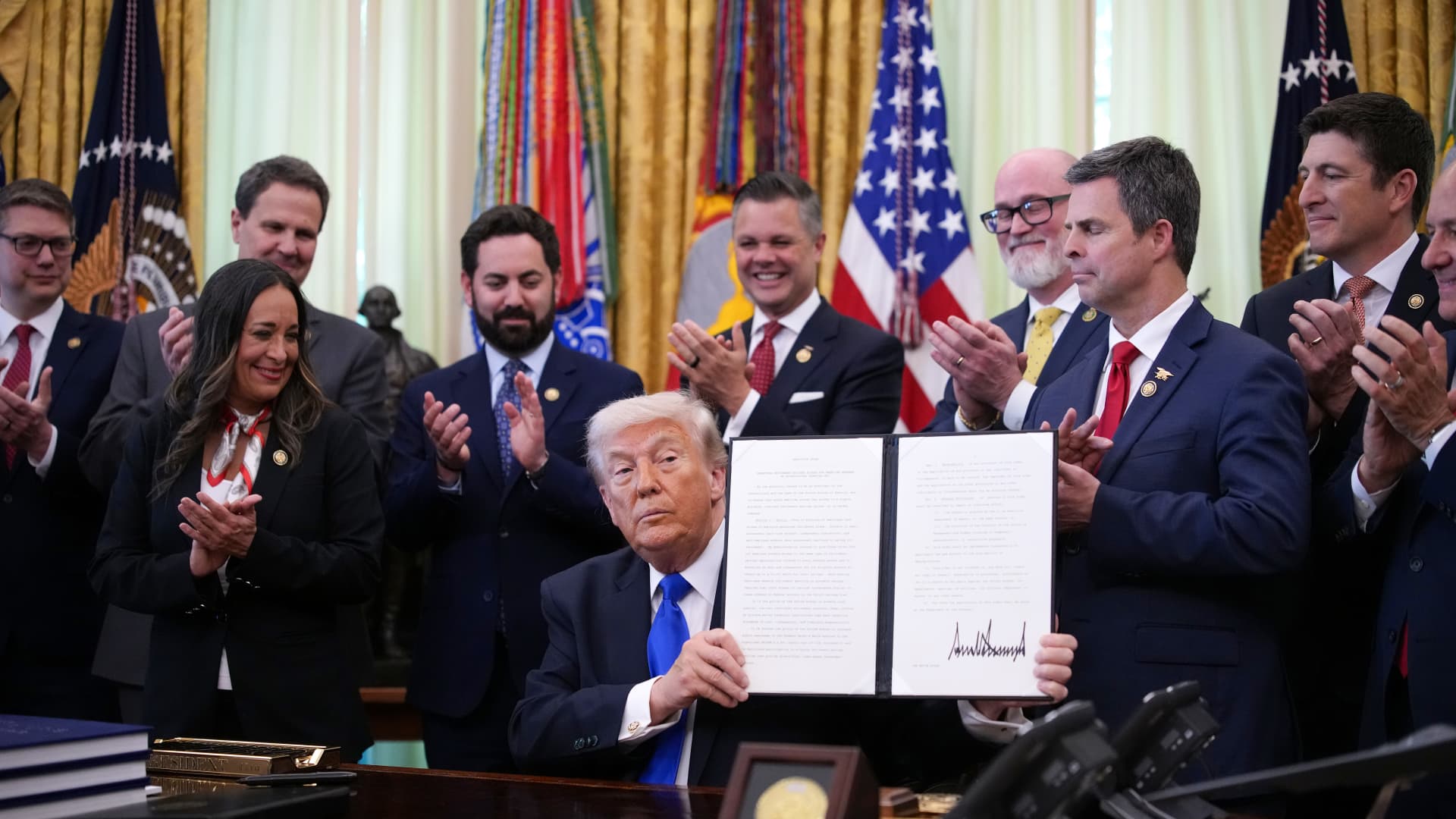
President Donald Trump holds up an executive order during an event in the Oval Office of the White House on April 30, 2026. Signed an executive order expanding workers’ access to retirement accounts.
Andrew Harnik | Getty Images News | Getty Images
President Donald Trump signed an executive order Thursday expanding access to retirement accounts, saying young workers could have $465,000 in retirement accounts by the time they turn 65 if they save regularly.
“In other words, they’re going to get rich,” President Trump said at the signing ceremony.
But financial advisors disputed this characterization, saying $465,000 doesn’t necessarily qualify you as wealthy in retirement, especially if your nest egg needs to be spread out over roughly 20 to 30 years.
“These accounts have their benefits, but I don’t believe they make people rich,” Barry Glassman, a certified financial planner and founder of Glassman Wealth Services, wrote in an email.

“With 3% inflation, $465,000 would provide a healthy retirement fund, but in 30 years it will equate to less than $200,000 today,” Glassman, a member of CNBC’s Financial Advisors Council, wrote. “Again, it’s not a small amount, but it doesn’t qualify the person as rich.”
The average 401(k) investor had about $168,000 in their accounts at the end of 2025, according to Vanguard Group, an asset manager and retirement plan administrator. The median balance was just over $44,000.
The average IRA balance at the end of 2025 was about $137,000, according to Fidelity Investments.
Why $465,000 is a “modest salary” in retirement
President Trump’s executive order aims to provide an avenue for retirement savings for workers who don’t have access to 401(k)s or other workplace retirement plans. That’s true for about 56 million Americans, according to a 2025 study by the Pew Charitable Trusts, an independent public policy nonprofit.
The executive order directed the U.S. Treasury Department to launch a website, TrumpIRA.gov, by January 1, 2027, to connect workers to “high-quality, low-cost IRAs” offered by private sector financial companies.
“$465,000 sounds like a lot of money,” said Winnie Sun, co-founder and managing director of Irvine, Calif.-based Sun Group Wealth Partners. “For many, if not most families, it’s definitely meaningful.”
But when you convert that lump sum into retirement savings, it looks more like a “decent salary” than a windfall that screams “I’m rich,” Sun said.
For example, consider the 4% rule. A commonly cited household budget guide sets out how much you can safely withdraw from your retirement savings each year over your lifetime.
A household with a lump sum of $465,000 can withdraw $18,600 in the first year of retirement. This amount increases annually to adjust for inflation.
In other words, that nest egg equates to about $19,000 a year in retirement income.
Additionally, $465,000 is far less than what the average person would consider “wealthy.”
A Charles Schwab study released last year found that Americans, on average, believe they need a net worth of $2.3 million to be considered wealthy. On average, respondents said it costs $839,000 just to be able to afford it.
But in the context of President Trump’s retirement plans, being “wealthy” may be less about the actual amount of money and more about developing general savings habits, some financial advisers said.
“Sometimes ‘wealth’ is not about excess,” said Sun, who is also a member of CNBC’s Financial Advisor Council. “I don’t think these programs are really about creating millionaires, they’re about inspiring people to start saving. So maybe the better question isn’t, ‘Am I rich?’ It’s, ‘Is this better than when I started?’
White House press secretary Khush Desai said in an email that people without access to employer-sponsored retirement plans are disproportionately low-income and, as a result, currently have “little or no money saved for retirement.” Desai said $465,000 in retirement savings could “make a huge difference” for these workers.
President Trump’s retirement plan targets low-income earners
Jonah Images | Jonah Images Royalty Free | Getty Images
Jarrett Seiberg, a policy analyst at investment bank TD Cowen, said in a research note Friday that President Trump’s policies are clearly “targeted at low-income workers.”
Trump’s projected wealth of $465,000 suggests this is the case. It assumes that savers are eligible to fully participate in the federal saver match every year for 40 years.
The Saver’s Match goes into effect in 2027, is worth up to $1,000 per person per year, and is similar to a 401(k) match for low-income households. To qualify for the full amount, an individual’s modified adjusted gross income cannot exceed $20,500 per year. You should also save at least $2,000 a year into your IRA. Married couples filing joint tax returns cannot earn more than $41,000 to qualify for the full match.
Single filers with annual income between $20,500 and $35,500 are eligible for matching contribution relief, and joint filers earning up to $71,000 are eligible for matching contribution relief.
This example assumes a 25-year-old saves about $165 a month until age 65, or nearly $2,000 a year. The average annual rate of return on their savings is 6%.
Of the total projected $465,000, nearly $155,000 will come from the Sabers match, according to a White House fact sheet.
There are benefits to these accounts, but I don’t think they make people rich.
barry glassman
Certified Financial Planner and Founder of Glassman Wealth Services
Sun said the projection’s calculations are reasonable, assuming investors save in a diversified stock portfolio that matches historical inflation-adjusted stock returns.
But financial advisers say it may be unrealistic from other perspectives.
For example, households are assumed to qualify for full Sabers Match participation each year. In other words, a household’s annual income must be below the threshold over a 40-year working career, Sun said. The threshold is adjusted annually for inflation.
Financial advisors say people with low incomes are less likely to have enough income flexibility or free cash flow to save consistently over their lifetime.

Zach Teutsch, founder of Values Updated Financial in Washington, D.C., pointed to a federal analysis released in 2024 by the U.S. Bureau of Labor Statistics to illustrate that point.
The analysis shows that the bottom half of U.S. households will have a negative aggregate savings rate in 2022. According to the BLS paper, the bottom 10% of households spent more than twice their income.
“In Mr. Trump’s example, he would have saved more than 10% of his income every year for 40 years,” Teutsch, who is also a member of CNBC’s Financial Advisory Council, wrote in an email.
“Among people earning less than $20,000, the average person has no savings at all and is actually depleting their savings,” he wrote. “And that’s over a one-year period. The idea of the bottom fifth saving is unusual, but saving every year for 40 years is highly unlikely.”
Why President Trump’s retirement plan is a ‘big step’ for some
Still, some financial experts say that if a low-income saver can build a nest egg of $465,000, he or she is likely poised for relative success in retirement.
Retirement researchers often measure savings based on the “replacement rate.” In other words, compared to your pre-retirement salary, how much can you replace with other funds such as personal savings or Social Security? The goal is to approximately recreate your retirement standard of living.
A person earning $20,000 a year could generate $20,000 in retirement income from sources such as a 401(k) or Social Security, resulting in an income replacement rate of 100%. There’s no consensus on the “right” percentage for retirement success rates, but some experts say you should aim to replenish at least 70%.
Financial experts say such people can be seen as wealthy relative to their peers, if not at a broader societal level.
“If the goal of[defined contribution]plans is to give workers an alternative path to a pre-retirement lifestyle, this would be a major step in helping low-income workers achieve that goal,” Michael Finke, a certified financial planner and professor of wealth management at the American College of Financial Services, wrote in an email.
