

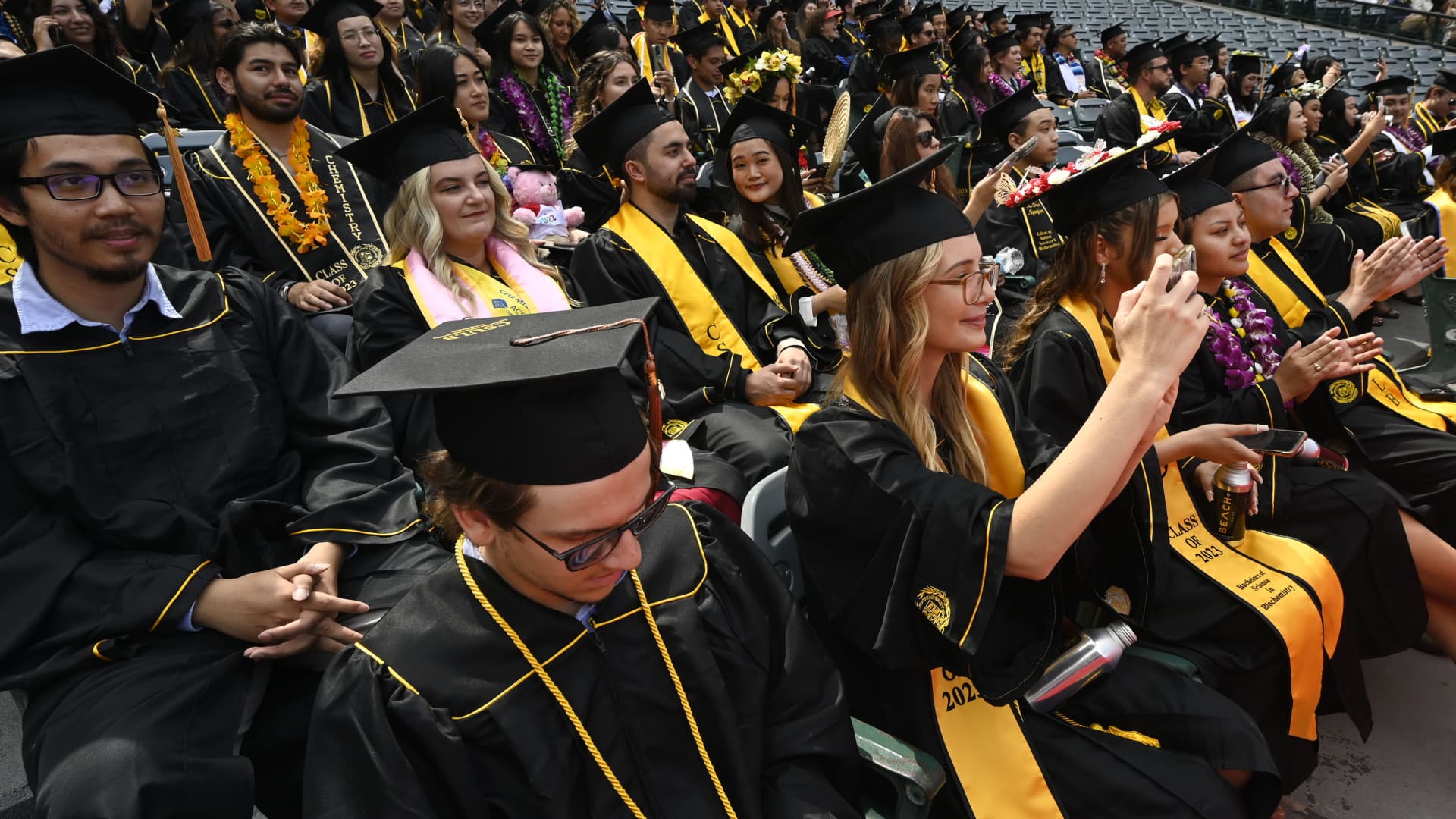

It’s a difficult labor market for those just starting out, and new job seekers will likely need to readjust their earning potential.
Today’s college seniors can expect to earn about $80,000 a year after graduation, according to a February-March survey of undergraduates pursuing bachelor’s degrees by real estate site Clever.
But the average starting salary for new graduates is $56,153, a difference of nearly $24,000, Kleber said.
The disconnect between perception and reality will only worsen over time. Students expect to earn an average of $144,889 10 years into their careers. That’s well above the average mid-career salary of $95,521, Kleber said.
More than 3 million new graduates enter the workforce each year, relying on the idea that a college degree is their ticket to a high-paying job.
But this year, those with newly issued diplomas face one of the toughest job markets in years.
Precarious employment outlook
As the artificial intelligence boom reshapes the workforce, some major employers say they will replace entry-level positions with AI to streamline operations and reduce costs. Some companies are putting hiring plans on hold due to concerns about the economy and the persistence of inflation.
Amid a volatile job market, rising tuition costs and ballooning student loan balances, more and more young people are questioning whether a college degree is worth it, according to several surveys. At the same time, Kleber found that students, regardless of major, overestimate the future value of a degree.
Engineers, for example, can expect to earn a starting salary of $92,452, nearly 20 percent more than they can expect to earn a year after graduation, Kleber said.
path to financial security
For many young people, future income is the key to achieving independence. Largely due to financial pressures, recent graduates have had to rely on their families for financial support for years after completing their degrees.
According to Savings.com’s 2025 report, nearly half of parents (highest on record) are now pitching in for help, including paying for essential monthly expenses like groceries, utilities and rent.
There’s also good news: the unemployment rate for college graduates with a bachelor’s degree is less than 4%, according to March data from the U.S. Bureau of Labor Statistics. Employers plan to hire about 5.6% more graduates from this year than from the class of 2025, according to a report from the National Association of Colleges and Employers.
“More and more employers are citing corporate growth and succession planning efforts as the main reasons for hiring new graduates,” said Andrea Conz, senior research manager at NACE.
Increase in starting salary
Another NACE study found that while salary expectations may be off the mark, average starting salaries for this year’s graduates are higher across most majors compared to last year.
“The outlook for this year’s class looks a little better, both in terms of employment and salaries,” Kontz said.
According to the NACE study, the overall average salary for new graduates rose 5.5%, from $65,276 to $68,873, but typically high-paying fields such as engineering and computer science continued to see large increases.
Computer science graduates are projected to have the highest salaries of all majors for the Class of 2026, with an average salary of $81,535, an increase of 6.9% from $76,251 in 2025. The overall average salary for the second highest-paid engineering graduate is currently $81,198.
Starting salaries for small business graduates, or adults ages 20 to 24, are also rising, with the average 2026 graduate earning $65,734, up from $62,801 a year ago, according to data from payroll firm Gust.
Kemal Yildirim | Getty Images
Kyle Fox, director of Alopex ID, a digital marketing agency based in Palmer, Alaska, says starting salaries for entry-level positions at his company are about $45,000 a year, but can rise to nearly $70,000 after a few years.
Fox said new employees are “generally satisfied with coming to work.” “There are very few entry-level positions available with a media degree, especially here in Alaska.”
In fact, according to Monster’s recent alumni report, 67% of recent college graduates said they would trade more money for job security in exchange for a higher salary. The recruitment platform surveyed more than 1,000 recent and soon-to-be graduates.
Subscribe to CNBC on YouTube.
