

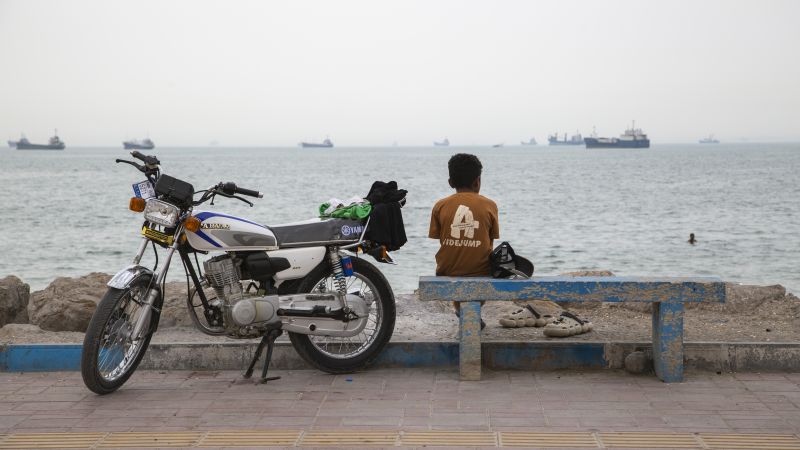
The closure of the Strait of Hormuz has created an “unprecedented” crisis for 20,000 seafarers stranded in the Persian Gulf, leaving them trapped on ships with no clear exit, a United Nations agency has warned.
As the Gulf standoff drags on, maritime workers, many from poor developing countries, find themselves stranded at sea, caught between commercial pressure from shipowners, security threats from drones and mines, and limited legal protection.
“This is an unprecedented situation,” Damien Chevalier, director of maritime safety at the United Nations’ International Maritime Organization (IMO), told CNN in an interview. “There are about 20,000 seafarers in the Gulf for almost eight weeks now. This is a humanitarian crisis. It’s the first time we’ve faced a situation like this.”
This warning makes clear the seriousness of the situation facing the crew. Many sailors are unable to anchor on either side of the Persian Gulf. Iranian ports pose war zone risks, and visa restrictions and logistical hurdles along the Arab states that line the Gulf’s southern coast make it difficult for many sailors to disembark their ships. The sea exit through the Strait of Hormuz remains effectively closed.
Since the war began, Iran has sought to impose new navigation rules in the Persian Gulf, allowing ships from so-called “friendly countries” to pass through the strait in exchange for a fee.
In response, the Trump administration imposed a naval blockade targeting ships entering and exiting Iranian ports and warned shipping companies that they could face sanctions if they paid these tolls.

Conflicting measures have created a stalemate that has brought traffic through the strategic chokepoint to a near standstill, with only a handful of ships compared to the more than 100 that pass through the waterway each day under normal conditions.
Hundreds of ships are currently trying to find a way out of the war-torn region.
“We hope to have about 800 to 1,000 ships evacuate the area through the Strait of Hormuz,” Chevalier said.
One such example is the Aurora, a sanctioned oil tanker associated with Iran’s shadow fleet that was used to transport oil in defiance of American sanctions.
The crew told CNN in an interview last month that they had been stranded on the ship for weeks after the outbreak of war and had asked to be repatriated, claiming the ship’s owners had pressured them to sail to Iran to recover oil despite the increased risks.
The ship’s crew, all Indian, said conditions on board were deteriorating, including a lack of food and fresh water.
Manoj Yadav, a union organizer with the Indian Forward Seafarers Union, said the situation was dire.
“Crews are facing a shortage of basic supplies,” he told CNN at the time. “They want to go home. Things are not good on this ship.”
The International Transport Workers’ Federation (ITF), a global trade union representing seafarers around the world, says Aurora is by no means an isolated incident.

“This is not just a repatriation, it’s an abandonment,” said Mohamed Alachedi, the ITF’s flag of convenience network coordinator for the Arab world and Iran. “Some seafarers have not been paid for eight or even 11 months.”
Alachedi explained that threats and pressure from shipowners have been widely reported.
“There are a lot of incidents of intimidation. Some ship owners are just furious,” he said. “There have been cases where seafarers have been verbally threatened.”
The crew of the Aurora allege they were threatened with having their wages withheld and warned of “serious consequences” if they refused to sail to Iran and load the oil.
“He said we were hijacking his ship and sabotaging his ship,” one crew member told CNN, explaining the accusations by the ship’s owner.
CNN has reached out to the ship’s management for comment, but has not received a response.
The crew said they had repeatedly requested recognition and repatriation, a right protected under international maritime law, including in situations where safety would be compromised, but had been denied.
“Despite repeated requests, the company refused to approve or arrange for repatriation,” a March 13 incident report to maritime authority UKMTO, seen by CNN, said. “We are effectively stranded on board the ship in dangerous conditions.”

Those concerns are increasingly becoming a reality. At least 10 sailors have been killed in attacks on ships since the war with Iran began, according to the IMO.
“There are cases where sailors say they sleep with their clothes on in case they are attacked,” Arechedi said. “The family is worried and asking us what is going on.”
The Aurora was attacked by a drone on March 13 while anchored off the coast of the United Arab Emirates, according to crew and security footage reviewed by CNN.
“It was pitch black,” one crew member said. “Suddenly there was an explosion and I saw debris everywhere.”
Video footage shows the explosion tearing apart the deck near the bridge, and the crew on duty narrowly losing their lives. The images also show that one of the ship’s lifeboats was damaged, indicating that the ship may not comply with international maritime safety regulations.
In an incident report to UKMTO, the crew described the attack as an immediate threat to life.
“While monitoring the bridge, a deck cadet narrowly escaped death,” the report said.
The ship ultimately sailed through the Strait of Hormuz toward Oman on April 14, hours before President Trump’s deadline to block Iranian ports, according to ship tracking data.
Some crew members of the Aurora were finally allowed to disembark after being stranded at sea for several weeks.


Seven crew members were fired and replaced with new Pakistani crew members, said one sailor, who requested anonymity to avoid retaliation. He said they flew from Oman to India between April 26 and 27.
For maritime officials and labor groups, the Aurora is an example of a broader crisis unfolding across the Gulf.
Captain Isdik Alam, a sailor on another ship in the Persian Gulf, told CNN that the situation of other ships stranded in the area is deteriorating.
He said some crew members have been forced to reuse water from air conditioning systems for washing and, in some cases, preparing meals.
“We can’t wash our clothes or take a shower,” he said. “They collect water from the air conditioner drains just to wash themselves and survive.”
Alam said there was a growing sense of abandonment among seafarers in crisis.
“Nobody cares about the sailors,” he said. “Ceasefire or no ceasefire, it’s not for us.”
Seafarers are trained to withstand harsh conditions at sea, but the threats they face now are fundamentally different, he said.
“I’m not a warrior. I’m a sailor,” he said. “I’m not afraid of the sea…I’m afraid of missiles and attacks.”
