

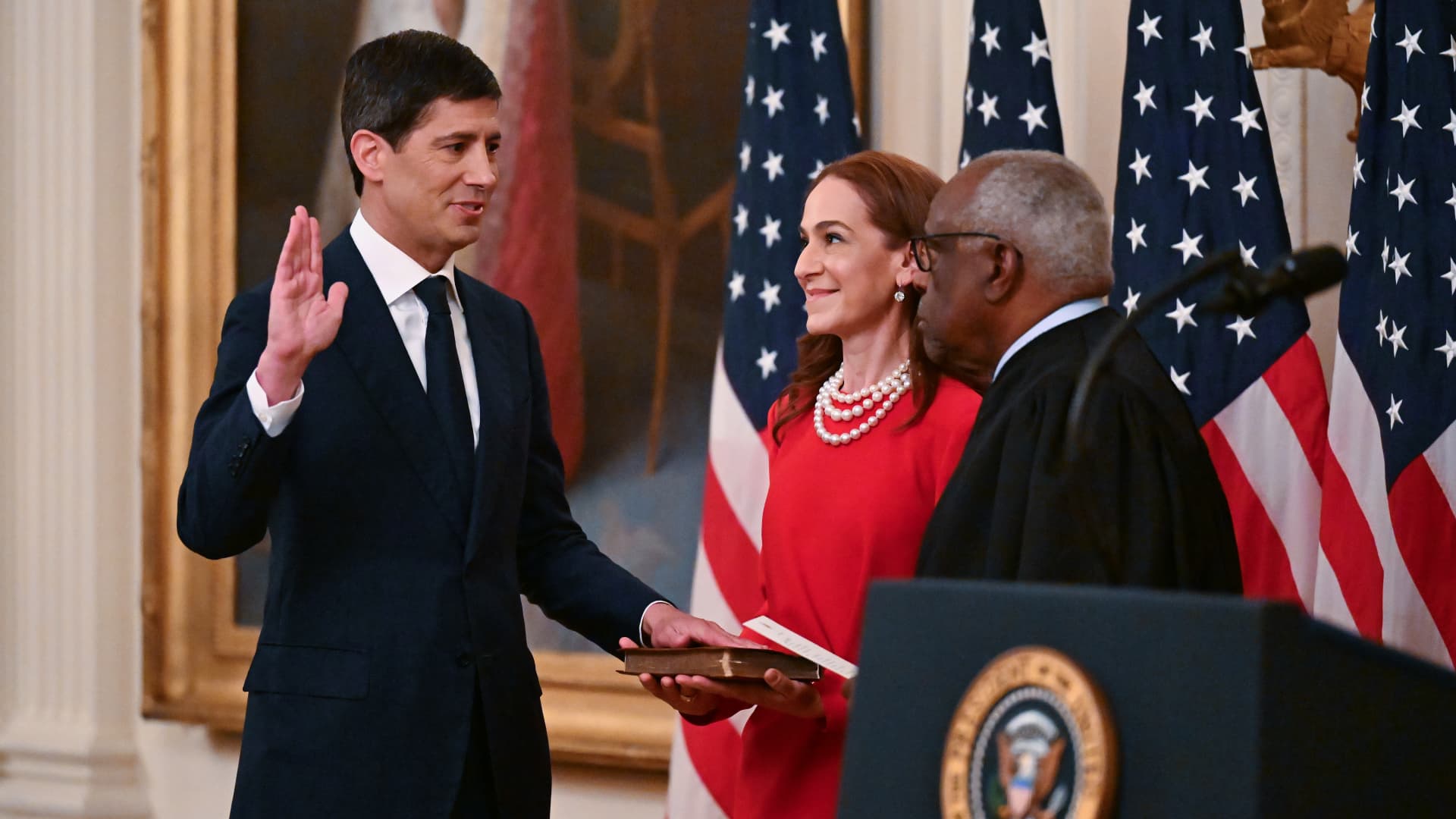
President Donald Trump led the ceremony and swore in Kevin Warsh as chairman of the Federal Reserve, putting him in charge of a central bank that must navigate a tumultuous economy and a president with very specific expectations about interest rates.
Trump, whose actions against the Fed have sparked bipartisan alarm over the executive branch’s influence over the historically independent central bank, said he wants Warsh to “do what he loves and do a great job.”
“I want Kevin to be completely independent,” President Trump said at the beginning of an event Friday morning. “Don’t look at me, don’t look at anyone.”
But the swearing-in ceremony itself highlighted the president’s unprecedented involvement with the Fed during his second term. Warsh will be the first Fed chairman to be sworn in at the White House since Alan Greenspan in 1987.
President Trump made his Warsh-era aspirations even clearer late Friday, insisting that interest rates would fall “very, very quickly.”
“We’ll see what happens. I went from being a rotten Fed chairman to being a great Fed chairman,” Trump said at a campaign-style rally in Suffern, New York. “Kevin was just sworn in today. He’s great, and he’s going to be great.”
Trump began talking about housing legislation in Congress, but then veered away. “Honestly, housing is all about interest rates…They can pass all the bills they want, it’s interest rates. If interest rates were lowered, everyone would be very, very happy,” he told an audience at a local community college.

The Warsh ceremony, held in the East Room, was attended by a wide range of celebrities, including Justice Clarence Thomas and Supreme Court Justice Brett Kavanaugh, Speaker of the House Mike Johnson, and many other politicians and ministers.
Thomas delivered the oath to Warsh.
“Our mission at the Fed is to promote price stability and maximum employment,” Warsh said after taking office.
“If we pursue these goals with wisdom and clarity, independence and determination, inflation will be lower, growth will be stronger, real take-home pay will be higher, America will be more prosperous, and America’s place in the world will be just as important and more secure,” he said.
“To fulfill this mission, I will lead a reform-minded Federal Reserve Board that learns from past successes and failures, moves away from static frameworks and models, and adheres to clear standards of integrity and performance.”

Mr. Warsh, 56, will become the 11th Federal Reserve chairman in the modern banking era, succeeding Jerome Powell, who served for eight years.
Powell, a key target of Trump’s ire for refusing to cut interest rates as quickly or significantly as the president had hoped, will remain on the Fed’s board. This was the first move by a Fed chair in about 80 years.
Friday’s swearing-in will be Warsh’s second term at the Fed. He previously served as governor from 2006 to 2011, during which time the central bank worked with Treasury authorities to rescue the economy from the global financial crisis.
Mr. Warsh supported the Fed’s efforts, but later became increasingly critical of the central bank, accusing it of maintaining crisis-era policies and going beyond its mandate to maintain price stability and low unemployment. For example, he cited previous efforts to address climate change and social inequality as areas where the mandate will grow, and vowed to reduce central banks’ influence on markets.
Warsh won his seat after a wide-ranging competition that began in the summer of 2025 and included as many as 11 candidates, ranging from current and former Federal Reserve officials to prominent economists and Wall Street strategists.
Mr. Powell’s tenure was marked by repeated and often personal criticism from Mr. Trump. Even though the Fed has lowered its benchmark borrowing rate by three-quarters of a percentage point and raised it by 4.25 points during President Joe Biden’s term, the president has called for more aggressive action from the Fed on lowering rates and accused Powell of having “Trump Derangement Syndrome.”
Despite President Trump’s calls for rate cuts, markets expect the Fed to keep policy on hold for most, if not all, of 2026, before potentially raising rates in early 2027.
Mr. Powell’s policies were also notable for keeping inflation above the Fed’s 2% target for five consecutive years. Warsh asserted that it is possible to reduce inflation while lowering the benchmark interest rate.
Since leaving the Fed, Mr. Warsh has spent time at Stanley Druckenmiller’s Duquesne Family Office and has lectured at Stanford University and the Hoover Institution. When President Trump made it clear that he would not nominate Janet Yellen, Warsh was considered the frontrunner for the Fed chair, but the president reportedly ultimately chose Powell at the urging of former Treasury Secretary Steve Mnuchin.
