

romeAP —
Calendars featuring close-ups of young, handsome men in clerical costumes have been a perennially popular Roman souvenir for the past 20 years, although it appears that few of them are actually clergymen.
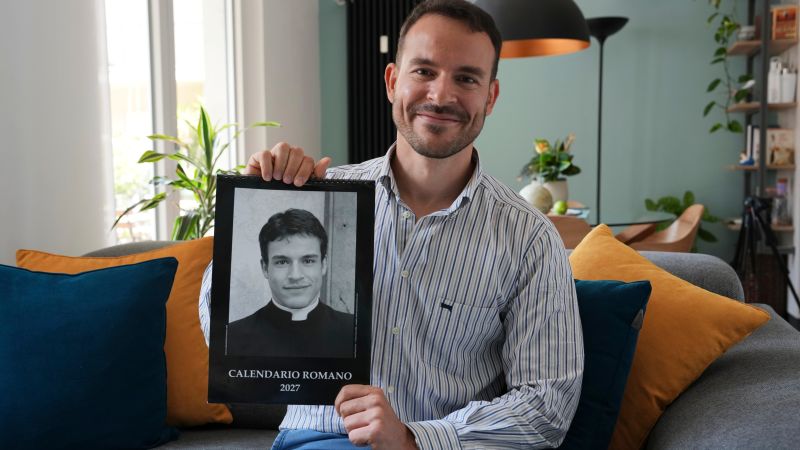
Giovanni Galizia has graced the cover of the so-called sexy priest calendar for many of the past 23 editions. In the same photo, which is used every year, Galizia wears a priest’s collar and faces the granite walls of a church in his hometown of Palermo, smiling with an enigmatic smile worthy of the Mona Lisa.
“It was the smile of a confused child, because I was dressed like a priest and I saw all my friends in front of me laughing out loud,” Galizia told The Associated Press in an interview Wednesday in his living room in Verona.
For Galizia, the shooting was a lark that left no mark on his life, but it gained national attention this week when an article in the Roman daily La Repubblica revealed that the “sexy priest calendar” was more accurately called the “fake priest calendar.”
The calendar is not affiliated with the Vatican, which declined to comment.
Popular souvenir with 12 black and white portraits
Galizia, now a 39-year-old flight attendant for a Spanish airline, was just 17 when a mutual friend contacted photographer Piero Pazzi. Piero Pazzi is also the man who created a calendar featuring Venetian gondoliers and founded museums on the history of cats in Budapest and Montenegro.
Officially named Calendio Romano, each edition features 12 black-and-white portraits of men, mostly in clerical garb, many of which are recycled each year. Galizia only knew one of the other subjects, a French man who was also not a priest.
Pazzi told The Associated Press that at least one-third of the people pictured in the already released 2027 calendar are actually clergy, but did not provide further details.
Galizia said she has never been stopped on the street, but her cousins have given calendars to her grandmother as gifts, and “they all died laughing.”

Galizia believes that photographs depicting priests are part of an artistic tradition, and points out that no one who watches a TV drama featuring a priest believes that the priest is actually played by a clergyman.
“Of course, I’m a bit wary of the dynamics between the sacred and the secular, because it’s clear that when a young man with such a refreshing face looks at a world as remote and in a sense exalted as the world of the church, there’s a certain kind of dissonance,” he said.
But he also said he doesn’t understand why a black-and-white close-up could be interpreted as sexy. Pazzi also said it didn’t matter.
“There is a tendency to confuse beauty with sensuality, because today, especially in today’s highly sexualized world, beauty is only expressed through sensuality,” Galizia said.
“That being said, I appreciate that opinion and take it as a compliment, because staying sexy in a priest’s collar is no easy feat.”
Pazzi won’t say how many Roman calendars he sells, but estimates it’s in the thousands each year. Mr. Pazzi said he received royalties, but Mr. Galizia, who signed the consent form when the photo was taken, said he never asked for payment.
The calendar is sold for about 8 euros (about $9.30) in busy stores around the Vatican and in Rome’s historic center. Shopkeeper Hassam Mohammad said he sells a few pieces every day.
Pazzi includes a page with information about the Vatican in the calendar, but its production is independent and not affiliated with the Holy See.
A South Korean priest walking near the Vatican this week said the calendar is well known in his country, especially among young people who view the calendar with humor.
“They often think of priests as formal and distant,” said the priest, who informally called himself Father Domenico. “But when they look at this calendar, they think that priests are more familiar to them, and that priests are more interesting. I think this calendar is very famous in Korea, so that’s fine.”
