

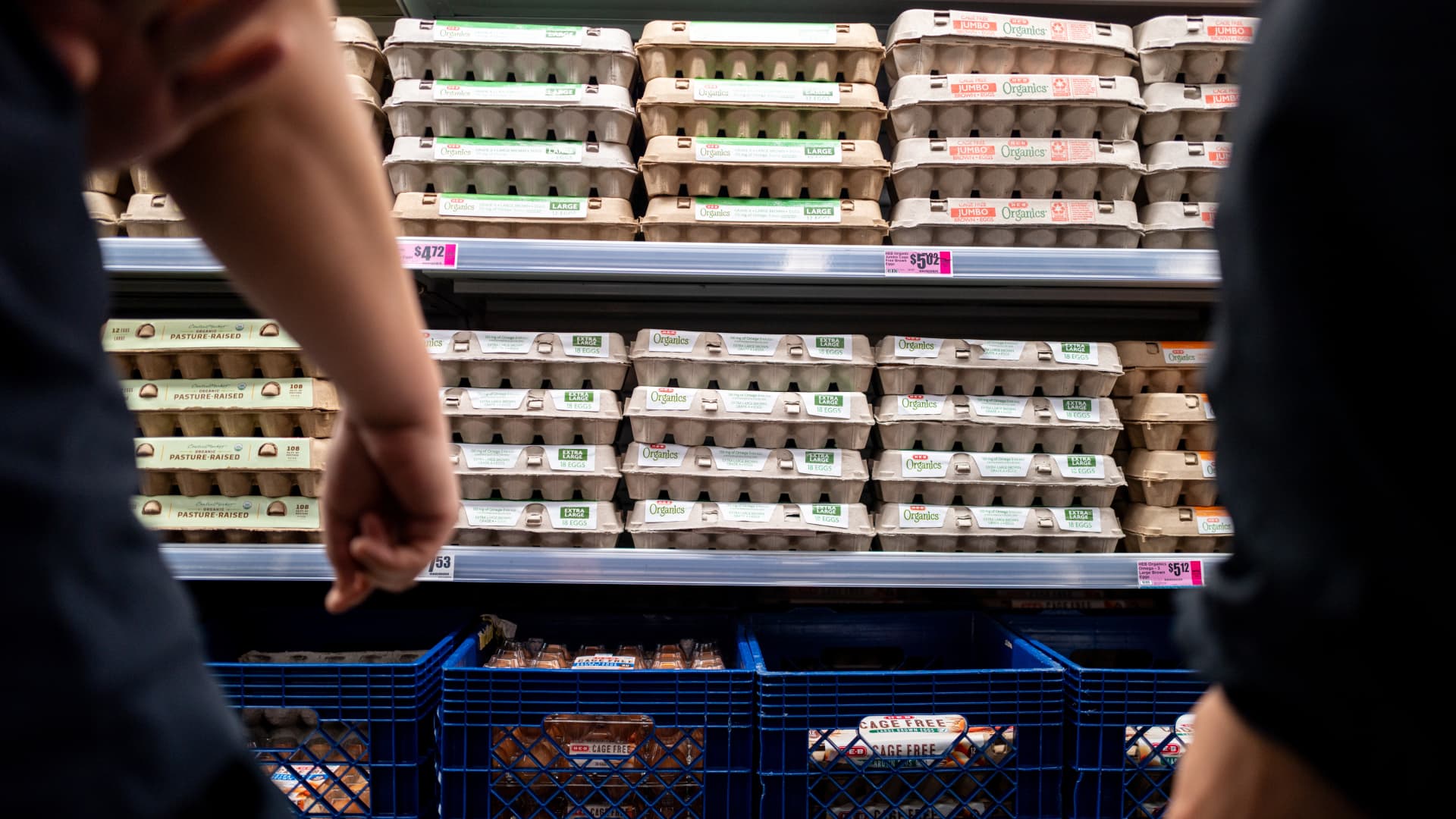
A customer buys eggs at a HEB grocery store on May 11, 2026 in Austin, Texas.
Brandon Bell | Getty Images
Egg prices are finally settling down, a welcome change for consumers.
But now producers are facing new challenges, producing too many eggs at once as input costs rise.
Producers say falling prices at grocery stores are masking pressure from cost inflation, as the market reels from last year’s avian flu-induced shortages to oversupply.
“A year ago, all everyone was talking about was how expensive eggs were because unfortunately we were losing a lot of birds,” said Thomas Flocko, CEO of egg producer Pete & Jerry’s.
“We’re in a situation of oversupply right now, so in some cases 12 eggs can cost less than $1,” Flocko said.
According to data from the Bureau of Labor Statistics, egg prices in March 2026 fell 44.7% from a year earlier, a sharp reversal from last year’s spike during the bird flu outbreak. The downturn comes after a period of herd rebuilding, and industry officials say producers are wary of another shortage.
The price collapse is putting new pressure on margins at a time when producers can least afford it. The cost of feed and other raw materials has been rising for years, with prices rising in 2022 and 2023, and now fuel prices are rising as a result of the Iran war.
“All of these cost pressures feed into our cost structure,” Flocco said. “About half the price of 12 premium eggs is feed. Diesel has an immediate impact. You have to drive to get those eggs.”
Emily Metz, president and CEO of the American Egg Board, echoed those concerns, saying that even as consumer demand returns and wholesale prices are low, feed, fuel and labor costs are “not going away” and continue to weigh on producers.
protein bump
The good news for producers is that demand is strong as shoppers prioritize protein in their diets, Flocko said.
More than four in 10 Americans say they’re paying more attention to protein than they were five years ago, according to a new survey commissioned by Pete & Jerry’s. It also found that two-thirds of Americans say they eat eggs weekly, especially for their protein, and many believe whole foods like eggs are more nutritious than processed alternatives.
Shoppers looking for eggs at grocery stores these days are finding them plentiful and affordable. But for producers, even that strong demand wasn’t enough to offset the oversupply.
“What we’re seeing in the market today is more of a recovery in supply and a shift in timing than a fundamental shift in consumption,” Sherman Miller, CEO of Cal-Maine Foods, the largest U.S. egg distributor, said in April.
Metz also said the current price weakness is not demand-related.
“(Prices) reflect supply growth faster than demand can absorb, driven by post-(avian flu) herd recovery, small farm growth and productivity gains,” Metz said.
Still, President Donald Trump is trying to promote affordability, blaming himself for falling egg prices in the lead-up to this fall’s midterm elections.
“We’ve brought the prices down significantly,” President Trump said Thursday. “It’s lower than it was four years ago.”
