

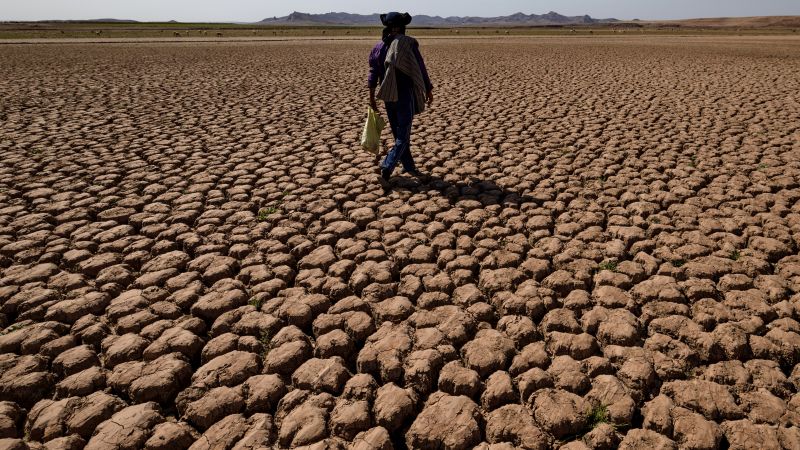
As the world enters an era of “water bankruptcy” and many regions are forced to adapt to a hotter, drier future, cities and farms alike may become increasingly reliant on desalination, which turns seawater into fresh water.
In 2024, there will be more than 22,000 desalination plants operating worldwide, most of them in the Middle East and North Africa, the world’s most water-scarce regions. More African countries are betting on the technology, with Morocco hoping to source 60% of its drinking water from the sea by 2030.
The country declared an end to a seven-year drought in January after heavy winter rains caused reservoirs to drop to historic lows. However, this bailout did not change Morocco’s long-term strategy.
“Relying only on rainfall and dam inflows is no longer enough,” Morocco’s Minister of Facilities and Water Nizar Baraka told CNN. He added that droughts are no longer “an exceptional or temporary phenomenon. What we are witnessing is a tectonic change in the climate cycle.”
Morocco’s plan would turn the Atlantic Ocean into fresh water for drinking and irrigating crops in coastal cities, and channel dam water and rainfall to farms and oases most vulnerable to drought inland. However, this process is costly both economically and environmentally.
Morocco’s strategy is led by a $650 million project under construction about 40 kilometers south of Casablanca. The desalination plant will be the largest in Africa and, according to its developers, the world’s largest to be powered entirely by renewable energy, powered by a 360-megawatt wind farm in the disputed region of Western Sahara.
The first phase is expected to be operational in February 2027, and the second phase is expected to be completed in August 2028. When fully operational, it will pump 79 billion gallons of drinking water annually to 7.5 million people in the Casablanca region and irrigate 20,000 acres of farmland.

The country already operates 17 desalination plants, producing approximately 108 billion gallons of water annually, nine times more than in 2021, and 11 more desalination plants are planned or under construction, Baraka explained.
To finance and construct such mega-projects, Morocco employs public-private partnerships (PPPs). In the case of Casablanca, Spain’s Acciona, a multinational conglomerate specializing in renewable energy and water management, was the lead developer along with a Moroccan partner, with the Spanish government covering more than half of the cost, and financing was completed in May 2025.
The desalination drive is part of a broader national water plan of about $14 billion, which also funds the construction of dams, wastewater reuse and a network of “water highways” – pipelines that move excess rainfall from the northern basins to the arid regions of the south.
Most modern desalination plants use a process called seawater reverse osmosis (SWRO). A high-pressure pump forces seawater through a fine membrane that filters out the salt. Although this technology is reliable, it is energy intensive, and most factories around the world run on fossil fuels and emit global warming carbon to solve problems caused by climate change.

Morocco’s plan is to capitalize on the country’s vast renewable energy potential, linking new desalination plants with the development of wind and solar power plants. “The purpose is two-fold,” Baraka said. “First, to reduce long-term operating costs, and second, to minimize the carbon footprint of water production.” As of 2024, renewable energy generates just over a quarter of the country’s electricity.
But desalination has other effects on the environment. For every gallon of fresh water produced, 1 to 1.5 gallons of salt water (water containing chemical residues and twice the salinity of the ocean) remains, which is typically returned to the ocean.
Poorly managed saltwater can damage marine ecosystems, creating oxygen-starved “death zones” that kill seaweed beds and plankton populations. The new Casablanca plant is equipped with 1.5 miles of discharge pipes designed to dilute the salt water before it reaches the ocean floor. The researchers believe dilution is the best approach, but point out that Morocco has no national regulations setting the required amounts and that many factory limits are set by financial backers rather than law.
The agricultural sector consumes 87% of Morocco’s water and employs almost a third of the workforce. However, seven years of drought cut grain production in half, leading to an increase in rural unemployment.
Desalination has been presented as a solution to irrigate fields without rain, and is for those who can afford it.
In Souss Massa, a region that accounts for 85% of Morocco’s fruit and vegetable exports, the Chtouka Aït Baha desalination plant supplies 1,500 farmers who grow tomatoes and fruit, mainly for European supermarkets.
Mohamed Boumarg, who used to grow 12 acres of cherry tomatoes, was able to grow 50, of which 60% was for export. “Desalination saved agriculture in Chutka,” he told AFP in July 2025. One farmer told AFP he had no choice but to accept higher prices for desalinated water, “or I’ll close up shop.”

Desalination “remains 1.5 to 4 times more expensive than many traditional freshwater sources,” Youssef Bourzin, regional director for the Middle East and North Africa (MENA) at the International Water Management Institute (IWMI), told CNN.
Burzin explained that desalination could realistically support areas like Chutka, “high-value, export-oriented, greenhouse-based production in coastal areas where the productivity and benefits of water justify the costs.”
He added that “despite the very impressive cost-cutting breakthroughs of Morocco and other MENA countries, desalinated water remains expensive for large-scale irrigated agriculture” and staple crops such as wheat depend on seasonal rains.

For smallholders, he noted, access depends on targeted subsidies, a mix of cheap resources such as desalinated water and treated sewage, small solar power systems, and growing crops that provide bang for the buck.
Morocco hosted the World Water Conference in Marrakech last December, where Mr. Baraka touted his country’s experience as proof that water, energy and food security can work together.
“Our goal is not to present a single model to be imitated, but to share experience, know-how and practical solutions that can be adapted to each country’s specific needs,” he said.
Desalination is progressing across Africa. Algeria already has one of the largest desalination programs in the Mediterranean, Egypt is rapidly expanding capacity and Senegal has signed an $800 million deal with Saudi Arabia-based ACWA Power for a renewable energy power plant near Dakar. Most production capacity remains concentrated in North Africa, but Namibia and South Africa have been desalinating seawater for more than a decade and are also developing smaller solar power plants.
The interests of agriculture are on the continent. Ninety-five percent of Africa’s agricultural land depends on rain, and irrigation can double yields in water-scarce areas. Desalination costs continue to fall, thanks to improved technology and a combination of cheaper renewable energy, which could further increase supply to African farms.

Instead of developing infrastructure in parallel, African countries need to share knowledge, finance and technology, Bourzin argued. The effort is being coordinated by bodies such as the African Council of Water Ministers and the African Water Vision 2063 Framework, in collaboration with research institutions such as IWMI.
He added that Morocco’s model is not just desalination megaprojects, but the packages surrounding them, from the country’s legal preparations to long-term planning. Importantly, he notes, “major water public-private partnerships cannot function without significant public support, and if affordability is not built into the design, farmers can be the link most at risk.”
“Long-term water security is not just about producing more cubic meters; it’s about producing more resilience, more value and more assets per cubic meter,” Bourzin added.
