

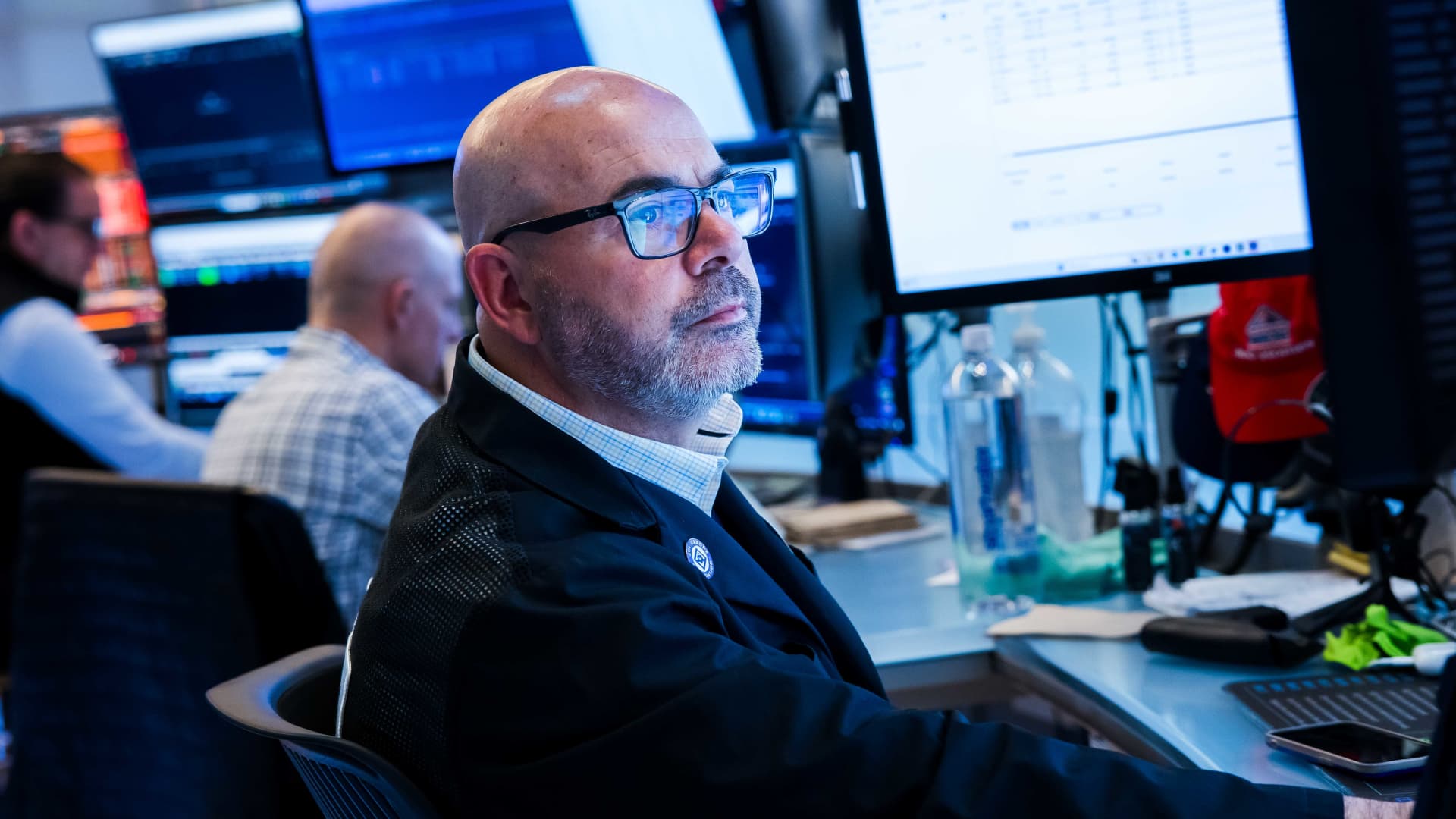
Traders at work at the New York Stock Exchange on May 28, 2026.
new york stock exchange
Assets in leveraged ETFs have nearly doubled in two months as investors scramble to take full advantage of artificial intelligence trends.
“Investors are increasingly using leveraged products related to ‘AI trading’. Assets in leveraged ETFs related to AI and technology themes are surging, with U.S. and South Korea/Taiwan exposure increasing rapidly, more than doubling in recent months,” Goldman’s Christian Muller-Grissmann wrote in a note.
Goldman cited data from EPFR, which tracks 573 leveraged U.S. stock ETFs, 52 Korean ETFs and 11 Taiwanese ETFs. The total net assets of equity ETFs leveraging U.S. stocks doubled in just two months, rising from $39 billion in April to $84 billion at the end of May. Leveraged ETFs in South Korea and Taiwan also surged to $43.1 billion from $17 billion in the same period.
The rally reflects growing demand for AI-driven stocks, but also raises red flags that the rally may be partially driven by inflows into these riskier funds. Leveraged ETFs use derivatives to provide returns that are double or even triple the daily return of a particular index or stock.
If there is a pullback in AI trading, there is a risk that inflows will flow back or become more aggressive, as investors are saddled with large losses in funds.
“Given the level of excitement that’s happening around AI, it’s no surprise that investors are looking to leverage, which is common in bull markets,” said Adam Crisafulli, founder of Vital Knowledge.
However, he points out that while AI is driving huge revenue growth for a wide range of companies, it is generating profits and cash for only a handful of companies, particularly memory and chip companies.
The South Korean and Taiwanese markets are particularly popular and have recently grown rapidly, outpacing established Western countries. It also houses some of the most important companies in the entire AI ecosystem.
SK Hynixa leading AI chip supplier Nvidia and samsung electronicstogether account for more than 40% of the Korean benchmark Kospi, Taiwan semiconductor manufacturing company TSMC accounts for over 40% of Taiwan’s Taiex benchmark.
While enthusiasm for AI continues to drive inflows, Crisafulli warns that the pace of growth may be difficult to maintain.
“It seems like we’re in unsustainable territory,” he said. “We have the following major stocks: Dell Parabolic price movements usually don’t last forever, as they double in just a few days. ”
It will be a big test as the market will need to absorb large amounts of supply in the coming months, he added.
The rise comes at a time when big tech companies are ramping up spending on AI infrastructure. alphabet, microsoft, meta and Amazon More than $700 billion is expected to go into capital spending this year. Wall Street analysts predict spending on AI will exceed $1 trillion by 2027.
Crisafulli said the current environment has some similarities to the technology boom of the late 1990s. However, unlike in the dot-com era, some of the largest AI companies, such as OpenAI, Anthropic, and xAI, remain private, making market valuations difficult to access.
