

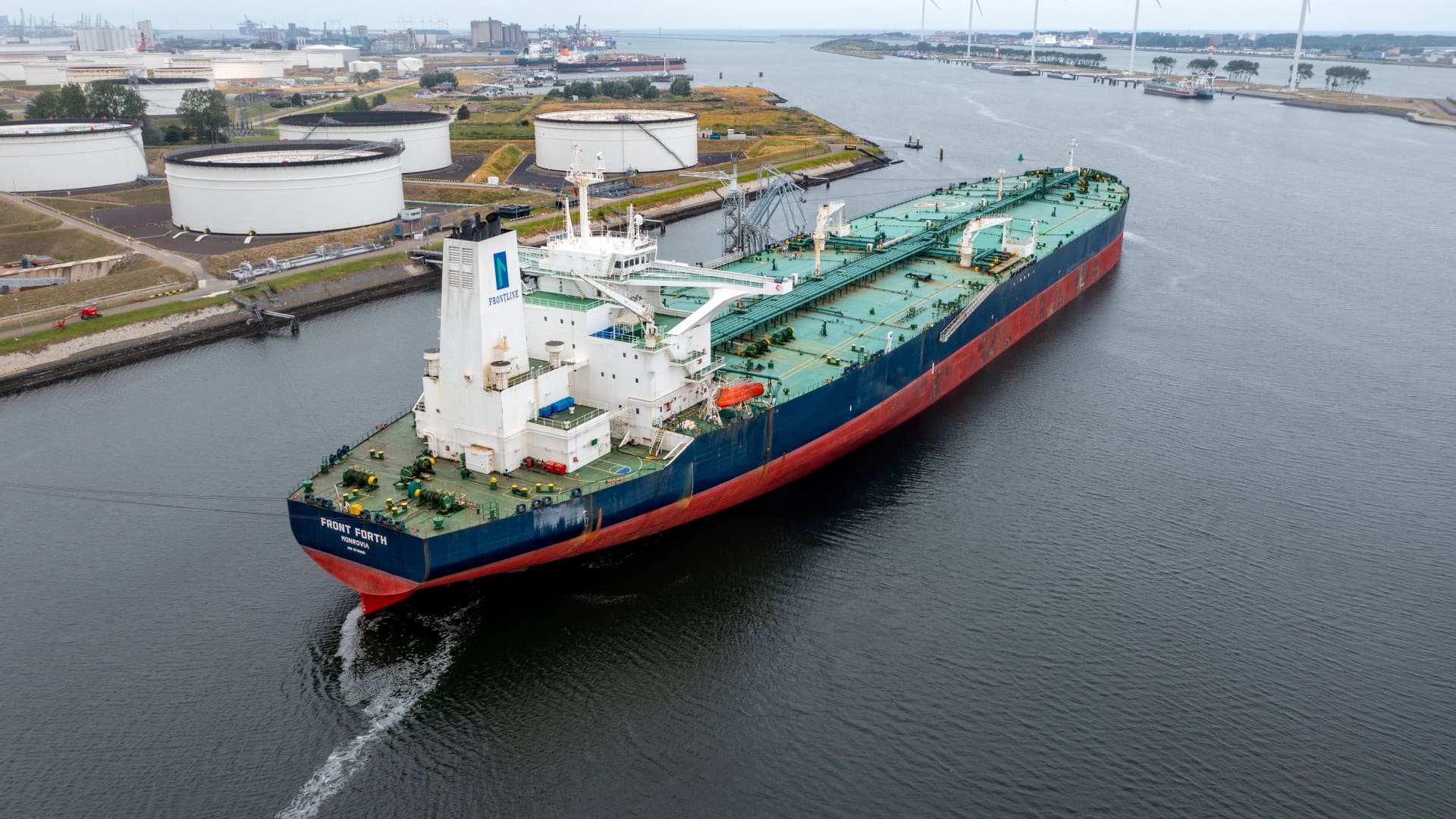
This photo obtained by Reuters on July 14, 2026 shows the VLCC Mobassa B (formerly known as Front Force), one of two tankers the UAE Ministry of Defense said was hit by an Iranian cruise missile while transiting the Strait of Hormuz in Rotterdam, Netherlands, on August 18, 2024.
Edwin van Veld | via Reuters
Oil prices continued to rise on Thursday, with Brent crude futures above $97, following reports of an attack on a tanker off the coast of Saudi Arabia and renewed threats from the US to escalate attacks on Iran.
At 3:45 a.m. ET, Brent crude oil futures for July delivery rose 3.9% to $97.76 per barrel, the highest since June 3. U.S. West Texas Intermediate crude oil futures rose about 3% to $89.50 per barrel.

brent crude oil futures
Britain’s Maritime and Trade Services Agency posted on social media platform X on Thursday that the tanker was struck about 70 nautical miles southwest of Al Shuqaik. The attack caused a fire on board, and the crew fought back, but there were no reports of casualties.
Yemen’s Houthis have claimed to have targeted two Saudi oil tankers with drones and missiles for allegedly violating a naval blockade.
CNBC could not independently verify the attack. If confirmed, the attack would be the first since Iran-backed extremist groups announced a naval blockade against Saudi Arabia.
The attack came hours after President Trump warned that the United States would destroy Iranian bridges and power plants every time Iran attacked a ship in the Strait of Hormuz, signaling further escalation of tensions following the collapse of the ceasefire between the United States and Iran.
“From now on, every time the Islamic Republic of Iran fires at a ship in the Strait of Hormuz, whether it’s with a missile, rocket, drone, or other device or weapon, the United States will destroy one of its bridges or power plants,” Trump said.
In response, Iran warned that if the United States carried out such an attack, it would retaliate against U.S.-linked infrastructure and energy assets across the region.
“If the US targets Iranian bridges and power plants, Iran will in turn attack infrastructure and bridges in the region, including energy facilities, in which the US has interests,” an anonymous Iranian military official told the state-run Tasnim news agency.
Congress considers petition to White House for increased funding
“It’s incredibly difficult to understand exactly where all of this is going,” former U.S. Ambassador to Saudi Arabia Joseph Westphal said Thursday on CNBC’s “Access Middle East.”
“There’s no real strategy,” he says. “The Secretary of the Army has testified before Congress asking for increased war funding. Congress is very concerned about that. We don’t feel there is an adequate strategy or plan to provide additional funding.”
Westphal said the United States is spending “huge amounts of money,” but it also lacks the resources to continue the war with Iran and protect shipping through the Red Sea.
“There’s a big problem here,” he said. “And because of that, gas prices continue to go up, prices of other goods continue to go up, so it’s going to cause a backlash from the American people, not just against this war, not just against the strategy that’s going on right now that is generally not understood by anyone in this country.”
On Wednesday, Secretary of State Marco Rubio said Iran was not “serious” about a deal with the United States, but insisted the United States remained “committed to diplomacy” in the region.
The recent rise in oil prices reflects renewed concerns over the Strait of Hormuz after the collapse of the US-Iran ceasefire, HSBC said in a note late Wednesday, warning that the outlook depends on diplomacy restoring predictable shipping.
“The ceasefire has been fraying since July 7-8 as Iranian attacks on ships transiting the Strait of Hormuz prompted retaliatory strikes by the United States,” said Kim Fastier, senior global oil and gas analyst at the bank.
“The core question remains unresolved: will traffic be controlled and by whom? In retrospect, the more traffic that passes through U.S.-controlled lanes in Oman, the less favorable the outcome was for Iran,” Fastier added.
