

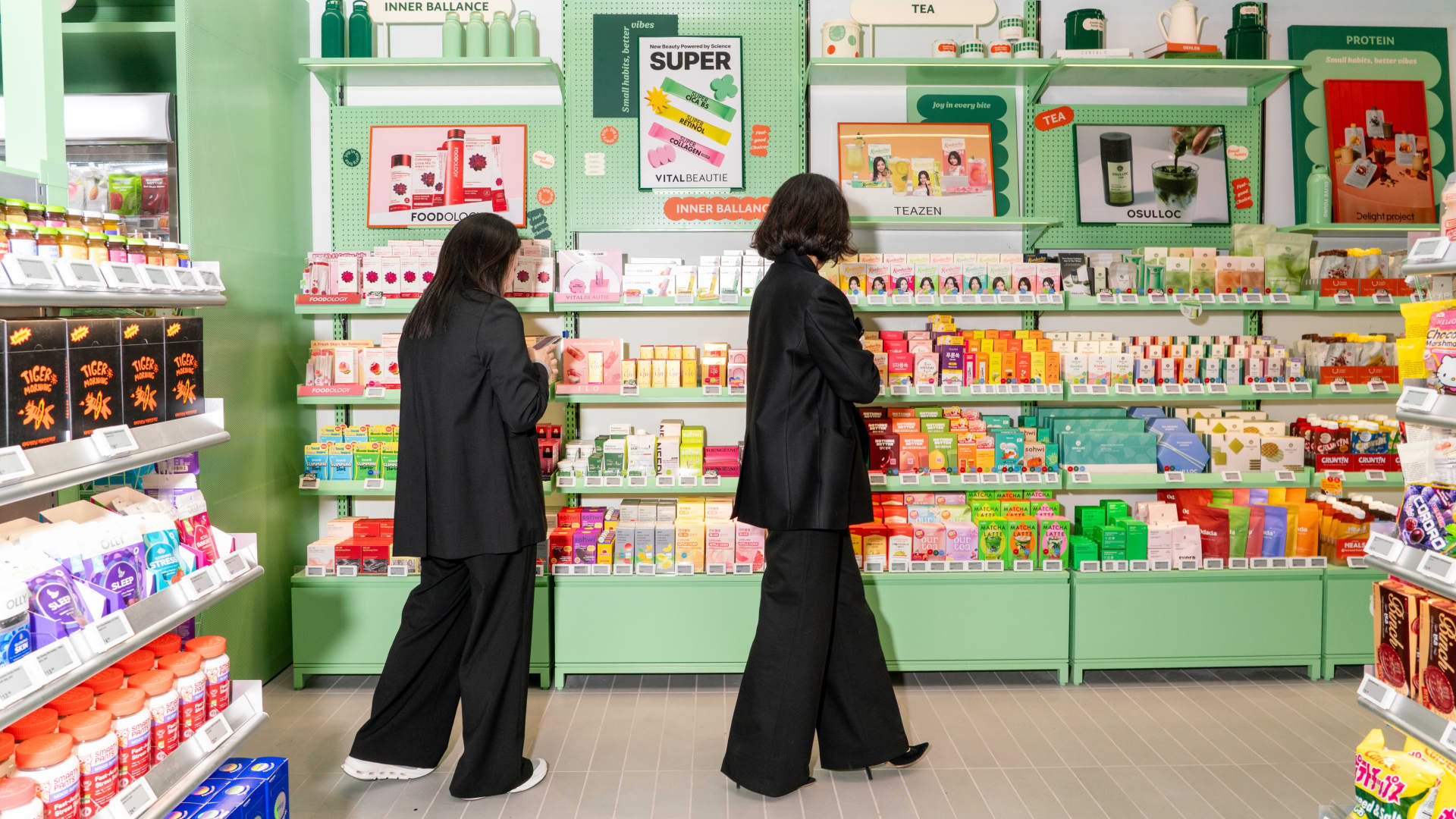
Shoppers attend the grand opening of an Olive Young store on May 29, 2026 in Pasadena, California.
Kyle Grillot | Bloomberg | Getty Images
When Olive Young opened its first U.S. store in late May, shoppers were already camped out and lines spanned multiple blocks.
The leading Korean beauty retailer’s new store in Pasadena, California, welcomed 6,000 customers during its opening weekend and now averages more than 1,600 customers per day, the company announced. The company has since opened another store in Century City, Calif., and said it plans to open more stores in the United States.
Shoppers wait in line for the grand opening of Korean beauty retailer Olive Young’s first U.S. store on May 29, 2026 in Pasadena, California.
Kyle Grillot | Bloomberg | Getty Images
Its popularity is a microcosm of a larger trend occurring in the United States. Consumers can’t get enough of beauty products from countries thousands of miles away, and some companies are in a position to stay ahead of the curve.
“The United States is not only the world’s largest beauty market, but also one of the most influential in shaping global beauty trends, content and consumer behavior,” said Lena Kim, head of global communications at Olive Young. “This was a natural and strategic next step in our global expansion.”
shine
Consumption of Korean cosmetics, also known as K-beauty, has been on the rise in the United States for years, with the “first wave” occurring in the 2010s and continuing until the coronavirus pandemic.
“People were at home. They had time to learn about 10-step skin care routines. They learned what certain ingredients do, how to layer products, and more,” said Anna Mayo, Beauty Thought Leader at NielsenIQ. “We’ve seen the rise of this ‘glass skin’ look and started focusing on healthy, glowing skin that looks beautiful every day, rather than the need to cover it up with cosmetics.”
“Consumers are already familiar with this skin-care-first philosophy and kind of live by it,” she added.
Now, a “second wave” is taking hold, with K-beauty brands capitalizing on U.S. consumers’ desire for skin care, Mayo said. According to NielsenIQ, U.S. K-beauty sales reached $2.8 billion in early 2026, an increase of about 48% year over year. This is an unusual acceleration, faster than the nearly 45% growth rate in the same period last year, Mayo said.
K-beauty is also penetrating more U.S. households, rising to 28.7% in the most recent year. This shows that K-beauty is becoming even more popular in the country.
Morgan Stanley analyst Simeon Gutman said he expects K-beauty’s growth trajectory to continue. In a March 11 note, the analyst predicted that K-beauty sales in the U.S. could reach about $4 billion in 2026, citing “the growing popularity of K-culture and U.S. consumer demand for functional skin care products” as catalysts.
Gutman later confirmed to CNBC that those views are current.
Even if those predictions don’t come true, the popularity of K-beauty will have a lasting impact on American consumers. Cassandra Bankson, a medical esthetician and skin care educator, believes this popularity has paved the way for cosmetics from other countries to follow suit, even in the United States, as long as information and trade routes remain open.
“I think it’s coming, but I don’t think people saw it coming,” Bankson said, adding that next will be products from China and Japan, then Vietnam, Singapore and Thailand.
“A lot of the beauty groups I’m in in America now have underground groups that say, ‘Hey guys, look at what I got from Judy Doll,’ or ‘I just went to China, I just went to Vietnam, look at this Thai sunscreen that you can’t get anywhere else,'” she said. “I think there’s more room for that.”
As a result, American shopping malls began to be restructured. New Jersey’s Westfield Garden State Plaza has expanded its lineup of Asian retailers over the past 12 months, adding new stores such as K-Beauty as well as Japanese Beauty, or Sukoshi, a top destination for J-Beauty and Asian lifestyle products.
“Consumer discovery has fundamentally changed,” said Kate Subbag, vice president of leasing at Westfield Garden State Plaza. “People are no longer just finding brands in the mall, they’re discovering them through TikTok, Instagram, and international travel. And once they connect with a brand, they want to experience it in real life. We’re seeing that ripple across our portfolio.”
Who will benefit?
Most of K-Beauty’s sales come from TikTok Shop and AmazonNielsenIQ data shows there is room for retail to capture more market share.
“There’s a huge opportunity to move this segment offline and into stores and reach people that way,” NielsenIQ’s Mayo said in an interview.
Earlier this year, Sephora partnered with Olive Young to offer K-beauty products to Sephora customers in stores and online, Morgan Stanley’s Gutman said. ulta beauty Also founded to benefit from the growing popularity of K-beauty in the US
“The skin care and wellness segment delivered low-single-digit profit growth this quarter,” Ulta CFO Christopher Dell’Orefice said in the company’s latest earnings call, noting that premium skin care, including Korean brand Medicube, continued to perform “strongly.” He said K-beauty brand Peach & Lily was one of the companies driving “healthy guest engagement”, while mass skin care’s “solid” growth during this period was supported by Anua’s in-store expansion.
“We expect the market to continue to trend in this direction,” said Anna Glasgen, a research analyst specializing in consumer products at B. Riley Securities. “With the hugely successful launch of the Olive Young Store, it is clear that there is a huge demand for K-Beauty and we need to be where our consumers are.”
Alta did not respond to CNBC’s request for comment. The company’s second-quarter numbers could further clarify this point for investors. The report is scheduled to be released on August 5th.
However, Glaessgen stressed that K-beauty’s popularity comes with risks. Given that K-beauty typically has a lower price point than luxury skincare, the average selling price for this category as a whole may be impacted.
“If people who would normally spend $30 to $60 on something are now spending in their teens and 20s for high-end skin care, that’s clearly putting downward pressure on the average spend in that category,” she says.
She sees the risk coming more from younger generations who are just getting into high-end skincare. “If a $20 or $30 product is found to be effective, it may be more difficult to get people to replace it with a product that costs several hundred dollars,” the analyst said.
other retail stores etc. target, costco and walmart Greater penetration into the K-beauty market could also help attract a broader audience to the category.
Target has already made great strides in that area. The company quadrupled its K-beauty offerings in the spring, offering more than 150 new products and more than 10 new brands across skin care, makeup and hair care, a company spokesperson told CNBC. The company plans to introduce more products.
Amanda Nusch, Target’s senior vice president of merchandising, essentials and beauty, told CNBC: “Beauty is a very important and very personal category for our guests, and our team is always working to flex our merchandising mandate by delivering the brands and trends our guests desire most.” “K-beauty is a good example.”
Raymond James analyst Olivia Tong is based in Canada. estee lauderIt incorporates ingredients that have become popular in the K-beauty field, such as , Centella asiatica.
“The way we look at this category is completely different. It’s more maintenance-heavy, it’s a lot more raw materials, and the speed to market is definitely more consistent,” she told CNBC. “We don’t think this is just a trend. We think this is a bit of a shift in the market.”
