

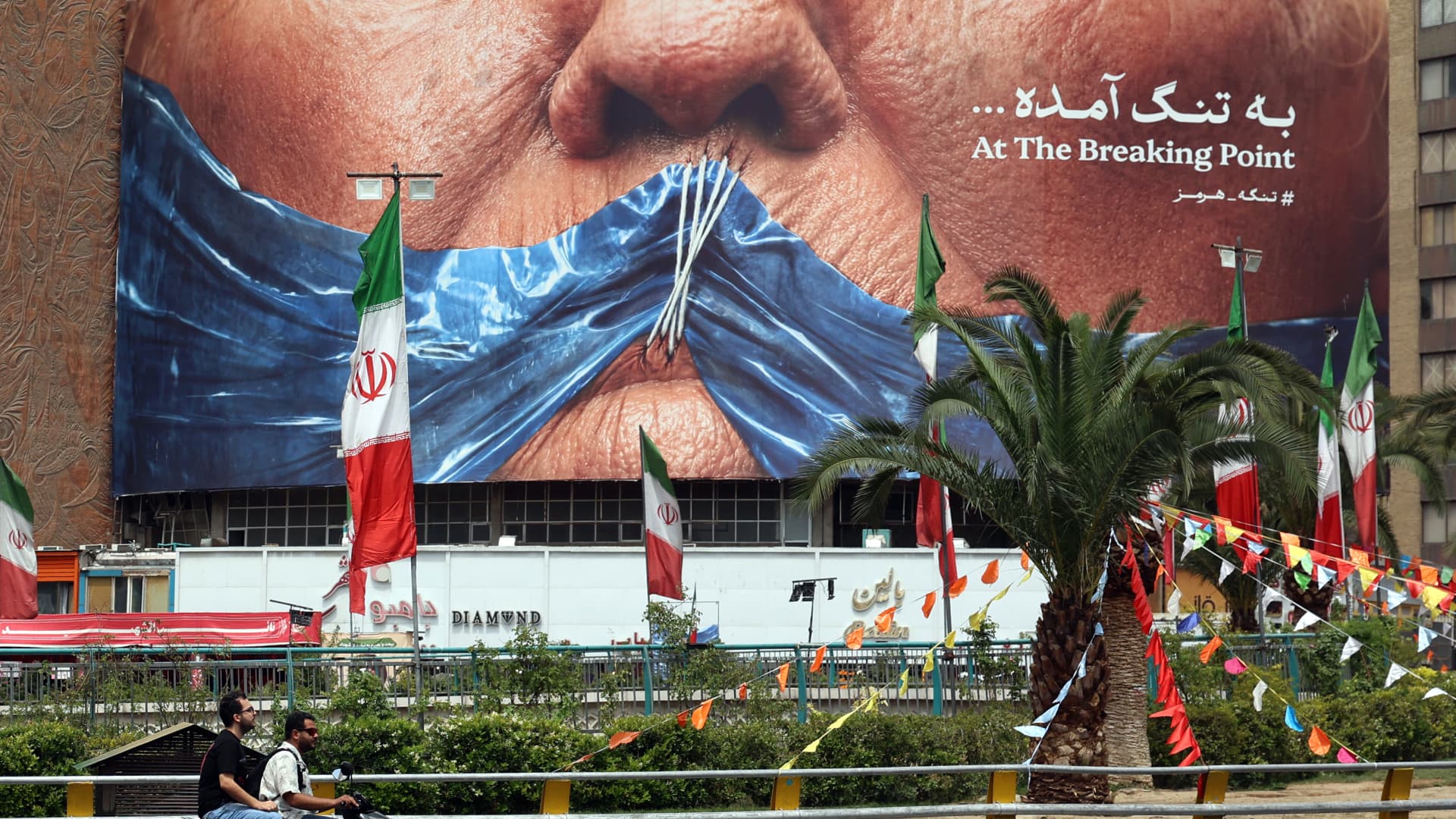
An Iranian man drives past a billboard depicting US President Donald Trump and the Strait of Hormuz on May 28, 2026 in Tehran’s Variasr Square.
– | AFP | Getty Images
Iranian state news agency Tasnim reported on Monday that Iranian negotiators had stopped exchanging messages with the United States through intermediaries and that Tehran would move to completely close the Strait of Hormuz in retaliation for continued ceasefire violations.
The report, translated and posted on the social media site Telegram, focused on Israel’s military operations against the Iranian-backed militia Hezbollah in Lebanon.
According to Tasnim news agency, “there will be no dialogue” until Israel completely withdraws from occupied Lebanese territory and ceases all attacks in both Lebanon and Gaza.
“The Resistance Front and Iran have also decided to completely block the Strait of Hormuz and activate other fronts, including the Bab al-Mandeb Strait, to punish the Zionists and their supporters,” the report said.
The Bab el-Mandeb Strait is a key point for trade between the Red Sea and the Gulf of Aden.
Oil prices soared more than 7% following Tasnim’s report. The report signals a breakdown in efforts to bring a diplomatic end to the war, now in its fourth month.

President Donald Trump said just three days earlier that a meeting in the White House Situation Room would decide whether to agree to a deal with Iran that would at least pause the conflict. However, the meeting ended without President Trump making a final decision.
The next day, the United States and Iran launched new attacks on each other, further undermining a tattered ceasefire that had already been repeatedly broken by intense military operations.
At the same time, Israel is stepping up its military offensive against Lebanon. Prime Minister Benjamin Netanyahu on Monday ordered an attack on the Hezbollah-controlled suburbs of Beirut, according to Reuters.
“It is clear that a ceasefire between Iran and the United States is a ceasefire on all fronts, including Lebanon,” Iranian Foreign Minister Abbas Araghchi told XPost on Monday morning.
“A violation on one front is a violation of the ceasefire on all fronts. The United States and Israel are responsible for the consequences of the violation,” Araghchi said.
The White House did not immediately respond to CNBC’s request for comment on Tasnim’s report. U.S. Central Command declined to comment.
Iran’s pledge to tighten controls on the Strait of Hormuz indicates that oil exports from the Persian Gulf are unlikely to increase any time soon.
Due to the Iranian blockade, exports through the strait have plummeted from pre-war levels. Before the US and Israel first attacked Iran on February 28, about a fifth of the world’s oil supplies passed through Hormuz.
Barrel prices for Brent and WTI crude oil, although still significantly elevated relative to pre-war levels, have fallen by double-digit percentages in recent weeks as investors become more optimistic about the prospects of a deal to fully reopen the Strait. But some of that optimism appears to have dissipated after Monday’s developments.
Ship traffic through the strait has remained effectively cut off since the start of the war due to Iranian threats and a retaliatory U.S. blockade. Although a small number of ships are now able to pass through the waterway, traffic remains far below pre-war levels, when more than 100 ships passed through the waterway each day.
Iran’s efforts to control the strait have raised concerns that the Iranian government could impose a toll system on ships passing through.
In a post on Truth Social early Monday morning, President Trump insisted that Iran “really wants a deal” and slammed U.S. critics who “continue to ‘complain’ negatively” about Trump’s handling of the war.
“Just sit back and relax, everything will be fine in the end, it always will be!” Trump wrote.
—CNBC’s Ryan Ruggiero and Spencer Kimball contributed to this report.
