

beirut, lebanon —
At the entrance of Beirut’s Rafik Hariri University Hospital, the human cost of Israel’s weeks of attacks on Lebanon was etched on the faces of desperate families waiting for news of their loved ones. The ambulance opened the door right at the entrance to secure the scene. Body bags were quickly brought in one after another.
“There are many martyrs. Unfortunately, many of them are still waiting to be identified,” the hospital’s director, Mohammad Zaatari, told CNN. Despite being Lebanon’s largest public hospital and operating at full capacity, the facility is within an Israeli-mandated evacuation zone, meaning it could also become a target. With hundreds of patients, including those in intensive care, evacuation is not an option.

Mohamed Jilani was pacing outside the hospital door. His uncle had been hospitalized after his apartment was hit by an Israeli airstrike on April 8th.
“They were not attacking combatants. Most of the injured were women, children or displaced people,” he told CNN. “Why would they target civilians if we don’t have weapons? Go to the hospital in Beirut and find one Hezbollah fighter. They are all civilians.”
These were the scenes in Beirut last week when the Lebanese capital came under an unprecedentedly heavy Israeli attack, just hours after the start of a ceasefire in the war between the United States, Israel and Iran. A 10-day ceasefire has now been announced between Israel and Lebanon, giving the country some respite, but it will take time to recover from the effects of the devastation.
The Israeli government said it was targeting fighters and infrastructure of the Iranian-backed Lebanese militant group Hezbollah, which has been in conflict with Israel for decades. The aim, according to Israeli Prime Minister Benjamin Netanyahu, is to make his country’s northern borders safer. But civilians across Lebanon are bearing the brunt of the conflict, which flared up again when Hezbollah began firing on Israel at the start of the US-Israel-Iran war.
The Lebanese government, including Hezbollah’s political representatives, has also moved to put pressure on the group, outlawing the militia and ordering security forces to remove all non-state weapons from the capital, Beirut. But Hezbollah officials insist that Hezbollah, rather than a weak national army, is the only force capable of defending Lebanon from an Israeli attack or possible occupation of the south.
Hezbollah’s traditional stronghold in southern Lebanon has faced near-constant shelling and ground attacks for more than two years. Now, this latest war has expanded its reach far beyond the front lines. Across Lebanon, towns and cities once thought safe, including the capital, are under unpredictable waves of deadly attacks by Israeli forces.

Lebanon’s Ministry of Health said more than 2,000 people had been killed and 7,000 injured in just six weeks, including at least 172 children and 91 health workers. Israeli airstrikes have killed and injured civilians taking shelter in their homes, workplaces, and even makeshift shelters.
Just over a week ago, Israeli forces launched the largest coordinated attack on Lebanon since the start of this recent war, hitting 100 Hezbollah targets in just 10 minutes. Israeli attacks are usually accompanied by some sort of warning, such as the ominous noise of a low-flying drone or an evacuation order shared on social media by an IDF Arabic-language spokesperson. But this one came without warning. Asked for comment by CNN, the IDF said it was “taking all possible precautions to reduce harm to civilians, in accordance with international law.” Military officials also said advance warning is not necessary in case of disruption to operations.
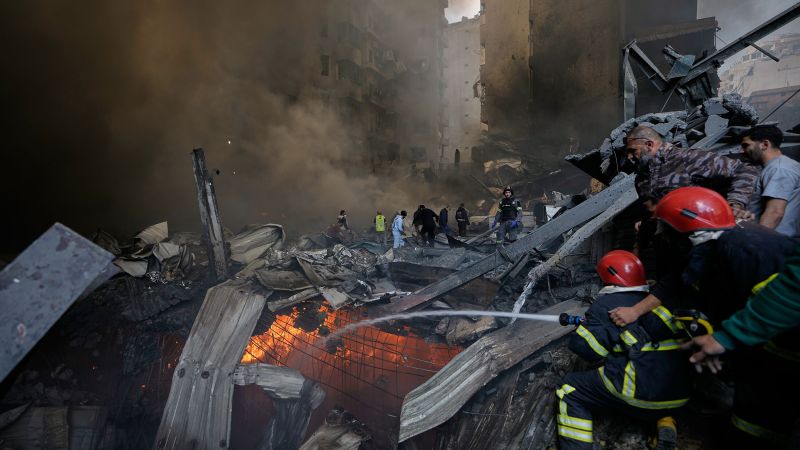
Downtown Beirut, previously not thought to be in the line of fire, came under fire within seconds of each other. Homes, stores and local businesses were destroyed in an instant, victims buried under rubble and twisted metal, survivors clinging to the blackened remains of apartment buildings.
Hospitals across Lebanon are in crisis mode following the attack. CNN visited Beirut’s Makassed General Hospital. There, a 3-year-old girl was recovering from a severe injury to her left hand. The mother said her daughter was outside playing when the education center where she had taken shelter was damaged.
“I started running screaming, ‘My daughter, my daughter.’ I couldn’t see anything, it was just black. I heard her calling me, ‘Mama, mama,'” the woman told CNN. “I was digging through the rubble with my hands. I was trying to look, but I couldn’t see. And I saw her face, her head. I pulled her out myself and carried her. I was in shock.”
My daughter has already lived through two wars between Israel and Lebanon in three years. According to his mother, he covers his ears when he sleeps to block out nearby sounds.
“Why should my child have to live like this? She clings to me in fear, clutching my veil. What did I do to put our children through this?”
Hospital officials here say they are bracing for more casualties but warn they could quickly run out of supplies in the face of another major attack. The World Health Organization also warned that some hospitals in Lebanon are close to running out of essential medical supplies.
“If the war continues, we are physically here and we are ready,” said Jumana Najjar, general manager of Makhased Hospital. “The doctors are ready, the staff is ready, but there is a limit to our ability to supply supplies and medicine. We don’t know how long the war will last and how long we can sustain a war like this.”
“We must always be concerned about Israel. We don’t know what they will do next. We saw what they did in Gaza.”

With mandatory evacuation orders in place south of the Litani River, Israeli forces gradually deepened their ground attacks and intensified air raids, resulting in the complete destruction of entire villages in the area.
Since March 2, Israeli forces have also stepped up operations to destroy key bridges connecting southern Lebanon with other parts of Lebanon, deepening the isolation of the region. More than 1 million people (approximately 20% of the country’s total population) have been forced to evacuate.
Many of these families are now sheltering in displacement camps hosted in schools, stadiums, and community spaces in and around Beirut. But other locations remain on the streets, with hundreds of tents lining the city’s exclusive waterfront.

“Our situation is very bleak. We left with only the clothes on our backs and could not take anything with us. They told us to take shelter here and we have been here in a tent ever since,” said Abu Mohammed, 85. “We lost our home. If we were to go back, we would have to take our tents with us. We have nothing left.”
During his lifetime, Abu Mohammed fought several wars with Israel and even experienced Israeli occupation. He said he would now cooperate with anyone defending the country from Israeli forces.
“We can endure all this as long as the resistance continues. The rest does not matter, whether we have food and drink, whether we have something. All that matters is our soldiers on the border, they are protecting us. They are defending our land, defending our country, our dignity.”
Lebanon’s Social Affairs Minister Hanin Said told CNN during a visit to a camp for displaced people in Beirut that the Lebanese government “cannot accept even one person on the streets.” Saeed said people in the temporary camps were said to have been offered alternative shelter, but many were refusing to be relocated.
“The problem is that many of them don’t want to go. They want to go home, and rightly so. They still have hope that they can go back to Dahieh or their homes in the south tomorrow. It’s difficult to tell them that you don’t think that’s going to happen.”
The number of internally displaced people in Lebanon continues to rise as evacuation orders expand, but many still choose to remain in the south.
In the ancient coastal city of Tire, the roads were eerily quiet when CNN visited. For those who remain, the low rumble of Israeli jets overhead and the plumes of smoke in the distance are constant reminders that their city is now on the front lines. Residential buildings have been repeatedly damaged, evacuation orders have been extended to the sea, and fishermen are unable to make a living.

Marwan Al Juni was born and raised in Tire. His Christian neighborhood has largely escaped the worst attacks by Israel as Hezbollah has gained a stronger foothold in the city’s Muslim areas, but he said his community is on par with its Shiite Muslim neighbors.
“We join hands and support each other. We stand shoulder to shoulder so that we don’t feel afraid,” Arjuni said. “Even in these difficult times, we will not abandon our land. Despite all the pressures and all the difficulties we face, we will continue to stand here resolutely.”
Rayhana Zaiter contributed reporting.
