

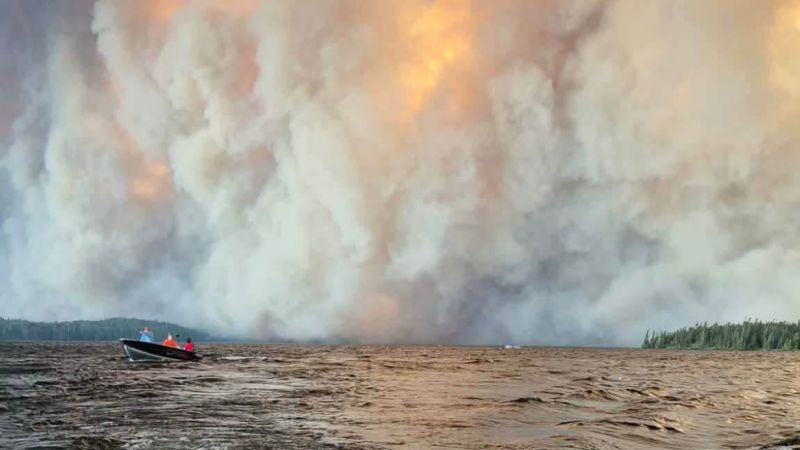
At first, all Miya Pavola could see was a thick wall of smoke.
Smoke could be seen nearby from her home in Namaigousisagagun First Nation in northwestern Ontario.
But the remote Indigenous community said it was told that Monday, July 13, by the Ministry of Natural Resources that there was no immediate danger.
Within hours, they were running for their lives.
“Everything was very fast-paced. I didn’t have much time to think about what was going on,” Pavola told CNN.
She grabbed a wet towel and climbed into a small aluminum boat with five other people, three dogs and a cat. Also known as Collins First Nation, this isolated community has no roads, only a railway and Collins Lake.
Pavola didn’t fully grasp the extent of the danger until the boat retreated.
“All you could see was orange and gray, it was very dark,” she said. However, as they sail away, she is finally able to see how close they were to the fire. “That’s when I observed it, probably as we were about to cross the second island. You could just barely see the fire reaching the shoreline, and there was a very thick wall of smoke following very quickly.”
“If we had waited any longer, we would have died.”
Only 25 of the approximately 60 community members were in Collins when the fire broke out. Residents say this likely saved lives as people piled into aging 12- and 14-foot aluminum boats powered by decades-old motors. Many people had to leave their pets behind.
The wildfire that devastated Collins is part of a broader wildfire emergency across Canada, with 889 active fires as of Thursday night, according to the Canadian Natural Fire Information System. There are 163 active wildfires in Ontario, according to the province’s Ministry of Natural Resources.
Miiya remembers that the escape itself was as scary as the fire itself.
“It was very scary,” she said. “There were many times when I almost tipped over.”

Their boat faced strong waves for the approximately 40 minutes it took to travel from the north side of Collins Lake to the south side. As soon as I left the shore, I hit a rock and almost fell over.
Miiya’s mother, Mayor Helen Pavola, was not in the village at the time of the fire. She said fire officials had previously told her there was no immediate danger and insisted that the smoke residents were seeing was from a smoldering fire in the distance.
Mayor Pavola remembers the painful moment when he was unable to contact local residents, including his daughter and two sons, during the evacuation.
“All I could think about was… they were gone. My children were gone, my community was gone,” she told CNN. “There are no words to describe the relief I felt when I found out everyone was out.”
But like every other home on the Collins First Nation, her home was completely destroyed in the fire.
At a news conference with Ontario Premier Doug Ford, government officials said there was little time to respond because the fire occurred unusually close to the community of Collins. The government said it would review its response to the situation.
The destruction of Collins became one of the most striking examples of the devastation caused by this week’s fires.
More than 30 homes were lost, as were administrative offices, schools, community centres, warehouses, vehicles and community necessities, said Linda Debasidge, grand council president of Ontario’s Anishinabek Nation.
“If we waited for the emergency response, we would all be on a recovery mission searching for bodies of children, elderly people, men and women,” she said.
The organization, which represents 39 First Nations, including Collins, said it is currently paying for lodging, food and supplies for evacuees staying in the nearby city of Thunder Bay, as government aid has not yet arrived.
She said Collins has fallen through the jurisdictional cracks because the area is considered a “near band” community that is still working towards full recognition from the federal government, complicating access to government assistance.
He said the area was under threat from wildfires just weeks ago, but nothing has been done since then to better protect the area with firebreaks and other precautions.
Collins’ destruction raises new questions about whether Ontario’s wildfire strategy is keeping up with an increasingly intense fire season.
Lise Vaugeois, the provincial councilor who represents Thunder Bay-Superior North, said at least a dozen communities in northwestern Ontario remain under evacuation or stay-at-home orders.
“As far as I know, this is the first time that an area within a three-hour drive of Thunder Bay has had to be evacuated,” she told CNN.
He said the increasingly intense fires are exposing a lack of wildfire preparedness, pointing to the need for more firefighting resources, prescribed burns and firebreaks to reduce fuels before fire season.
“It’s somehow becoming acceptable for indigenous communities to be displaced every year,” she says. “It’s traumatic and I’m sure the effects will be with people for a very long time.”
Areas immediately outside the fire are also feeling the effects.
“There’s ash fall in Thunder Bay and the air quality is very poor,” Vaugeois said.
Smoke has spread hundreds of miles across northwestern Ontario, affecting people far from the line of fire. Canada’s largest city woke up Wednesday under hazy orange skies as the smell of wood smoke lingered in the air, with Environment Canada issuing an air quality warning and advising residents about the health risks of spending time outdoors.
The impact is even more severe for people with respiratory problems. Scott Bailey of Belleville, Ont., who has chronic obstructive pulmonary disease (COPD), agrees.
“It’s been very hazy for the last two days, every day, all day, around 9 p.m.,” he said.
For Bailey, living with a chronic lung disease means every change in air quality is important. Breathing isn’t his biggest challenge, but his lungs have a hard time expelling carbon dioxide. Smoke-filled air makes it even more difficult.
“It’s like breathing through a straw,” he said.
“When you breathe in smoke-filled, polluted air like this, it makes things even worse. Because of forest fires, there are a lot of molecules and substances in the air. It’s just not smoke. There are a lot of substances in smoke,” he explained.
Deteriorating air quality means major changes to his daily life.
“My wife loves to keep the windows open during the summer, but this is the first time we’ve stopped doing that,” Bailey said. “You need clean air ventilation, and you need air purifiers and oxygen nearby.”
Now even simple errands have to be planned and he avoids leaving the house.
“You need to make plans like going grocery shopping or going to someone’s house. You need to make sure the air in your car is circulating so the air is fresh.”
It is unclear when the fire will be extinguished and the air will clear.
For the people of Collins, the smoke billowing over Ontario is just a reminder of what they left behind.
Chief Pavola said her community is grieving the loss. “There is despair, there is confusion, there is hurt, there is sadness, but there is also hope.”
She says she had no doubts about what would happen next.
“We’re going home,” she said. “We will rebuild and go home.”
