

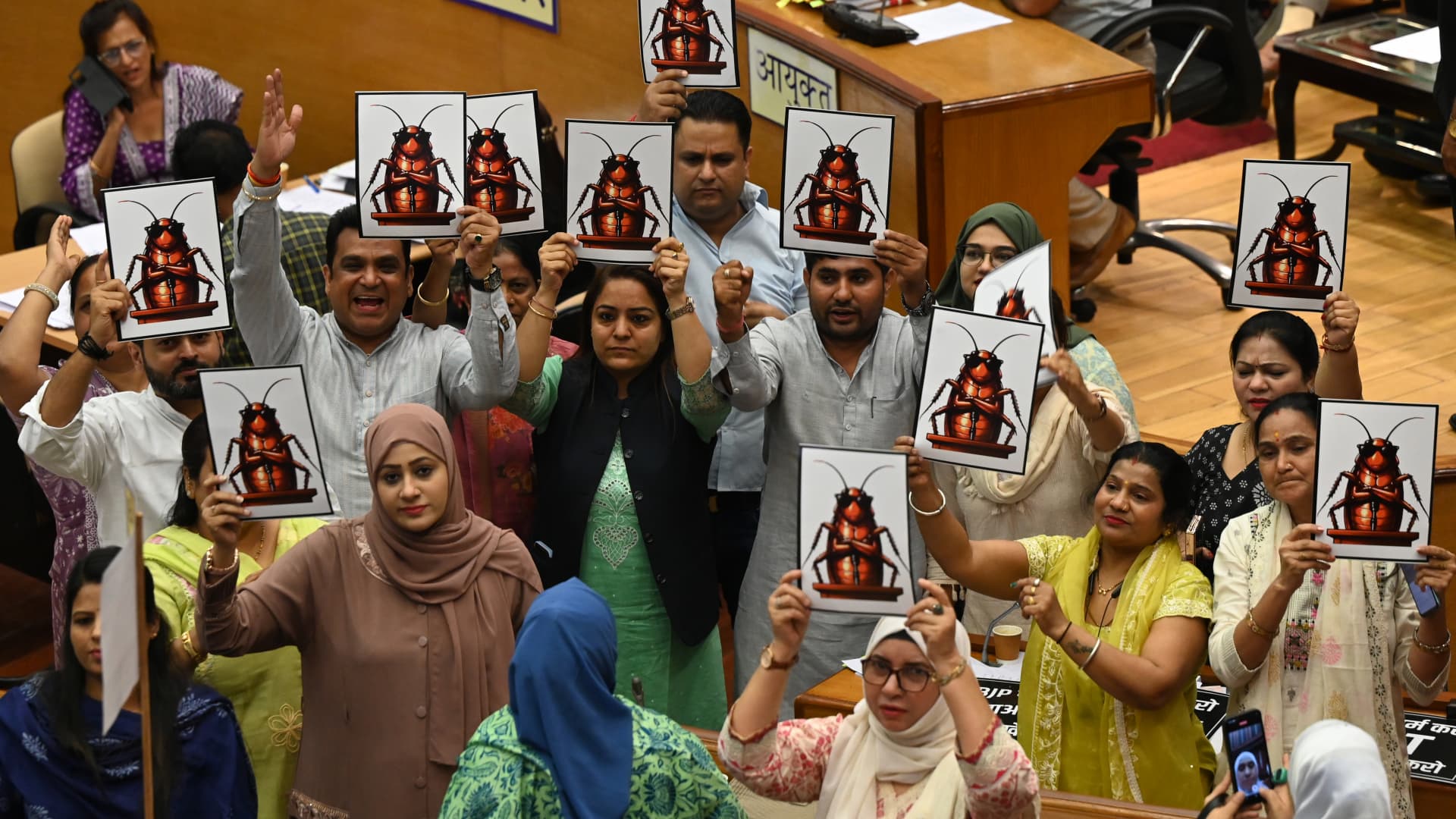
AAP councilors protest against the leak of undergraduate exam papers during the Delhi Municipal Corporation’s House meeting in New Delhi, India on May 25, 2026.
Sonu Mehta | Hindustan Times | Getty Images
An Indian youth political movement trending on social media – whose mascot is a cockroach – will face its first offline popularity test as it plans a protest in New Delhi on Saturday.
Within weeks of its launch in mid-May, Cockroach Janta Party (CJP) had amassed more than 22 million followers on Instagram.
The pseudo-political CJP was founded on May 16 by Abhijeet Dipke, a political communications strategist and Boston University student, in response to comments made by India’s Chief Justice Surya Kant during a court hearing in which he called some unemployed youths “parasites” and “cockroaches.”
CJP claims more than 1 million members and describes itself on its website as “the voice of the lazy and unemployed.”
But experts say there is little evidence of local support for the mock party, adding that the scale of the weekend protests will determine whether the movement is seen as a warning sign or a market-moving event.
In Nepal, Bangladesh, and more recently Indonesia, similar movements led by disaffected youth on social media are disrupting economic activity and threatening political stability. In some cases, it has even led to the downfall of the ruling party.
Reema Bhattacharya, head of Asia research at Verisk Maplecroft, told CNBC that it is important for investors that governments “maintain confidence that the next generation will enjoy a better economic outlook than the previous generation.”
Across Asia, this proposition is “becoming increasingly difficult to sustain,” she added.
Bhattacharyya said the movement’s core reflects “growing dissatisfaction with why the much-debated demographic dividend has delivered uneven outcomes, despite more than a decade of political promises and expectations.”
India’s economy has been under stress since the outbreak of the Iran war, with energy supply disruptions causing the rupee to weaken against the dollar and raising concerns about slowing growth and rising inflation.
Against this backdrop, experts said job creation remains the biggest challenge facing the country, which has the world’s largest youth population.
In an open letter in April, global equity research firm Bernstein warned Prime Minister Narendra Modi about the deepening employment crisis in the country. With the rise of generative AI, India’s IT sector employment is also expected to slow down, while manufacturing employment has not shown a significant increase.
Other major countries in Asia, such as China, are also facing declining private sector employment prospects due to the economic downturn and deteriorating business confidence.
protest test
CJP has been posting about lack of development and rising unemployment rate through its social media handles. But Saturday’s protests will address recent discrepancies in the government’s key high school and entrance exams, which media reports say are affecting millions of students.
“This party, this youth movement, demands accountability from the system,” a spokesperson for the Roach Party said at a press conference on Wednesday. He added that “corruption” within the system runs deep and people are speaking out about it by supporting the party on social media.
The CJP has demanded the resignation of India’s Education Minister Dharmendra Pradhan, he said in a press conference.
India’s opposition leader Rahul Gandhi also raised the issue of exam marking errors in a post in X magazine on May 17, saying Pradhan had “failed every age group of Indian students at once.”
Ashok Malik, a partner at public policy think tank Asia Group, said the discrepancies in exams were “pretty dire”. “This is probably the biggest challenge the government has faced in the last 12 years,” he added.
He also said that while the government’s track record on job creation has been poor, these issues have not dented Indian Prime Minister Narendra Modi’s popularity so far.
Last month, Prime Minister Modi’s Bharatiya Janata Party won a historic election victory in West Bengal, tightening its grip on power even as the country faces economic challenges.
“The prime minister’s predictability is still quite high,” Malik said, adding that if Saturday’s protests drew 1 million people, it would be significant enough for investors to take notice.
The last time the Modi government faced violent protests was in 2020 when it introduced agricultural reforms. Prime Minister Modi repealed the controversial laws in November 2021 after a year of protests by farmers across the country. The Modi government returned to power for a third term, but lost its outright majority.
“I don’t think India is at risk (of political change) because it is a vast and complex country and requires serious physical presence and ground mobilization to exert political influence,” said Ronojoy Sen, a senior fellow at the South Asia Institute.
“Online presence alone is not enough,” he added, referring to CJP’s social media handles.
