

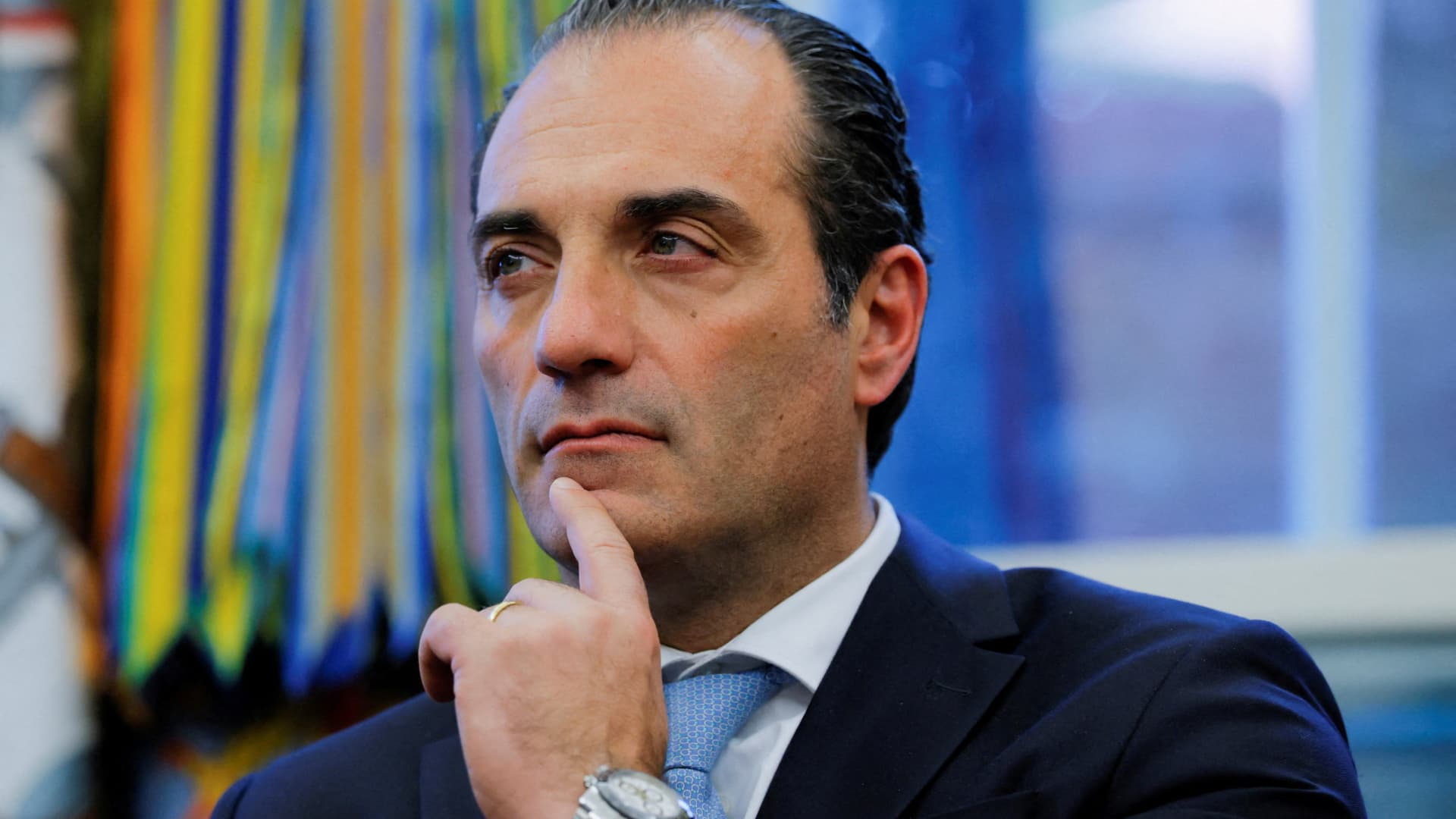
Stellantis CEO Antonio Filosa listens to U.S. President Donald Trump’s announcement of new fuel efficiency standards in the Oval Office of the White House in Washington, DC, on December 3, 2025.
brian snyder reuter
Auburn Hills, Michigan — Stellantis Chief Executive Officer Antonio Filosa said he believes there is an opportunity to expand partnerships with automakers in North America to replenish factories and expand sales, and there is potential to produce Chinese-branded cars outside the United States.
Filosa said Thursday that the company “certainly” sees opportunities with Chinese automaker Zhejiang Leap Motor Technology to expand vehicle production and sales into Mexico and possibly Canada.
“We believe there is space in Mexico. … There may be space in Canada as well. We’ll see,” he said at a press conference after an investor day at the company’s North American headquarters near Detroit. “There’s no space in the United States right now. We don’t see it that way.”
Traditional automakers, especially those with deep regional roots such as Stellantis, have been concerned about the expansion of Chinese automakers into North America. U.S. executives have expressed concern that the business could become a gateway to American consumers.
Amid trade tensions with the United States, Canada is now allowing 49,000 Chinese-made electric vehicles a year to be imported for retail sale at a 6.1% tariff.
A notable option in Canada is the large Stellantis assembly plant in Brampton, Ontario, just outside of Toronto. The plant has not produced any new cars since ending production of the Dodge Charger and Challenger in December 2023.
Bloomberg News reported last month, citing people familiar with the matter, that Stellantis was discussing options with Leap Motor to build electric vehicles in Canada.
Filosa said the partnership between Stellantis and Leap Motor continues to grow as a way for the company to grow sales, learn from Chinese competitors and share capital expenditures.
Starting in 2023, Stellantis will also be a 51% majority owner of the joint venture with Leap Motor, which includes exclusive rights to sell and manufacture its products outside of Greater China.
Earlier this week, Stellantis, Leap Motor’s largest shareholder with a 21% stake, announced expanded partnerships with Chinese automakers and the creation of a European joint venture with Chinese automaker Dongfeng.
In the U.S., Filosa said there are still opportunities for the company to partner with brands outside of China, such as the announcement earlier this week to explore a partnership with Jaguar Land Rover.
“We think there is potential for us to partner with other projects in the U.S.,” he said at a media briefing. “JLR, this is a partnership that works very well for both parties, because we see that the profile of what we industrialize and what we build is not that different… So there are synergies in the product concept that we can share with JLR.”
