

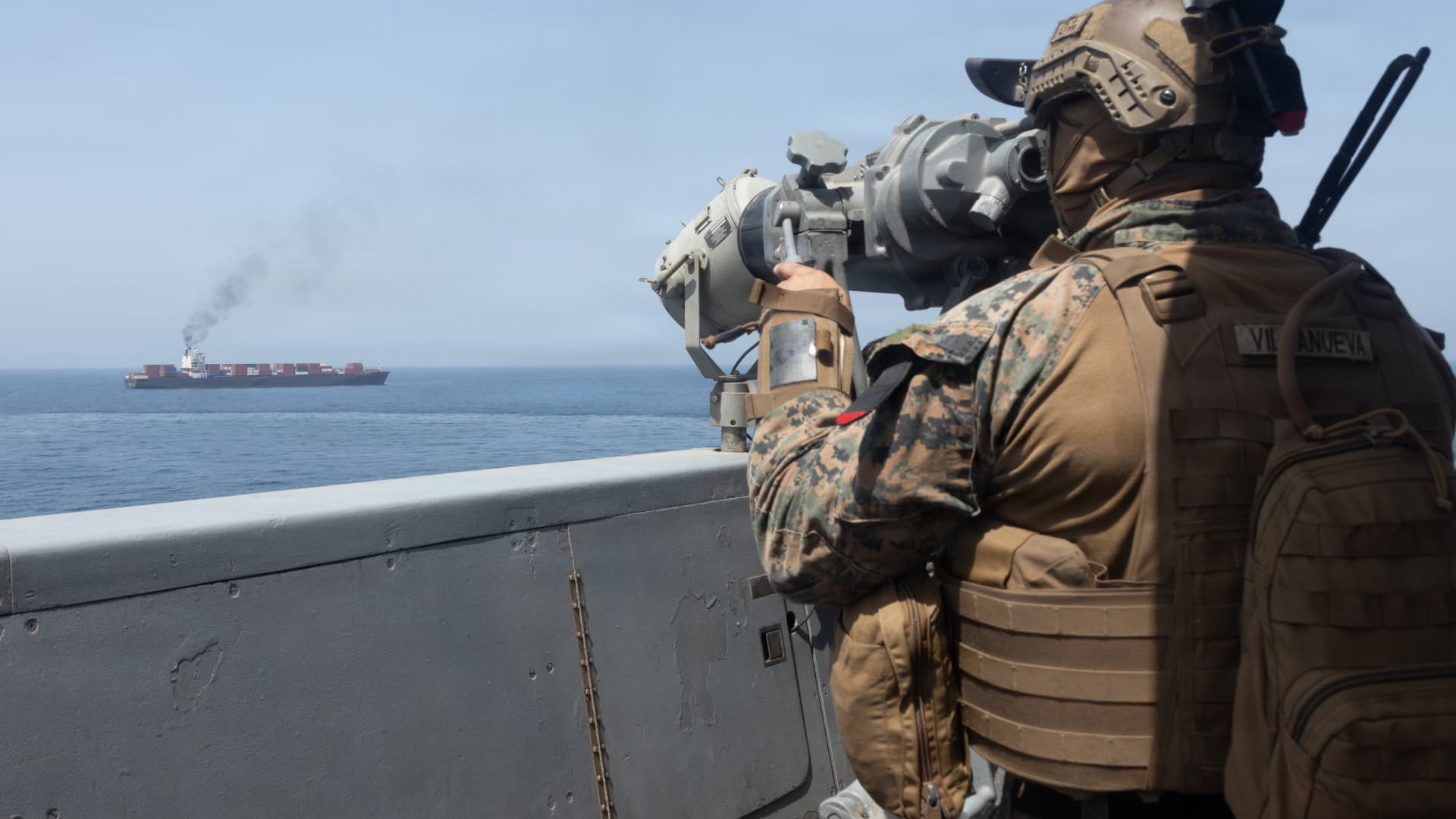
This distributed photo provided by U.S. Central Command shows U.S. forces patrolling the Arabian Sea near the M/V Tuska on April 20, 2026, after firing on an Iranian-flagged vessel that the U.S. accused of attempting to violate the U.S. naval blockade of Iranian ports near the Strait of Hormuz.
US Navy | Getty Images
The U.S. Navy on Thursday lifted a blockade of Iranian ports and coastal areas at the direction of President Donald Trump.
“U.S. forces are not interfering with the access of ships to and from Iranian ports,” U.S. Central Command said in a statement on social media. “All U.S. military blockade enforcement activities have ceased.”
The lifting of the blockade comes after President Trump and Iranian President Masoud Pezeshkian signed a memorandum of understanding on Wednesday aimed at ending the US-Iran war.
Under the agreement, Iran is obligated to allow commercial ships to transit the Strait of Hormuz without paying tolls for 60 days.
Vice President J.D. Vance told reporters earlier Thursday that Iran had not fired on ships in Hormuz for the second night in a row. “So far, they have complied with their end of the bargain,” Vance said.
The vice president said more than 12 million barrels of oil passed through Hormuz overnight. CNBC could not immediately confirm the numbers. Three Saudi tankers carrying about 6 million barrels passed through the strait, according to trade information firm Kupler.
Before the United States and Israel attacked Iran on February 28, about 14 million barrels of oil and 6 million barrels of refined products passed through Hormuz.
The Iranian government responded by attacking ships in Hormuz, essentially cutting off sea lanes and causing the largest oil supply disruption in history.
Kupler predicted in a memo earlier this week that oil flows through Hormuz could reach nearly 50% of pre-war levels within 30 days if the U.S.-Iran deal is fully implemented without any issues. It is unclear when exports via the Strait will fully return to pre-war levels, if at all.
“Everything is going to be more gradual,” Amrita Sen, founder of Energy Aspects, told CNBC. “Of course, initially there will be some stranded ships, but it won’t return to pre-conflict levels overnight.”
