

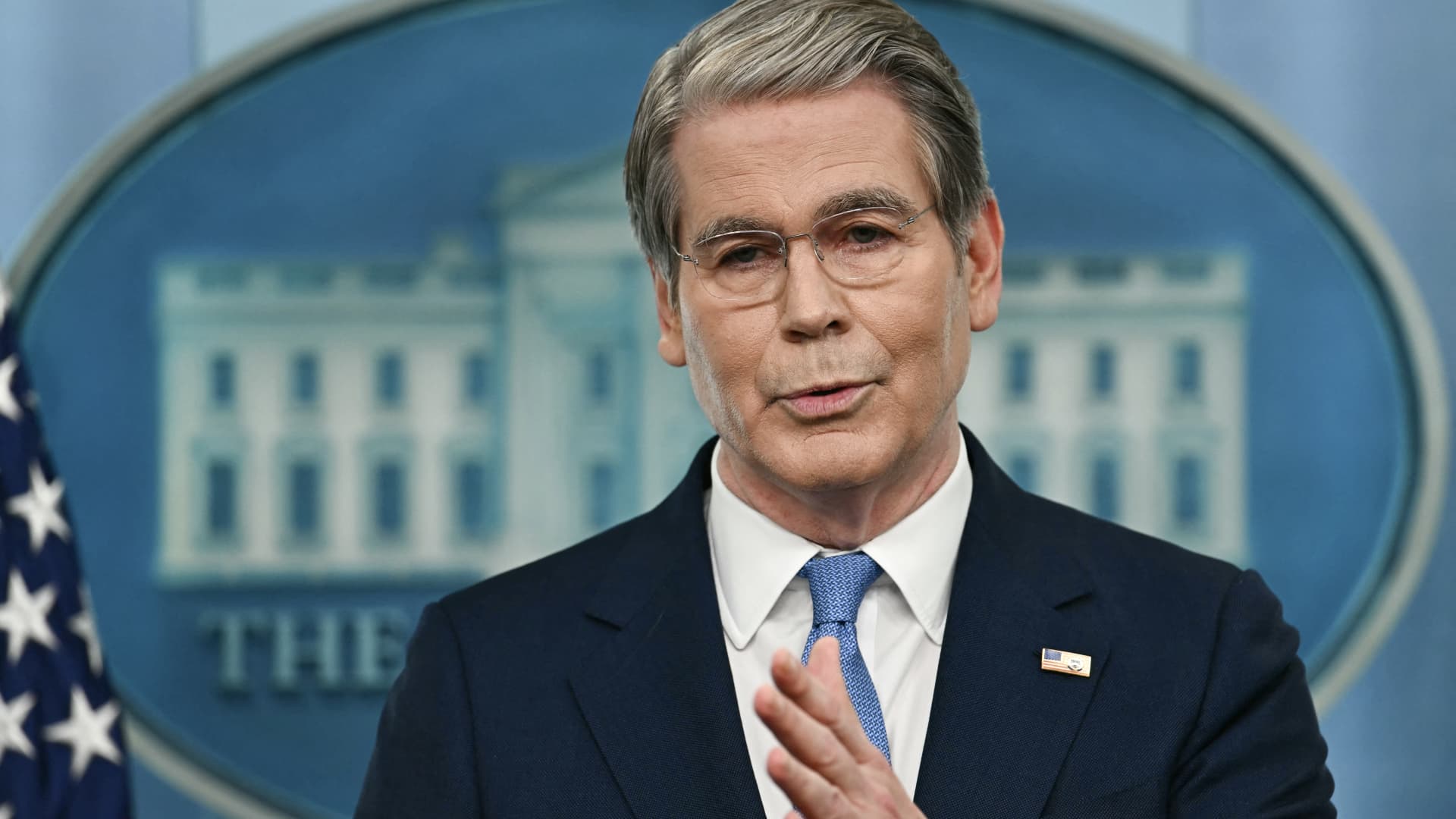
U.S. Treasury Secretary Scott Bessent speaks during a press conference in the Brady Briefing Room at the White House on May 28, 2026 in Washington, DC.
Kent Nishimura | AFP | Getty Images
A day after Iran’s series of attacks on Kuwait and Bahrain, sources said on Saturday that the U.S. government is seeking to divert Iranian assets to Gulf states to help rebuild and repair future damage caused by Iran.
U.S. Treasury Secretary Scott Bessent also directed a team to assess the cost of damage Iran has already inflicted on Gulf allies, the people said, adding that the U.S. would also consider using Iranian assets to fund those repairs.
The revelation came a day after Mohsen Rezaei, an adviser to Iran’s supreme leader, told CNN that the peace deal hinges on the release of $24 billion in Iranian assets frozen by the United States.
The official did not say on Saturday what assets the Treasury Department was investigating. The language used to explain the new measures does not appear to be limited to frozen assets.
Iran’s semi-official ISNA news agency reported that peace talks appear to have stalled, although ministers from mediator Pakistan visited Tehran on Saturday with a letter to Iranian Supreme Leader Mojtaba Khamenei.
Threats to transfer Iranian assets could give new impetus to the fragile ceasefire between the United States and Iran, which is being tested again this weekend with attacks by the United States and Iran.
Early Saturday, U.S. forces attacked Iranian coastal radar facilities on Gork and Qeshm islands in the Strait of Hormuz, after U.S. Central Command shot down an Iranian-launched drone that it said posed a threat to maritime traffic.
Iran’s Revolutionary Guards said it retaliated against U.S. military bases in Kuwait and Bahrain, and Kuwaiti forces said Saturday they engaged seven ballistic missiles that passed through residential areas, causing property damage but no casualties.
Sirens blared in Bahrain and residents were told to evacuate. Kuwait and Bahrain condemned the attack.
Pakistani minister lands in Tehran
Iran later announced that it had attacked US military bases in both countries with ballistic missiles, but the US military said six missiles had been intercepted and a seventh missed its target.
The United States and Iran have been negotiating largely indirectly for an interim agreement to end their three-month war, but issues such as Iran’s nuclear program will be left up for further negotiations.
However, an agreement remains elusive as both sides engage in regular skirmishes.
The Iranian government wants access to billions of dollars in oil revenue, exemption from sanctions on oil exports, a lifting of the U.S. port blockade, and influence over the Strait of Hormuz. Before the war, Iran effectively blocked the waterway through which about one-fifth of the world’s oil shipments passed.
Iranian state media reported that Pakistan’s Interior Minister Mohsin Naqvi arrived in Tehran on Saturday for talks with Iranian officials, including Foreign Minister Abbas Arakchi. ISNA reported that Naqvi said he was carrying a “special letter” from his country’s military commander and prime minister to Iran’s Ayatollah Khamenei.
US President Donald Trump faces increasing domestic political pressure due to rising gas prices to end the unpopular war. He told NBC that most of Iran’s drones and missile manufacturing facilities were destroyed, but Iranians still had access to about a fifth of their missiles.
“They have some missiles, they have some drones, probably 21% to 22% of the missiles, percentage-wise. It’s a lot of missiles, but it’s not like when we first attacked,” Trump said on NBC News’ “Meet the Press,” according to excerpts released by the network Friday.
After the United States and Israel launched a war against Iran on February 28, Tehran attacked Gulf states that host American military bases and nearly halted shipping through the Strait of Hormuz.
The conflict has driven up oil prices and disrupted supply chains for other goods, including humanitarian aid.
Fighting flares across the region despite ceasefire
In parallel with the Lebanese conflict, the Lebanese army announced that two Lebanese military officers and a soldier were killed in an Israeli attack on a military vehicle in southern Lebanon. The Israeli military said it was investigating the incident.
Iran made a ceasefire in Lebanon between Israel and Iran-aligned Hezbollah a condition of its peace deal with the United States.
The Lebanese army said on Saturday that its commander, General Rudolf Heikal, had traveled to Pakistan in response to an invitation from the Pakistani side, without providing details.
The surprise visit was notable given Washington’s insistence, and the insistence of Lebanese leaders, including the president, that Lebanon’s ceasefire talks remain separate from the Pakistan-brokered US-Iran negotiations.
Hezbollah leader Naim Qassem this week rejected a US-brokered deal between Israel and the Lebanese government aimed at halting fighting in Lebanon. The agreement did not provide for Israel’s withdrawal, and Hezbollah was not involved in the negotiations.
Israel says its troops will not withdraw or halt operations in the country as friction with the US escalates
