

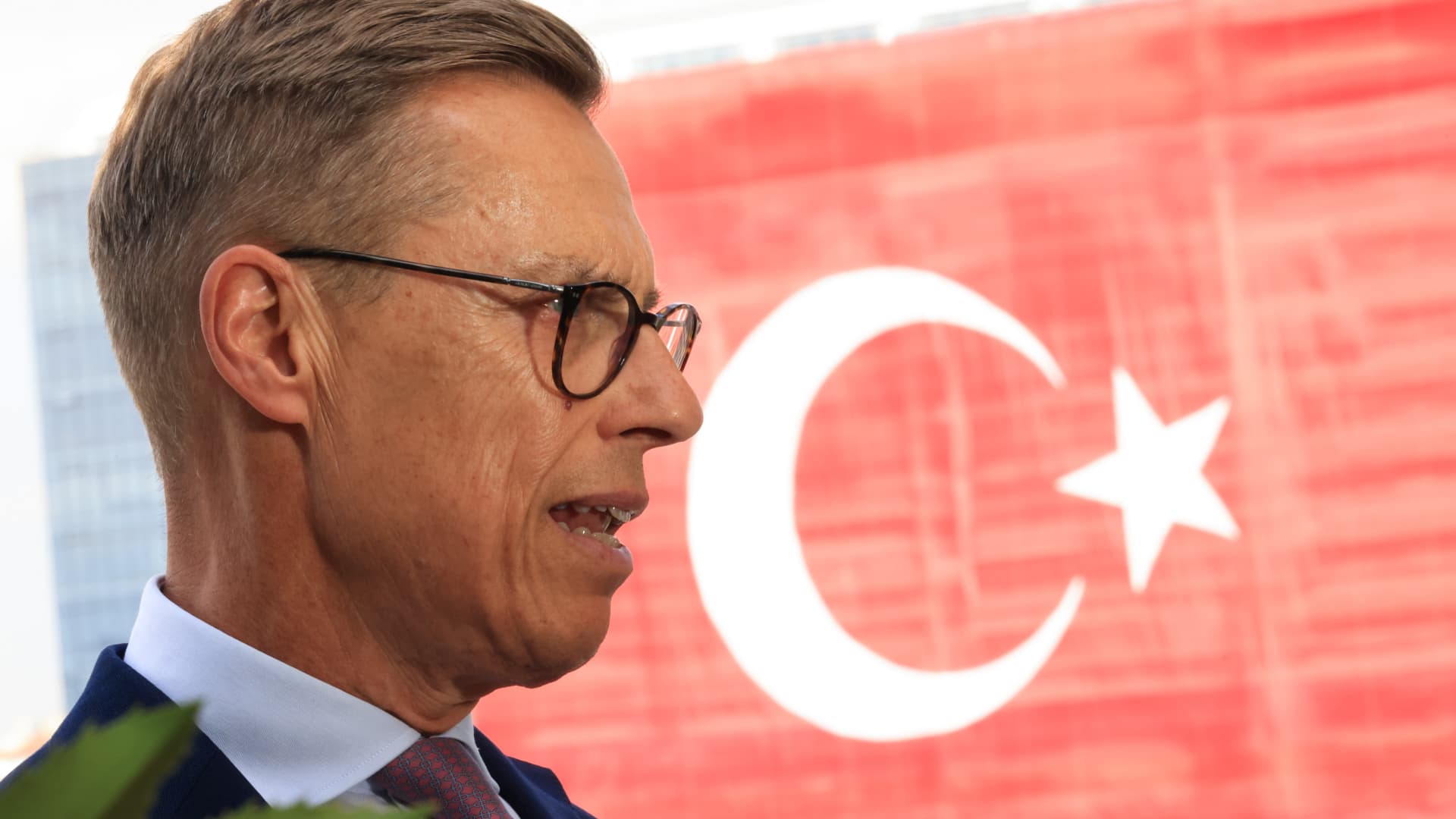

Finnish President Alexander Stubbe told CNBC on Tuesday that Ukraine has already won the war with Russia, but warned that Kiev still urgently needs more air defense support from its NATO allies.
Mr. Stubb stressed that despite more than four years of full-scale aggression by Moscow, Ukraine has managed to maintain its independence, sovereignty and territorial integrity.
“Let’s look at things from Moscow’s perspective. In the last four years of the war, they advanced 60 kilometers. In World War II, they advanced 1,400 kilometers from Moscow to Berlin. You have to ask yourself, ‘Who won and who lost?’ I say Ukraine won,” Stubb said Tuesday at a NATO summit in Ankara, Turkey.
“My message is, yes, Europe needs to strengthen, but you know, Ukraine needs NATO and NATO needs Ukraine just as much as the other way around,” he added.
Swedish Prime Minister Ulf Kristersson struck a similar tone earlier in the day.
“It’s clear that Russia is not winning the war with Ukraine at the moment. Ukraine has been a remarkable success,” Kristersson said. “Russia has not been able to manage this war at all as originally expected.”
President of Finland Alexander Stubb at the NATO Summit Defense Industry Forum (NSDIF) in Ankara, Turkey, Tuesday, July 7, 2026.
Bloomberg | Bloomberg | Getty Images
The Nordic leaders’ comments came as NATO allies gathered in the Turkish capital for a summit centered on the future of Ukraine, the Russian threat to Europe, and the scale and speed with which European countries can reduce their dependence on the United States.
It’s been a year since NATO leaders pledged to raise defense spending from 2% of GDP to 5% of GDP by 2035, following years of pressure from Washington and Russia’s invasion of Ukraine.
Mr Stubb called last year’s agreement “historic” and said the Ankara summit would be judged on whether allies could show they were implementing the deal.
“That’s why we’re talking about NATO 3.0. That’s why we’re talking about shifting the burden from the United States to Europe. And that’s why we’re basically talking about a stronger Europe in a stronger NATO,” he said.
Finland’s president, who heads the country which shares a 1,340-kilometre border with Russia, said European allies were listening to the US message on defense spending and military preparedness.
“Americans, we have heard loud and clear: We need to take more responsibility for our own defense. That means in wartime, in crisis, in peacetime, and in planning. That’s exactly what we’re doing,” Stubbe said.
However, he added that Ukraine still needs large-scale military assistance, especially in the area of air defense.
“We shouldn’t be too happy about this, because President Zelensky needs air defense and we need to support Ukraine as much as possible,” he said.
Sweden’s Kristersson said the question now is “on whose side is time?” and argued that Russia was betting that Europe would be tired, distracted and threatened by the war and its costs.

“Time is not on Russia’s side at the moment, unless we allow it,” he said. “Russia hopes that Europe will get tired of this war and say they have other priorities, or be scared, but I think now they’re proving the opposite.”
The Swedish leader cited Europe’s 90 billion euro ($103 billion) loan plan as an example of remaining united in support of Ukraine.
He said Sweden is moving ahead with plans to provide Ukraine with Saab Gripen fighter jets, including new-generation aircraft for purchase and older models for support.
“This is a very good start and will improve and strengthen Ukraine’s defense capabilities,” Kristersson said.
Strengthening defense capabilities led by Russia
Christerson and Stubbe’s comments reflect broader changes among NATO allies since Russia’s invasion of Ukraine. Finland joined the alliance in 2023, followed by Sweden in 2024, ending two centuries of military non-alignment.
Both countries now argue that their defense efforts are being driven more by Russian aggression than by U.S. pressure.
“We’re not doing this because of American rhetoric, we’re doing this because of Russia’s actions. We need to be clear about that,” Kristersson said. “Russia is a critical threat to our world, which is why we are taking this action.”
Still, the NATO summit has been overshadowed by questions about whether the United States will reduce its military footprint in Europe faster than allies build their own defense industrial bases.
Kristersson said he accepted the U.S. argument that Europe needs to do more, noting that multiple U.S. administrations have been making that point for decades.
“It’s not an unreasonable request and things are happening now,” he said. “To be honest, I think it would have been better if Europe had reacted sooner, including Sweden, and not reduced their defense capabilities as severely as we did. But now we’re back on track.”
But he also cautioned that the shift of responsibility from the United States to Europe would need to be carefully managed.
“We agree on the fact that we need a shift in burden. The more orderly we can do that, the more open we can be and the more transparent we can be with each other, the more successful this shift in burden will be.”
