

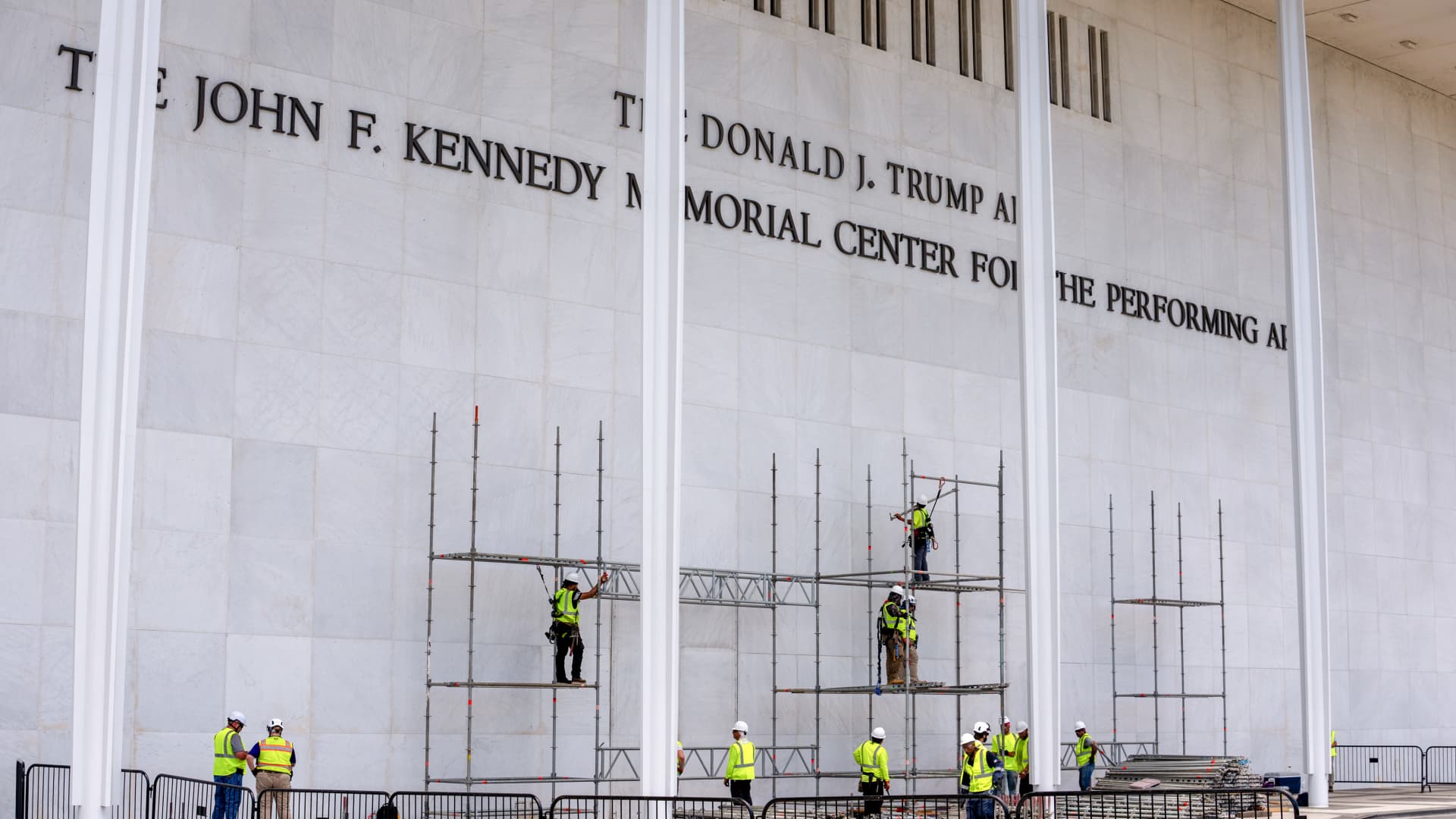
Workers assemble scaffolding at the Kennedy Center on Friday, June 12, 2026, in Washington, DC, USA.
Andrew Leidenbloomberg | Getty Images
President Donald Trump’s name must be lifted from the facade of the Kennedy Center in Washington by Friday night, after a federal appeals court rejected a last-minute motion to block a lower court judge’s order for its removal.
But a three-judge panel on the U.S. Court of Appeals for the District of Columbia Circuit left open the possibility that Trump’s name could be added back to the performing arts landmark if the Justice Department succeeds in appealing the lower court judge’s ruling.
Early Friday morning, Judge Christopher Cooper of the District Court of Washington, D.C., refused to put on hold a May 29 ruling that Trump’s name would no longer appear on the list by Friday night so that the appeals court could consider the case.
The Justice Department quickly asked an appeals court to uphold Cooper’s ruling even as workers were erecting scaffolding next to the facade in preparation for removing Trump’s name.
“It makes no sense to change the center’s name and signage now, only to potentially change the name back again after a successful appeal,” Assistant Attorney General Brett Shumate wrote in the Justice Department’s motion to halt it.
Hours after the suit was filed, the appeals board said it was “ordered to deny the motion for immediate administrative suspension.”
The panel included Judge Gregory Katsas, who President Trump appointed to the D.C. Circuit in 2017, as well as two judges appointed by former President Barack Obama, Patricia Millett and Robert Wilkins.
The committee did not explain the reasons for its decision, but it directed Rep. Joyce Beatty, D-Ohio, who sued Mr. Trump over the name change, to file a response by June 22 to the Justice Department’s emergency motion to suspend her appeal. The Justice Department was ordered to submit any response to Beatty by June 29.
“Defendants have not met the burden of establishing that the court’s permanent injunction on renaming the Kennedy Center is justified pending an appeal to the D.C. Circuit of the underlying judgment,” Cooper wrote in an order Friday denying the Justice Department’s request to suspend the ruling.
“Most notably, the detailed reasons set forth in the court’s decision do not make the defendants ‘strongly able to demonstrate that they are likely to prevail on the merits,'” the judge wrote.
Cooper also noted that the administration “appears to have taken significant steps to comply” with Trump’s name-removal orders, including removing the president’s name from the center’s official materials.
“Furthermore, issuing a stay pending appeal would not be in the public interest, and it is rarely accomplished by the ‘perpetuation’ of ‘unlawful’ government conduct.”
CNBC has reached out to the Department of Justice for comment.
The center was renamed the Trump Kennedy Center in December, 10 months after President Trump removed several directors from the board and appointed himself as director.
Beatty, an ex-officio Kennedy Center director, filed suit seeking to block the name change, prevent the center from closing for renovations, and to reverse the board’s removal of his voting rights in May 2025.
“The Kennedy Center’s name was given by Congress, and only Congress can change its name,” Cooper wrote in a May 29 ruling in favor of Beatty.
“The Kennedy Center’s statutes make clear that the center is named for President (John) Kennedy and cannot bear any other official name or public monument based on the board’s unilateral decision,” Cooper wrote.
“The court should deny defendants’ 11-hour request for a stay of appeal,” Beatty’s lawyers wrote in a filing Friday morning, asking that the judge’s order remain despite the government’s request.
“The court granted defendants ample 14 days to comply with its order or, in the alternative, to appeal to the D.C. Circuit,” the filing states.
“Defendants initially chose to follow the court’s instructions, refusing to appeal, and began restoring the Kennedy Center’s digital and physical footprint in accordance with the court’s instructions. However, on the eve of the deadline, defendants reversed course,” the filing states. “After filing their notice of appeal, almost at the last minute, they filed a complaint with the court seeking ‘exceptional relief’ pending appeal.”
“This ploy is frivolous and the court should deny the motion,” Beatty’s attorney wrote.
