

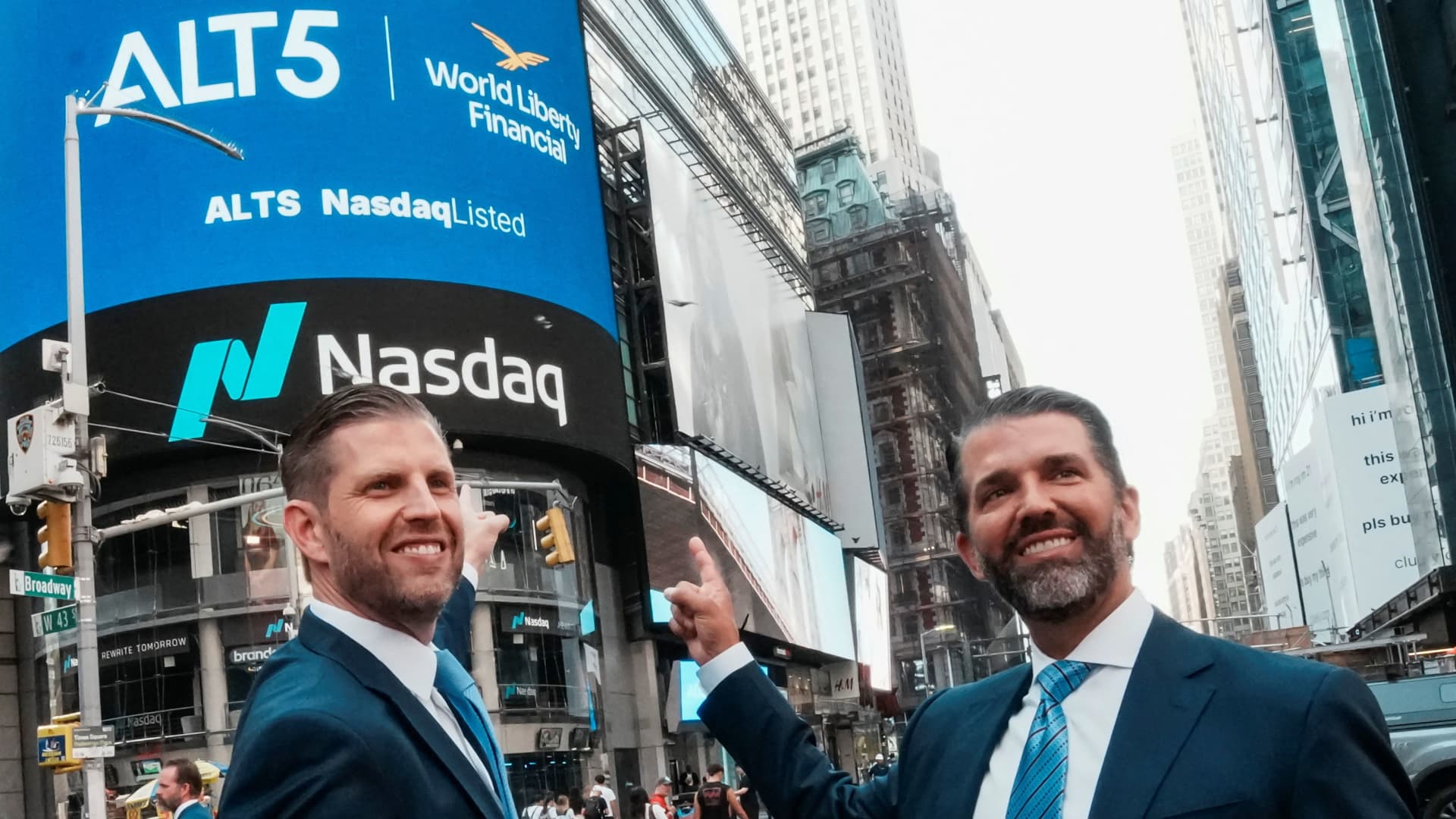
Eric Trump, left, and Donald Trump Jr. pose for pictures outside the Nasdaq MarketSite after ringing the opening bell to celebrate the closing of Alt5 Sigma’s adoption of its cryptocurrency deal with World Liberty Financial, in New York, Aug. 13, 2025.
Eduardo Munoz | Reuters
Back in August, Eric Trump and Donald Trump Jr. were all smiles. They showed up at the Nasdaq stock exchange in New York to celebrate a new business partnership with a little-known publicly traded company, then called Alt5 Sigma, to give investors easier access to a cryptocurrency backed by the Trump family.
Less than 10 months later, the company has warned investors it may not be able to stay in business much longer. Its share price has fallen more than 90%, and a rebranding hasn’t revived investor interest. If the company, now called AI Financial Corp., can’t sustainably raise its share price out of penny-stock levels in the next 15 trading days, it faces the prospect of being delisted by the Nasdaq.
One of the few parties who benefited from the Alt5 Sigma transaction is the Trump family. As part of the August deal, Alt5 acquired $1.5 billion worth of crypto tokens from World Liberty Financial, the crypto company co-founded by Eric Trump and Donald Trump Jr., among others, in 2024. The president and undisclosed members of his family were entitled to roughly $500 million in proceeds from the crypto sale, according to disclosures by World Liberty Financial.
Alt5 closed at $8.97 on Aug. 8, the last trading day before the World Liberty deal was announced. Since then, AI Financial‘s stock — originally trading under the ticker ALTS, now AIFC — fell to 66 cents a share at the June 8 close, a 93% loss, according to FactSet data.
Attorneys for Democracy Defenders Fund told the Securities and Exchange Commission in an April letter that the regulator needs to “commence an independent investigation into ALTS without delay.” The nonpartisan group has sharply criticized the Trump administration over allegations of ethics issues. They didn’t receive a response to their letter. “The question now is: What happened to all that money?” Virginia Canter, chief anti-corruption counsel for the group, said in an interview.
The SEC declined to comment on whether it has looked at AI Financial since its involvement with the Trumps.
AI Financial has become a cautionary tale for investors who saw a Trump-linked deal as a natural winner in a Trump presidency. The company is on its third CEO and third outside auditor since Eric Trump and Donald Trump Jr. celebrated the World Liberty partnership at the Nasdaq in August. In January, it turned to World Liberty for a loan, then used some of the proceeds to try to lift its own share price. The effort failed. What looked to some like a public-market entry point into the Trump family’s expanding business empire has instead left investors with steep losses.
Eric Trump in an X post in May said he has “zero leadership or decision-making role in the company.” He was nominated to a role on the company’s board, but World Liberty nixed the plan after a discussion with Nasdaq, Alt5 said in an SEC filing. The exchange requires a majority of board members of its listed companies to be independent. Eric Trump wouldn’t qualify as an independent director for Alt5 given the World Liberty deal, and another board seat was going to fellow World Liberty co-founder Zach Witkoff, son of President Donald Trump’s Middle East negotiator, Steven Witkoff.
Eric Trump threatened to sue MS NOW host Jen Psaki for allegedly damaging his reputation when she raised questions about his role in the company in a May television segment that discussed his potential conflicts of interest. MS NOW spokesman Richard Hudock declined to comment. MS NOW and CNBC are both owned by Versant Media Group.
“Neither Eric nor Don have any involvement in ALT5, nor have any visibility to the company,” Kimberly Benza, a spokeswoman for the Trump Organization, said in response to emailed questions about the brothers’ role in the company and the August transaction. “Neither have ever been on the board, know anything about the leadership team or have ever been involved in their operations.”
Some of the canniest investors in AI Financial may have been able to salvage their bottom line through quick sales. Many of them are anonymous. But among those who participated in the August deal are two major U.S. hedge funds. New York Mets owner Steven A. Cohen’s Point72 Asset Management bought in for $36.5 million and sold out at an undisclosed point before the end of the year. It could have made a profit or loss, depending on the precise timing. ExodusPoint Capital Management acquired $44 million worth of Alt5 stock and still held some as of the end of March at a paper loss of $14 million on those shares, though that may have been offset by earlier sales. Spokespeople for Point72 and ExodusPoint declined to comment.
Another fund, Hong Kong-based Soul Ventures Holdings, disclosed an $85 million stake in the August Alt5 transaction. By mid-October, it announced it had exited that position entirely. The SEC filings that detail these kinds of holdings give at best a fleeting, partial picture of the financial transactions involved. But if Soul Ventures sold its entire holding in mid-October on the open market, it would have lost approximately $56 million to $58 million.
Soul Ventures didn’t respond to requests for comment sent through a form on the company’s website.
“We have no interest in participating in stories built on unfounded accusations and speculation,” a spokesman for AI Financial Corp. said in response to emailed questions. “AiFi’s management team is laser-focused on building its business, serving its customers, and creating long-term value for shareholders.”
The White House brushed aside questions about the family’s involvement in AI Financial and the prospect of it going bankrupt, which could affect the president’s family’s wealth.
“President Trump’s assets are in a trust managed by his children. There are no conflicts of interest,” White House spokeswoman Anna Kelly said in response to questions for this story.
There is no evidence that anyone involved in Alt5 Sigma’s August stock sale, which ultimately benefited the Trump family, tried to exploit that relationship for their own benefit.
Alt5 Sigma followed a winding path through U.S. markets before it made contact with the Trump family. Originally a recycling company, it went through a phase as a biotech before settling in 2024 as a crypto exchange and payments business, according to securities filings. That decision became the basis for a supersized bet on crypto tokens issued by World Liberty Financial.
World Liberty was founded in 2024 as a private company by Eric, Donald Jr., and Barron Trump, sons of the president; Zach and Alex Witkoff, sons of Trump Middle East negotiator Steve Witkoff; and business partners Zak Folkman and Chase Herro, according to a company document. Disclosures on World Liberty’s website in early June show that “approximately 38% of the equity interests” in World Liberty’s parent company are owned by “an entity affiliated with Donald J. Trump and certain of his family members.”
World Liberty would go on to issue crypto assets in different assortments: A so-called governance token called WLFI, which would enable its owners to participate in some decision-making about the crypto network while the token rose and fell in value; and a stablecoin called USD1, an asset pegged to the U.S. dollar and backed by safe assets such as Treasurys.
Donald Trump Jr., left, and Eric Trump at the Nasdaq MarketSite before ringing the opening bell to celebrate the closing of Alt5 Sigma’s adoption of its cryptocurrency deal with World Liberty Financial, in New York, Aug. 13, 2025.
Eduardo Munoz | Reuters
World Liberty in August embarked on a deal with Alt5 that mirrored other deals in the crypto space. Alt5’s stock became a kind of financial wrapper for a cryptocurrency. These types of companies, called digital asset treasuries, typically buy and hold certain crypto assets. The best known is Michael Saylor’s company Strategy Inc., which holds bitcoin.
The idea is to broaden the base of potential investors in the underlying crypto holding. Investors who may find it difficult or inconvenient to directly hold crypto assets — or who simply prefer stocks — can buy the listed company’s stock easily through a platform such as Robinhood, rather than dealing with the complexities of directly owning crypto.
In Alt5’s case, the company became a wrapper for World Liberty’s WLFI tokens. In other words, investors could use Alt5’s stock to bet on a cryptocurrency issued by a privately held company co-founded by members of the Trump family.
Alt5 announced the World Liberty deal on Aug. 11. It had two parts. Alt5 traded shares and stock warrants in itself to World Liberty in exchange for $750 million worth of WLFI tokens, and Alt5 sold $750 million in stock to investors at $7.50 a share. The $750 million in proceeds, minus some fees, was given to World Liberty in exchange for WLFI tokens. All told, Alt5 received nearly 7.3 billion WLFI tokens, which it initially valued at about $1.5 billion. Zach Witkoff, World Liberty’s CEO, became chair of Alt5’s board.
The Trump family is entitled to 75% of the proceeds from World Liberty’s crypto token sales, according to disclosures made in a document World Liberty published in 2024 describing its token offering, and repeated in fine print at the bottom of its website. That would put the Trump family’s direct gains from the August Alt5 transaction at roughly $500 million after fees and other expenses.
The Trump family’s minority stake in World Liberty also gives it an indirect stake in the ongoing value of Alt5. World Liberty received 1 million shares in Alt5, as well as 99 million prefunded warrants and 20 million warrants in multiple tranches that could be exercised at prices ranging from $7.50 to $9.75 a share, according to SEC filings.
Zach Witkoff, co-founder and CEO of World Liberty Financial and chairman of Alt5 Sigma Corp., right, and Eric Trump at the Nasdaq MarketSite in New York, Aug. 13, 2025.
Adam Gray | Bloomberg | Getty Images
Before renaming itself AI Financial in April, Alt5 told investors in filings about several potential problems.
“Alt5 Sigma has all the indicators that normally raise significant concerns among regulators, which would typically result in inquiries from enforcement agencies,” said former New Jersey Attorney General Matthew Platkin. He is now in private legal practice and reviewed the Alt5 episode as part of a collaboration with Canter’s organization.
“There are serious red flags with this company that warrant investigation,” Platkin said.
Alt5 said in a filing after the August deal with World Liberty that in May 2025, a Rwandan court had found an employee of the company’s Canadian subsidiary guilty of offenses including money laundering, which it said was under appeal. In October, Alt5 said it had suspended its CEO; his acting successor was removed the next month and replaced by a third CEO, who remains in charge. Alt5 disclosed the leadership changes in SEC filings without providing further explanation.
In November, Alt5 told investors it had been warned of a potential delisting by Nasdaq because it hadn’t filed its quarterly report on time. It also said that month its outside auditor had resigned. It replaced that auditor, but in December said it had to move to a third auditor after discovering the second auditor’s license had expired. Alt5 eventually filed its report and said it had resolved that delisting warning.
Some of these issues, such as the court filing and auditor issue, should have been revealed to investors more swiftly, Canter said. “I started my ethics career at the SEC, and I think they would have started investigating this for just one or two of these failures to disclose,” Canter said.
Enforcement agencies don’t typically discuss matters that may be subject to investigation. The SEC in 2024 agreed to settle an earlier fraud allegation against AI Financial when it was named JanOne in the company’s biotech iteration. The company paid a $250,000 fine and didn’t admit guilt.
One potential wrinkle in the investigative process, Canter said, is the Trump family’s recent “anti-weaponization” settlement with the Internal Revenue Service. Under the settlement, acting Attorney General Todd Blanche issued an order releasing Trump from ongoing audits. The settlement’s language is vague and is written in a way that could be interpreted to apply to regulators’ potential investigations of companies related to the Trump family, such as AI Financial, Canter said.
The SEC also declined to comment on Canter’s assertion that the IRS settlement may apply to the agency.
The Department of Justice and the Internal Revenue Service didn’t respond to requests for comment.
Whether AI Financial can continue to do business remains to be seen. The company dropped a bombshell on investors on May 18. WLFI tokens had lost value, wiping $348 million off the listed company’s balance sheet in the first quarter. It had taken an operating loss, too. Its liabilities exceeded its assets.
“These conditions raise substantial doubt about the company’s ability to continue as a going concern within one year after the date these financial statements are issued,” AI Financial said in an SEC filing.
Attempts to right the ship appear not to be working. The company said in a press release in late January it had borrowed $15 million from World Liberty. It has used the funds to buy its own shares on the open market.
The low share price isn’t just painful for shareholders, it is a potentially existential issue for the company. Nasdaq requires its companies to trade above $1 a share. A company may face delisting if its shares trade below $1 for 30 consecutive days.
June 8 marked AI Financial’s 15th consecutive day of closing below $1. It traded below $1 for 24 days ending in mid-May before briefly rising above $1.
Nasdaq declined to comment.
There are still steps AI Financial can take, among them a so-called reverse share split, where the company could, for instance, halve the number of shares trading, which would effectively double their price. But it would still face the question of whether anyone will want to hold those shares.
The value of AI Financial’s star holding, its hoard of WLFI crypto tokens, has fallen sharply since Donald Jr. and Eric rang the Nasdaq opening bell in August. After fees and expenses, the $1.5 billion transaction netted 7.3 billion tokens, acquired at 20 cents each. As of June 8, their market value had fallen to about 5.7 cents, according to Coinbase, a 72% decline. That put AI Financial’s overall WLFI holdings at just $412 million. AI Financial’s market capitalization was down to just $89 million, according to FactSet, suggesting investors see that holding the stock is riskier than directly holding the underlying cryptocurrency.
World Liberty is embroiled in litigation with Justin Sun, a crypto investor who was a major early purchaser of WLFI tokens, over his allegations that World Liberty has quietly prevented him from selling his tokens. The two parties have filed suit against each other; litigation is at an early stage.
AI Financial couldn’t sell its way out of the hole either; its crypto holdings are still locked — which means they can’t be sold — under the agreements made in August, when the two Trump brothers celebrated Alt5’s pivot toward World Liberty’s cryptocurrency at the Nasdaq.
A delisting wouldn’t happen quickly, and AI Financial could take steps to halt the process. But the prospect of it undermines the premise of the Alt5-World Liberty deal. Investors who are keen to hold a piece of Trump-linked crypto assets can buy them directly without going through the hassle of holding a volatile stock worth less than the crypto it holds. With its stock price sliding and its time below $1 a share dragging on, AI Financial and its investors need a lifeline.
