

Over the past week, the conflict between the United States and Iran has gone from a state of smoldering retaliation to something more akin to all-out war.
US President Donald Trump last week threatened to escalate the war if Iran did not stop attacking ships passing through the Strait of Hormuz.
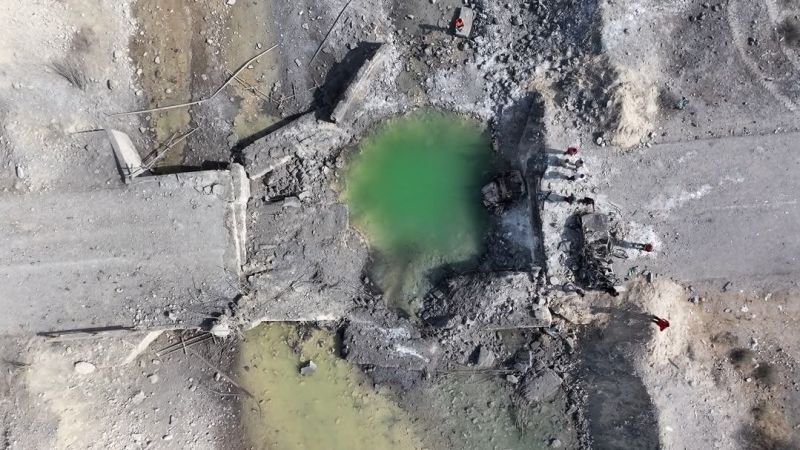
In recent days, the United States has expanded its targeting beyond Iranian coastal areas where radar and drone facilities are located, as well as roads, tunnels, railways, port infrastructure and, according to Iranian media, desalination plants.
Meanwhile, Iran has expanded its target list to seven countries in the region, with official media suggesting major ports in the Gulf Arab states may soon be added. Kuwait bore the brunt of the Iranian attack, which damaged its desalination facilities and oil refineries. Jordan also experiences regular barrage.
The conflict is at a tipping point. That could give way to yet another round of mediation and negotiations. But to most analysts, that seems unlikely. Neither side seems in the mood to talk. The companies said a memorandum of understanding (MoU) agreed in June after weeks of tortuous negotiations is no longer in force.
“The days ahead are among the most dangerous of the war,” said Ian Bremer, founder of geopolitical risk analysis firm Eurasia Group, after two U.S. service members were killed in a barrage of Iranian missiles in Jordan on Friday.
The United States, which announced the death of another service member in northern Iraq on Sunday, said it would “swiftly punish” the Tehran airstrike. And Iran targeted Jordan again on Sunday.
“It’s becoming increasingly clear that things are getting out of everyone’s control,” said Danny Sitrinowitz, an analyst at the Tel Aviv National Security Institute.
“While both Washington and Iran initially seemed interested in keeping the conflict within certain bounds, the conflict is now moving alarmingly close to the point where those limits could break down,” Citrinović told X.
He added that “the conflict could expand far beyond its current scope, drawing Gulf states more directly into the conflict and putting further strategic objectives and critical infrastructure at risk.”
An Iranian missile attack targeting Jordan’s Aqaba on Sunday was proof enough of that danger, with Israel announcing that debris had fallen on its territory. Israel has so far not been involved in the conflict at the request of the Trump administration, but it is no secret that the government is unhappy with the Iran deal. Israeli defense officials warned Sunday that Iran would respond strongly if it attacked Israel.

As military historians like to say, the enemy has the vote, and Iran appears confident in its ability to cause damage.
“Iran is adapting to the defense of the United States by launching high-velocity, maneuverable missiles at U.S. military bases in the region,” the Institute for the Study of War wrote on Saturday, adding that Iran is deploying cluster munitions on a large scale to maximize damage.
US military casualties in Jordan are evidence of that adaptation.
A sign of this is that the Iranian government believes it can outlast President Trump by mobilizing public support around Khamenei’s funeral. The collective leadership, which has emerged in the absence of new supreme leader Mojtaba, Khamenei’s son, appears to believe resistance is the only option for now.
“Iran’s current rulers believe that showing restraint will only invite further pressure from the United States,” Iran analyst Vali Nasr wrote in the Financial Times.
Although Iran’s economy is in dire straits with rampant inflation, chronic medical shortages and economic collapse, “Iran’s government will accept the inevitable economic hardship that another U.S. naval blockade will entail, believing that its pressure on the global economy by closing the Strait of Hormuz…will be the first to make President Trump blink,” Nasr added.

There is certainly no evidence for President Trump’s claim that Iran is desperate for a deal. And the issue of Iran’s nuclear program, which triggered the conflict, has become almost invisible as the focus has shifted to the dispute over the Strait of Hormuz.
Essentially, the rock encountered a difficult location: the entrance to the Persian Gulf.
The memorandum’s ambiguous language sought to conceal irreconcilable differences between the United States’ demands for freedom of navigation in and out of the Gulf, supported by much of the international community, and Iran’s insistence on maritime control.
Indeed, in his first message as supreme leader in March, Mojtaba Hammanei argued that the strait blockade was a strategic tool and that “the means of closing the Strait of Hormuz must continue to be used.”
For many analysts, the Memorandum of Misconceptions was a dead giveaway.
Nasr said control of the strait would give Iran “a sword of Damocles over the head of the global economy” and that Tehran considered it “essential” to get anything from Washington.
If the conflict continues to escalate, Iran could increase pressure on the global economy and Saudi Arabia by collaborating with its Houthi allies in Yemen to disrupt shipping in the Red Sea near Bab al-Mandeb, a key chokepoint such as Mark Two in Hormuz.
U.S. allies in the Gulf have previously interceded with Trump over the war effort and control of Hormuz. Most recently, a flurry of appeals from multiple governments, including Saudi Arabia, the United Arab Emirates, Bahrain and Qatar, deterred President Trump from implementing a plan to collect fees from ships passing through the strait.
There are broader concerns that the escalation of the conflict will further damage both countries’ economies, delaying any agreement on Hormuz and leaving Washington to fight an intractable enemy from beyond the Gulf once it decides enough is enough.
The question now is whether they will reach out again, individually or collectively, if Iran follows through on its threat to attack ports and other infrastructure across the Gulf. And whether such appeals will be heeded.
In response to the US attack on Iran’s Chabahar port, Iran may target a “network of major ports” in the Gulf state, the semi-official Fars news agency warned on Friday.
A decisive American military victory against Iran seems a distant prospect. It will likely require the commitment of ground forces and a far more intensive and large-scale offensive operation than has been evident over the past week. Anything less is unlikely to shake up the regime in Tehran, which is seen as a struggle for survival.
“I don’t want to do that,” President Trump said of a ground war in an interview with Fox News last week. But he added, “Sometimes ground operations are needed, and we have other people who can do ground operations.” CNN reported that President Trump is considering new options and that an attack on the strategic Kharg Island is being considered again.
“Launching a ground operation into southern Iran in the heat of the day, with a fully mobilized military and primarily a population rallying to the war effort, would be an extraordinary gamble that is virtually guaranteed to be a historic catastrophe,” said Sina Toosi of the Center for International Policy.
Such operations would be made even more difficult if allies such as Saudi Arabia would not tolerate their territory or airspace being used to attack Iran. Saudi Arabia’s Crown Prince Mohammed bin Salman told Iran’s president in January that Saudi Arabia would not allow its airspace or territory to be used to attack Iran.

Pakistan and Qatar, which brokered talks between the United States and Iran in Switzerland and Lucerne in June, have been very quiet in recent days. According to Iran’s semi-official Tasnim news agency, the last time a Qatari delegation visited Tehran was on July 10.
If the oil market panics and oil prices rise above $100 on the back of dwindling global reserves, mediation could come back into focus.
There is also an election element as the US midterm elections approach. Trump’s advisers argued that new restrictions on Hormuz would only drive up oil and gas prices and increase political pressure on Republicans, CNN reported.
Many analysts predict that neither full-scale war nor diplomatic lines will prevail in the coming weeks. Rather, a messy conflict beckons, alternating between bouts of strikes and periods of relative calm while mediators seek new avenues to restart negotiations.
A lot depends on the mood of the US president.
But one Gulf diplomat said: “Things are likely to get worse before they get better.”
