

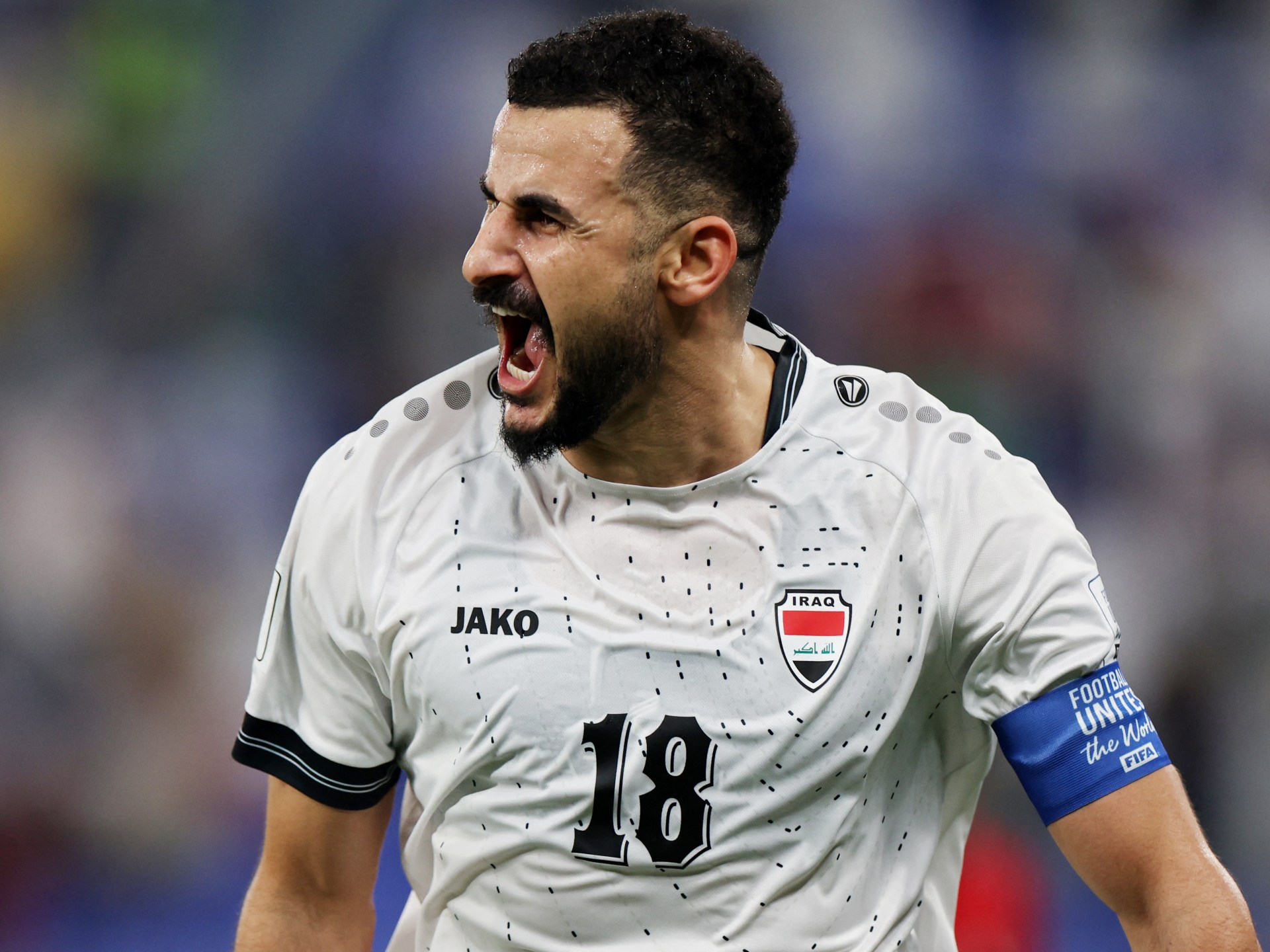
It’s been a long and tough journey to the World Cup for Iraq center forward Aymen Hussein. He scored the winning goal in Mexico’s qualifying match against Bolivia, leading his country to the tournament for the first time in 40 years.
When he was only 12 years old and already playing soccer for a local team, his father was brutally murdered while buying materials to build a house.
A few years later, his brother was kidnapped and his whereabouts have been unknown since then.
“I decided to quit soccer to take care of my family, but my mother refused,” Hussein said in an interview.
“She asked me to continue playing.”
His mother told him, “It’s your dream, I know it, and you have to achieve it.”
And he’s been living that dream ever since.

violent legacy
Mr. Hussein was born in 1996 in the village of Al-Sahra in Al-Khawija district in north-central Iraq and grew up in a family that made a living from farming and raising sheep.
Tragedy occurred in 2008 when her father, an Iraqi soldier, was killed by al-Qaeda, which at the time controlled Kirkuk and surrounding areas.
“He went to buy materials for a new house he was building. A few hours later, he received a call that your father had been murdered and his body was in the hospital.”
He had been fatally shot in the heart.
“At first I couldn’t believe it. But when I got to the hospital, my father’s body was lying there. It was devastating for all of us.”
Hussein begged his family to leave the village, but his brother, who joined the Iraqi army after their father was killed, refused.
So instead of fleeing, Hussein joined an Iraqi youth soccer team. It was only when he returned from a training camp in Tolkie several years later that he learned that his brother had disappeared. He was kidnapped at a time when ISIL (ISIS) was taking control of the area.
“We haven’t heard anything about him since then,” he says.

“I was ready to play for free.”
Amidst the tragedy, Hussein’s soccer career began to take off.
A turning point came in 2012 when he was scouted by Duhok Football Club, one of the teams in the Iraqi Stars League in the Kurdistan Region of Iraq.
Hussein signed a contract worth 18 million Iraqi dinars ($14,000) and a monthly salary of 1.2 million Iraqi dinars ($920).
“To be honest, I was ready to play for free,” he recalls. “At that time, you may not be able to imagine what it meant to me to play with the players of the Iraq national team. Playing with Duhok was the dream of my life at that time.”
After 18 months, he moved to Baghdad and played for teams in the Iraq Stars League such as Al-Shouta, Al-Taraba, and Al-Zawra, where he became the league’s top scorer. Most recently, he signed with Al Khor club in Qatar, before returning to Iraq to join Al Karma.
A contract reportedly worth $1 million makes him Iraq’s most expensive soccer player.
Through it all, Hussain says his father and brother were always at the forefront of his mind.
“I always wished my father and brother were still alive so they could see what I’ve accomplished and share those moments of happiness.”
He recalls some of his proudest moments he wishes he had shared.
In 2016, in the third-place deciding match of the AFC U-23 Asian Cup Championship held in Doha, they defeated Qatar in extra time at the Rio de Janeiro Games, becoming the last Asian nation to qualify for the Olympics, and scoring the second goal in extra time.
In 2023, Aymen was named the top scorer in the 25th Arabian Gulf Cup. He scored three goals and led the team to the cup victory.
In 2024, Hussein scored one of the two goals in a 2–1 victory over Indonesia in the third-place match, helping Iraq qualify for the Paris Olympics.

lion roars
The last time the Mesopotamian Lions (known as the Iraqi national team) qualified for the World Cup was in 1986, 10 years before Hussein was born.
Now, all eyes are on him as fans look forward to his participation to lead the team as far as possible in the tournament.
“Aymen is a self-explanatory name. His performances speak volumes about him, not only in Iraq but in the region and in Arab football,” Iraq goalkeeper and vice-captain Jalal Hassan told Al Jazeera.
“He is a quality striker. The team absolutely needs him and his presence will make a difference at the World Cup. We expect a lot from him.”
Iraq is placed in Group 9 along with France, Senegal, and Norway, and will face stiff competition from the off-season.
Former Iraq captain Hussein Saeed, the country’s top scorer with 78 goals, is hopeful. “It’s clear that Aymen’s influence is on the team and all the players. As a person, he has a nice and humble personality,” Saeed told Al Jazeera.
“We hope he can use this positive trait to benefit the team in the next World Cup and lead the team into the post-group stage.”
Iraqi soccer journalist Zaid al-Sarraj said: “We all hope that the team and all the players, especially Abu Toubal (the ‘hatchet man’ as Iraqis affectionately refer to Hussein), will be fully ready mentally, physically and technically when the time comes.”
For his part, Hussain said he just hopes some of his fans will be able to attend, but it will be difficult.
“It is not easy to get a US visa. In fact, it is almost impossible for Iraqis, especially at the moment because the war between the US and Iran is still going on,” Saif al-Bayati, an Iraqi soccer fan, told Al Jazeera.
“That’s not the only problem. A ticket costs more than $3,000. It’s a huge expense to go there and spend at least two weeks there, potentially more than $15,000. This is beyond the capabilities of the average Iraq fan.”
