

In the spring of 1990, Cuban President Fidel Castro was grappling with the possibility of conflict with the United States without a promise of Russian aid for the first time. Cornered, Mr. Castro reportedly declared that he would rather Cuba become a second Numancia than be conquered.
He was referring to the ancient Roman siege of the Spanish city of Numancia in 133 BC. However, most of the city’s residents refused to surrender to the attackers, choosing instead to take their own lives within the city walls.
Cuban policy expert Frank Mora told CNN that “La Numancia” became a motif in Castro’s defiant speeches late in his presidency. Cuban policy expert Frank Mora said “La Numancia” was used as Cuba’s once-powerful and Russian-backed military aged and subsidies dried up with the collapse of the Soviet Union.
Now that Cuba faces a new threat from the United States, Mora said, the country’s leadership is following a similar scenario to the late Castro’s, making it clear that the country is prepared to be put on the back foot, even if it lacks the capacity.
Hundreds of videos and images released online by Cuba’s military and government in recent months show the country’s declining fighting strength, as the Trump administration escalates its pressure campaign against Cuba.
The video intentionally showcases aging hardware, Mora said, as it is designed to project defiance rather than strength. Regardless of how the Cuban military opposes the larger and more technologically advanced U.S. military, they are intended to “demonstrate the resistance” of the Cuban people, he explained.
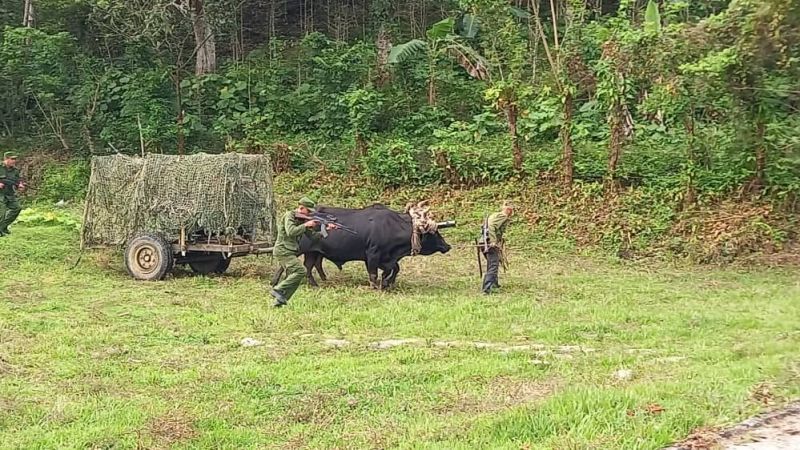
An image from April shows an old Soviet-made ZU-23 anti-aircraft system being towed by a cow. Local reports said the system was being used as part of local military training.
Other footage shows everything from antique military trucks to more advanced Russian anti-aircraft systems to elite special forces ziplining near the beach.
Cuban officials have said they do not intend to threaten the United States at Guantanamo Naval Base or elsewhere, but would defend themselves if attacked. In April, Cuban President Miguel Díaz-Canel told Newsweek that in the event of a military invasion, “to die for your country is to live, even if you fall into combat.”

At its peak in the early 1990s, Cuba’s military had grown to more than 235,000 active duty soldiers and many more in reserve, making it what analysts hailed as “a First World army in a Third World country.” This force was reinforced with advanced Soviet weaponry that could compete with American weapons.


Experts say the military strength has been halved in recent years after the loss of Soviet support, leaving only 50,000 active troops at most. This reduced force continues to train on decades-old Soviet equipment, much of which was given as foreign aid before the collapse of the Soviet Union in 1991.
The island still preserves some serious hardware, albeit dilapidated, and has become a staple of videos published by Cuba’s Revolutionary Military Ministry, such as the one posted on Facebook in January. In it, soldiers pilot a modified Soviet-era BM-21 Grad multiple rocket system that helps them carry out agile attacks and defend against enemies.
When the mobile launcher shuts down, soldiers in army green uniforms run around the truck. Although the tube itself does not appear to be loaded, the soldiers carefully adjust the angle of the tube, gesturing to each other with colored flags.
As the truck drives away, the front of the truck bears the “Ural” branding, a recent Russian upgrade to a weapons system designed in the early days of the Cold War.
In another video, one of these rigs launches a payload of self-propelled rockets in slow motion to dramatic orchestral music.
The clip, like many others reviewed by CNN, was punctuated by nostalgic archival footage of Cuban military training from decades ago.
“There is no question that over the past 35 years, this First World military has now become, at best, a vestige of its previous versions,” Mora explained.
Faced with economic turmoil and without access to Soviet subsidies, updated equipment, and spare parts, Cuba’s military strength deteriorated from the early 1990s to the 2000s. It was around this time that Cuban military planners adopted a “hedgehog strategy” aimed at “making conquest difficult,” explained retired U.S. Marine Colonel Mark Cancian.
As part of this change, Cuban generals are choosing to train their soldiers in guerrilla tactics rather than conventional warfare. This is clear in the footage, and is a strategic departure backed up by Mr. Cancian.
Recent footage shared by the Cuban Revolutionary Army shows soldiers training in guerrilla tactics. They mount and dismount motorcycles and brandish rocket-propelled grenade launchers, wooden-handled PK machine guns, and AK-style rifles.
Some of them wear face paint, camouflage uniforms and ghillie suits as they venture in and out of trenches dug into the ground. Other videos show armored personnel carriers emerging from man-made jungle shelters and amphibious soldiers training to storm beaches.
These tactics could make it even more difficult for Cuban forces to subdue them. Even if it’s a much more powerful enemy, Cancian said.
Other videos showing Cuba’s dilapidated military drills are difficult to explain. For example, special forces rappell en masse from a sheet metal tower at Playa Baracoa, a military base outside Havana. Soldiers fired their rifles almost indiscriminately and at times ziplined just a few hundred feet from passing taxis and motorcycles.
In another, a lone combatant shows off his martial arts skills while training as part of the Black Wasps, Cuba’s elite equivalent to the U.S. Navy SEALs and Delta Force. He practices alone on an asphalt courtyard with a pattern reminiscent of a four-square court.
The caption reads, “We are ready to defend our homeland.”
There are fewer planes and gasoline is being rationed.
The Cuban Air Force has also declined compared to its Cold War-era might, and its remaining assets are rarely displayed to the public, with the exception of the occasional Soviet-designed Mi-17 helicopter, seen primarily in low-risk training missions and in support of humanitarian relief operations.
Decades ago, the Air Force operated a handful of MiG fighter jets, but experts say nearly all of them are now likely disabled. And, as Mora pointed out, it’s difficult to fly Russia’s fourth-generation fighter jets without gas.
Last month, Axios reported that Cuba had acquired more than 300 military drones. Details regarding the type and capabilities of these aircraft remain unknown, but they may form part of the island’s sole air capability.
Cuban officials vehemently denied the report.
But even if drones existed, they would only provide a “one-off pulse of attack power,” leaving the Cuban regime with few options to respond later, Cancian said.
No images of these purported drones have surfaced, and only a small number of videos have surfaced in recent months that appear to show the Cuban military training with small civilian drones.
With few options to fend off a potential U.S. attack, Cuban officials have no choice but to project power, publicly reject the U.S. government’s vision for a new Cuba, and hope that the Trump administration’s attention will shift elsewhere.
CNN’s Patrick Oppmann contributed to this report.
