


Iran responded to a new U.S. attack over the weekend by launching attacks on U.S. military bases in the Gulf, deepening the standoff over the strategic Strait of Hormuz.
The exchange casts further doubt on the future of the interim peace agreement signed last month. The agreement was intended to reopen the Strait of Hormuz and pave the way for 60 days of negotiations to end the war.
Iranian airstrikes targeted U.S. military bases in Kuwait, Bahrain, Jordan, Oman and Qatar and were said to be retaliation for new U.S. bombings, Iranian state media said.
Sirens sounded for the third time in Bahrain on Monday, Reuters reported, citing the interior ministry. The Islamic Revolutionary Guards Corps (IRGC) said it targeted US military facilities in Bahrain and radar systems in Oman as part of its latest retaliatory strikes.
U.S. Central Command announced Sunday that U.S. forces successfully struck dozens of targets in multiple locations to reduce Iran’s ability to continue attacking ships passing through the Strait of Hormuz.
Centcom said in a post on
The United States and Iran have also issued conflicting statements about whether shipping in the Strait of Hormuz remains open.
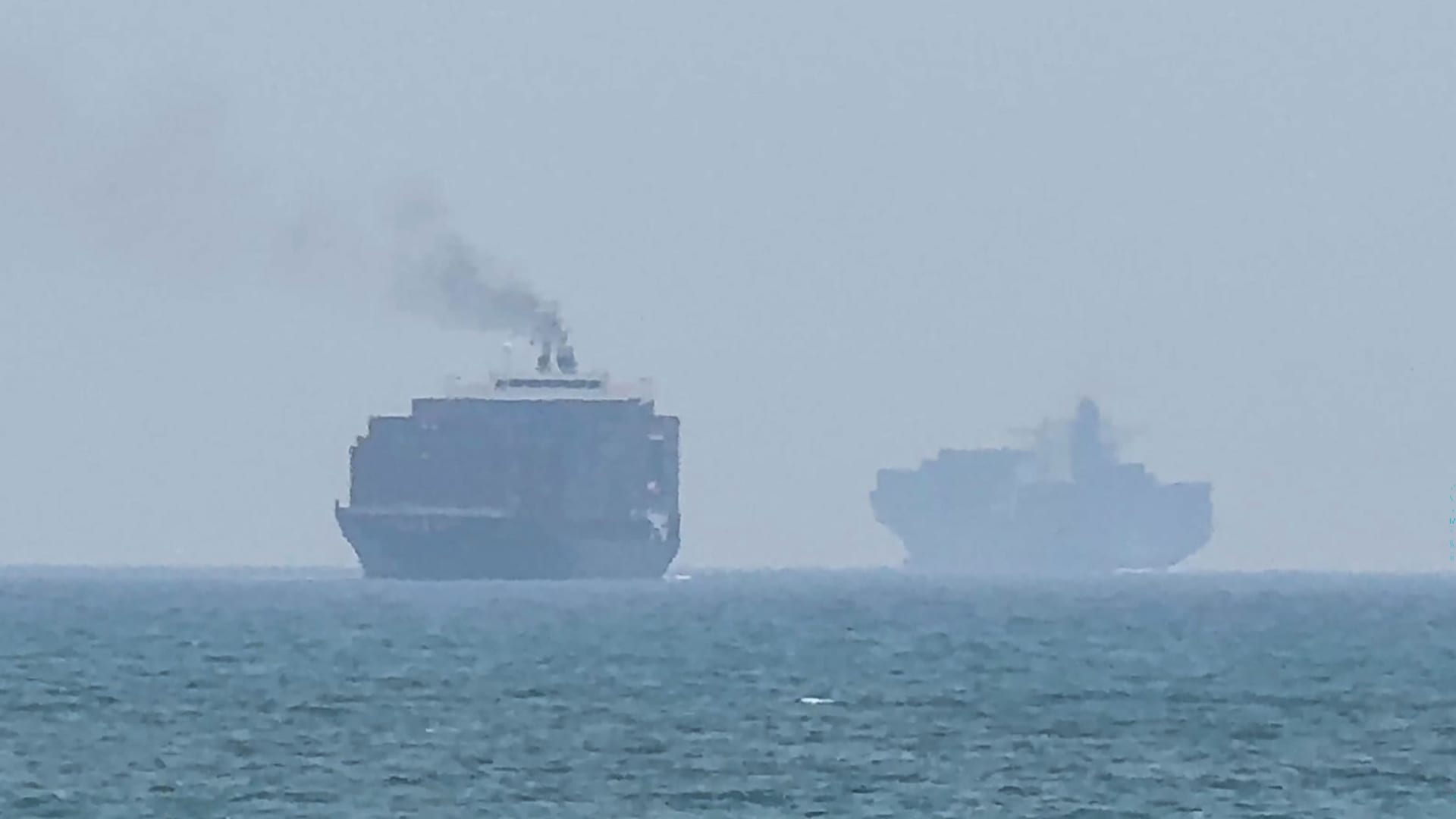
This frame taken from AFPTV video footage on July 12, 2026, shows a cargo ship anchored in Khor Fakkan, near the Strait of Hormuz, off the east coast of the United Arab Emirates.
– | AFP | Getty Images
The Strait of Hormuz, located in the Gulf between Oman and Iran, is recognized as one of the world’s most important energy chokepoints. This narrow waterway typically handles about 20% of the world’s oil shipments.
Oil prices soared Monday morning as a recent series of attacks and counterattacks renewed concerns that flows through the Strait of Hormuz could be further disrupted.
International benchmark Brent crude oil futures for September delivery rose 2.8% to trade at $78.14 per barrel, matching gains from early trading. Meanwhile, US West Texas Intermediate futures (for delivery in August) rose 2.5% to $73.24.
“The era of unilateral deals is over. We said, keep your promise or pay the price. Reality is knocking,” Iranian Parliament Speaker Mohammad Berger Ghalibaf said in a social media post on Sunday.
Ghalibaf’s comments were posted alongside an image of Article 5 of the Memorandum of Understanding between the United States and Iran related to the reopening of the Strait of Hormuz.
US President Donald Trump said on Friday that the US and Iran had agreed to continue peace talks, but said the ceasefire established in last month’s peace deal had been broken.
Iran accuses US of putting pressure on Oman
Iran’s Foreign Ministry on Monday condemned the US attacks over the past 24 hours, saying the bombings posed a “serious threat to international peace and security” and “made all efforts in the past months to reduce tensions and establish peace in the West Asian region go to waste.”
Iran also accused the US of exerting “overt and covert pressure” on Oman, thereby impeding the outcome of recent bilateral talks in Muscat to establish arrangements for control of the Strait of Hormuz and traffic routes.
A White House press secretary was contacted by CNBC on Monday morning, but did not immediately respond for comment.
Oman, which is located on the southeast coast of the Arabian Peninsula and across the strait from Iran, is holding joint talks with Iran on a new maritime security order amid reports that the two countries may push for a transit fee.
Analysts told CNBC that Oman’s ability to impose service fees is within strict legal limits, given that the strait is subject to the transit passage principle, which does not allow states to charge ships for passage. However, service fees may be one way around this.
—CNBC’s Emma Graham contributed to this report.
