

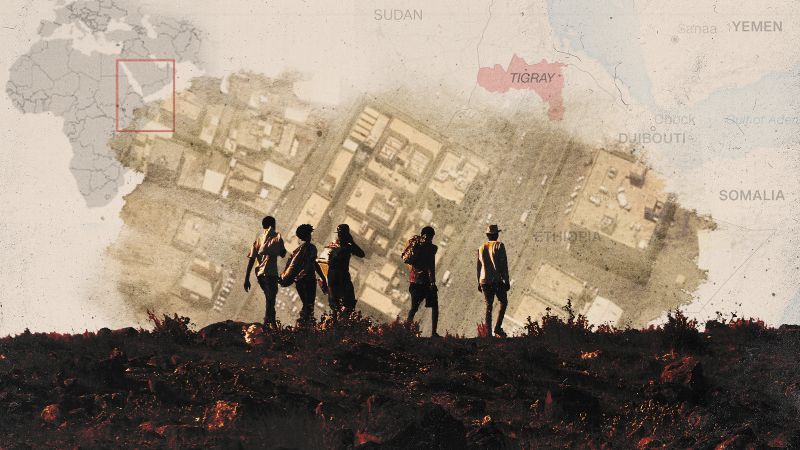
Amanuel wakes up every day not knowing if it will be his last. A knock on the cell door could mean time is up. No goodbye phone call, no last meal. Executions in Saudi Arabia often occur without prior notice.
“I’m walking like a dead man,” he says. “Since my friends were executed, I haven’t eaten food or drank water.”
Amanuel is the pen name of a young prisoner who has been imprisoned for several years. CNN obtained his testimony from inside Khamis Mushait prison in southwestern Saudi Arabia. CNN is not naming him for its own protection.
Human rights groups say he is one of about 60 Ethiopians sentenced to death on drug-related charges in Khamis Mushait alone, with many more being held in other cells at the prison.
“These are not isolated cases,” said Maya Foa, chief executive of human rights group Repriv. “There is a clear pattern of Saudi authorities targeting vulnerable migrants. In many cases, their real ‘crime’ appears to be crossing the border in search of a better life.”
CNN also spoke with relatives of three other men on death row in Saudi Arabia on similar charges. All said they learned of the arrests only weeks after the verdict, not from Ethiopian or Saudi officials, but through word of mouth or community contacts.
“What I am praying for, and what I am asking the world to do, is to put active pressure on the Saudi government to reconsider this decision,” said Salem, the brother of one of the men, using a pseudonym to protect his family. “Saudi government, please have mercy on my brother and others in a similar situation.”
A total of 356 people were executed in Saudi Arabia last year, the highest number in recent history, according to Saudi records compiled by NGOs. Of these, 240 people were convicted of drug crimes, most of them foreigners. Two years earlier, in 2023, the same observer recorded two similar executions during the year. The number of people executed this year for non-lethal drug offenses has reached 71, with the highest number of foreigners being Ethiopians.
Taha al-Hajj, an expatriate Saudi lawyer and legal director of the European Saudi Human Rights Organization, outlined serious concerns about due process in the kingdom.
“Saudi Arabia’s capital tribunals routinely fail to meet even minimal guarantees of fairness,” he said. “Defendants are denied legal representation and proper interpretation, resulting in migrants being convicted and sentenced to death, often on the basis of ‘confessions’ under torture, without understanding the process.
“This is not justice. This is state violence inflicted on defenseless people.”
CNN reported in November that a similar case occurred in Saudi Arabia’s Tabuk prison, where an Egyptian fisherman was sentenced to death after being detained on drug smuggling charges.
Human rights activists say there are many stories like Amanuel’s in Khamis Mushait, where he is being held.
Amanuel said he fled Ethiopia’s Tigray region during the civil war and pandemic and was stranded in Yemen for two years before eventually entering Saudi Arabia. There, he worked as a shepherd for three months.
When that was over, his Saudi employer offered him another job, moving things around, but Amanuel said he didn’t think much of it. “It was the Saudis who offered me the job. I trusted them.”
He told CNN that he was arrested several years ago after police found hashish in his car during a delivery.
“I thought we were just carrying regular stuff,” he said.
What came next was a beating with an electrical cord and kicks to the body. A document written in a language he could not read was placed in front of him for him to sign. He said neither a lawyer nor anyone from the Ethiopian embassy in Riyadh came.
Of his three court hearings, only the last had an interpreter and was a short session during which the judge read out the verdict. There was no appeal, he was told. Amanuel was sentenced to death.

Amanuel, a Christian, was once beaten for it and no longer wears a cross for fear of persecution. “He tied my hands behind my back, beat me, and left me in the sun for three hours.” He said he could no longer practice his faith at all.
He says four of his cellmates tried to take their own lives. Each time, other people in the cell intervened to save them.
Saudi Arabia has not yet responded to CNN’s request for comment about the number of foreign prisoners held in its prisons on drug-related charges, the conditions in which they are detained, their access to legal representation, and the number of people executed.
Two weeks ago, five of Amanuel’s cellmates were executed. “First I called two names, then five more. Then the first two came back. I didn’t call the other five,” Amanuel said.
Saudi authorities said in an official statement that the individuals “undertook to jointly smuggle hashish into the Kingdom…After investigation, charges were brought against them for committing a crime. They were referred to the competent court…The verdict became final after an appeal and subsequent affirmation by the Supreme Court.” The statement added: “The Kingdom of Saudi Arabia is committed to protecting the safety of its citizens and residents from the scourge of drugs and to imposing the harshest penalties provided by law on those who smuggle and promote drugs.”
“(After the execution), the guard walked across the block and spoke to the Saudi prisoner, and he put his finger on his neck and signed what had happened. We had to inform our families ourselves,” Amanuel told CNN.
However, he has not told his mother or father that he is on death row. “I don’t want the news to be what kills them.” Only distant relatives, he says, have any understanding of the gravity of his situation, and all he asks of them is “please pray for me.”
Amanuel’s story follows the path taken by hundreds of thousands of immigrants each year. Most are Ethiopians seeking work in Saudi Arabia after leaving the Horn of Africa, one of the world’s poorest regions hit by drought and armed conflict. The bilateral collective bargaining agreement, a formal agreement governing how Ethiopians can legally work in the kingdom, has opened legal routes for immigration, but many continue to cross irregularly.
“This is the continent’s largest migration route in absolute terms,” said Ira Bonfiglio, director of the Mixed Migration Center for Eastern and Southern Africa (MMC). “We estimate that more than 100,000 Ethiopian migrants cross into Saudi Arabia each year, but this is likely an underestimate as most of our data are captured in Yemen.”

The United Nations’ International Organization for Migration (IOM) has described the same corridor through Djibouti and crossing the Bab el-Mandeb Strait or the Gulf of Aden by boat to Yemen as one of the world’s busiest and most dangerous migration routes.
Traveling involves danger. “Those who have the resources to get through Djibouti pay smugglers to travel by car or truck at night,” Bonfiglio said. “Those without have sometimes have to walk 200 to 250 kilometers (124 to 155 miles) in extreme heat, hoping that their families will send them money before they reach the smugglers in Obock.”
For many, surviving the journey is just the beginning of the ordeal.
Families CNN spoke to in Tigray said their relatives were held for ransom by an unknown group while traveling in Yemen. The kidnappers forced them to borrow money to secure their release.
“He was locked up and we borrowed money to free him. He has not yet paid back the family,” one of his relatives said.
It’s a debt many migrants never escape, said Surafel Getahun, who studies irregular migration from Ethiopia. He explained that migrants are often pressured or forced to bring hashish, a plant-based stimulant, or khat into Saudi Arabia to retaliate against smugglers. Although khat is legal in much of East Africa, it is banned in the kingdom, a distinction that smugglers exploit.
“Migrants do not know that khat is prohibited in Saudi Arabia,” Getahun said, adding that “smugglers are taking advantage of this and forcing them to transport it without explaining the serious risks.” Some people are then caught and arrested.

Against this backdrop, Gilmathieu Aduguna, an expert on migrants from Ethiopia and the Horn of Africa, questions the use of the death penalty for non-violent drug crimes. He said Ethiopian migrants are particularly vulnerable because their right to a fair trial can be undermined by language barriers, limited access to legal aid, and allegations of being forced to bring in drugs by traffickers.
He said direct negotiations between Ethiopia and Saudi Arabia could help ensure that Ethiopian migrants receive fair trials and legal protection.
The two countries have previously cooperated on immigration. Bonfiglio said Saudi Arabia and Ethiopia carried out large-scale repatriations between 2017 and 2022, during which approximately 500,000 Ethiopians were deported.
In 2022, the two governments agreed to repatriate more than 100,000 Ethiopians living in Saudi Arabia without legal status, many of whom were being held in detention centers that human rights groups say are overcrowded and abusive. At the time, the IOM estimated that there were 750,000 Ethiopians in Saudi Arabia, about 450,000 of whom were in the country illegally.
For some in Saudi Arabia’s prisons, signs of Ethiopia’s intervention bring hope and, in some cases, could mean the difference between life and death.
Amanuel said Ethiopia’s diplomatic representatives visited the prison last month and promised to review his case. Despite this, the Ethiopian government has not publicly challenged Saudi Arabia over Ethiopians being held in prison on drug charges.
Ethiopia’s Ministry of Foreign Affairs declined to comment to CNN on individual cases, citing the sensitivity of ongoing legal proceedings. In a written statement, the government said it maintains “regular communication and constructive engagement” with Saudi authorities and listed 1,971 Ethiopians who “benefited from royal pardons,” but did not say whether they included a man sentenced to death for drug offenses.
Saudi authorities have not yet responded to CNN’s request for comment.
For now, Amanuel says all he can do is wait for the knock that will come without warning.
“I don’t know exactly when that will happen. It could be tomorrow,” he said. “Every time they knock, I feel like it might be my turn next.”
