


As Elon Musk prepares to lead his second trillion-dollar company into the public markets, a move that will likely put him in charge of two of the 10 most valuable companies in the United States, rumors are circulating that Musk’s ultimate goal is to combine both companies into one.
SpaceX is expected to start trading on the Nasdaq just over two weeks after merging with Musk’s artificial intelligence company xAI earlier this year, giving it a private market valuation of $1.25 trillion. Tesla’s Its market capitalization currently stands at approximately $1.6 trillion.
The two companies already have a long list of shared resources, and Mr. Musk has discussed the possibility of merging the two companies with colleagues, said people familiar with the talks who asked not to be identified due to the sensitivity of the topic.
A current Tesla employee told CNBC that many at the electric car company have long expected such a deal to eventually take place, and the topic has been openly discussed within the company. Another person close to the company said common challenges related to power and computing constraints led to regular collaboration.

While companies that launch rockets under government contracts and EV makers may not seem to have much in common, both companies are increasingly focused on AI and the human and computing resources needed to build AI infrastructure and services. More than three-quarters of SpaceX’s $10.1 billion in capital spending in the first quarter was related to AI, and Tesla said in its latest earnings report that capital spending will nearly triple to $25 billion this year.
“Tesla needs to run powerful AI systems inside moving vehicles, with tight limits on power, cooling, latency, reliability, and cost,” said Tomáš Tungs, a former engineer and current venture capitalist at Theory Ventures. “SpaceX needs to think about computing in orbit, where radiation, thermal cycling, launch mass, power generation, and waste heat are all existential design constraints.”
Tungs said the potential merger has attracted the attention of Silicon Valley technology enthusiasts, but acknowledged that a deal of this size would be “complicated.”
Representatives for SpaceX and Tesla did not respond to requests for comment.
Mr. Musk, the world’s richest man, is scheduled to begin a SpaceX roadshow next week as he tries to sell Wall Street on the promise of the 24-year-old company, already a large conglomerate. The company consists of xAI, which includes a reusable rocket business, the Starlink internet satellite service, and the social media site X, formerly known as Twitter. SpaceX also agreed to acquire AI coding startup Cursor for $60 billion.
“I think that was proven by Elon himself,” said Tejpor Bhatia, a longtime SpaceX investor and CEO of Nevex, a startup building the financial infrastructure for space-related deals. “Parallel entrepreneurship seems to suit him.”
considerable overlap
Tesla and SpaceX have spent years pooling resources and sharing personnel.
Musk is a member of both boards, as is venture capitalist Ira Ehrenpreis, founder of DBL Partners. Musk’s older brother, Kimbal, currently sits on the board of Tesla and was previously a director of SpaceX. SpaceX board members Antonio Gracias and Steve Jurvetson previously served on Tesla’s board. and Charles Kuehmann, vice president of materials engineering at Tesla and SpaceX. apple Ten years ago, he was known for playing a key role in troubleshooting critical design issues.
Tesla announced in January that it had invested $2 billion in xAI. These shares became SpaceX’s holdings following SpaceX’s merger with xAI the following month.
SpaceX said in its prospectus that it has purchased Tesla’s MegaPack battery energy storage system worth $697 million in 2024 and 2025 to power data centers owned and operated by xAI in the area around its Colossus facility in Memphis, Tennessee. SpaceX also said it spent $131 million on Tesla’s Cybertruck in 2025, purchasing it at the manufacturer’s suggested retail price.
Previous deals between the two companies have included Tesla selling solar equipment and auto parts to SpaceX, Tesla using SpaceX’s private jets, and Tesla relying on SpaceX to develop a special alloy for the Cybertruck.
Suppliers sometimes view Mr. Musk’s companies as one big customer. In 2024, Nvidia agreed to divert a $500 million order for GPUs from Tesla to xAI at Musk’s request.
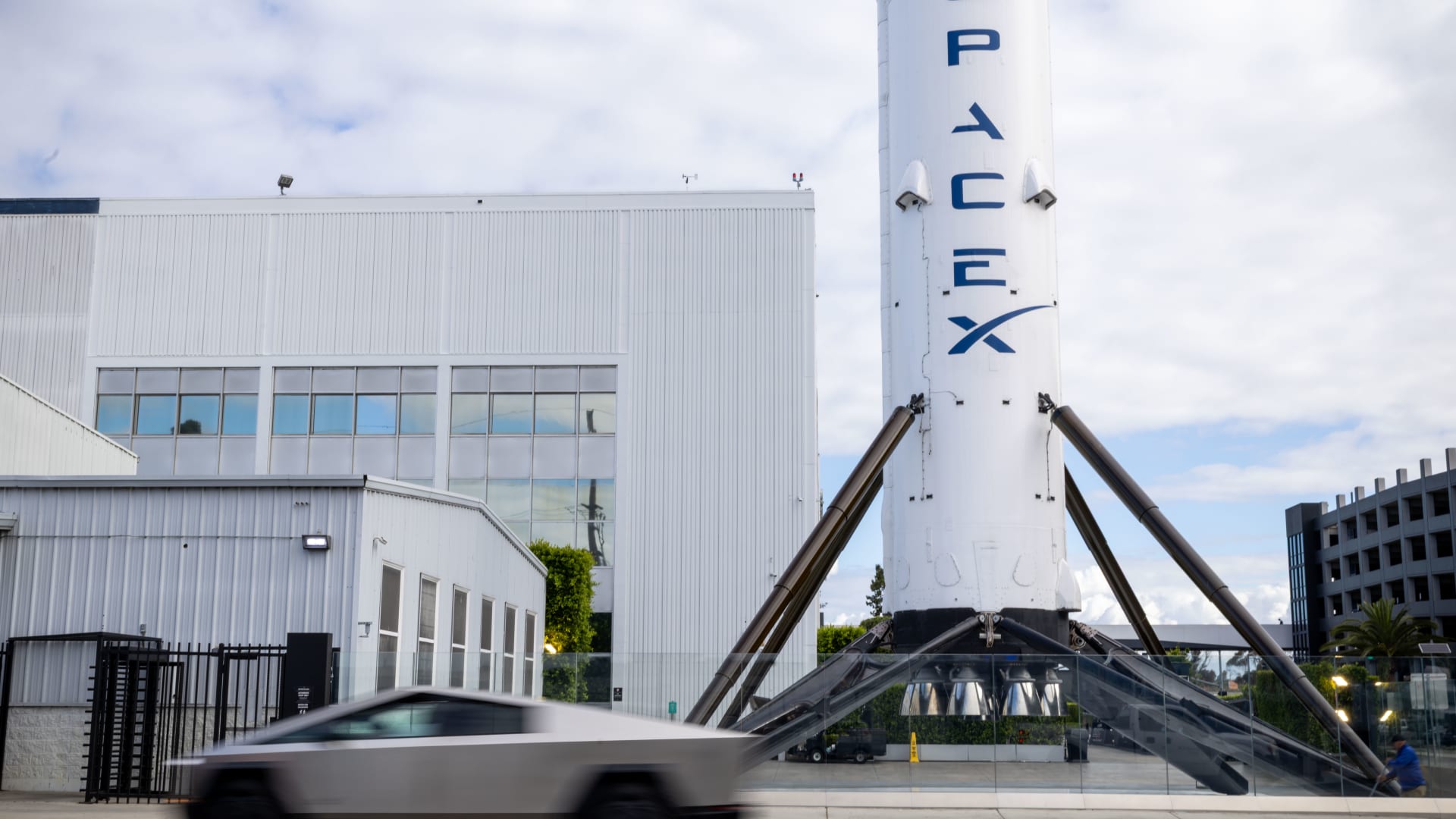
A Tesla Cybertruck drives in front of the SpaceX facility in Hawthorne, California, U.S. on Monday, April 13, 2026.
Ethan Swope | Bloomberg | Getty Images
Legal experts said a SpaceX-Tesla merger is unlikely to raise antitrust issues, but could raise concerns among shareholders of both companies. Among the thorny issues are which company will become the parent company, how the share exchange will take place, and who will decide the appropriate price.
One thing that’s almost certain is that Musk won’t have to worry about any backlash from the SpaceX board, given that the CEO has 85% voting power. SpaceX states in the risk factors section of its prospectus that it is a “managed company.” This allows for exceptions to governance rules, meaning Class A shareholders “do not enjoy the same protections afforded to shareholders of companies that comply with all of Nasdaq’s corporate governance requirements.”
Musk may be the biggest beneficiary of the SpaceX-Tesla partnership.
SpaceX is tying Musk’s pay to two milestones: reaching a market capitalization of $7.5 trillion and colonizing Mars, home to at least 1 million people. Meanwhile, Tesla shareholders late last year approved a compensation plan comprised of 12 tranches, with each dividend tied to market capitalization growth and operating performance.
Ross Gerber, CEO of investment firm Gerber Kawasaki, previously told CNBC that a SpaceX-Tesla merger would allow Musk to fulfill his dream of running one large company, making it easier for Musk to raise and borrow the capital he needs to compete with competitors in the AI field. google.
Bhatia said the merger is about recognizing future opportunities in SpaceX’s core markets.
“We believe the space market is huge right now,” Bhatia said. “And it’s going to get even bigger after SpaceX’s IPO.”
Correction: An earlier version of this article incorrectly identified Kimbal Musk’s current board seat.
WATCH: Bet on Musk’s space ambitions

