

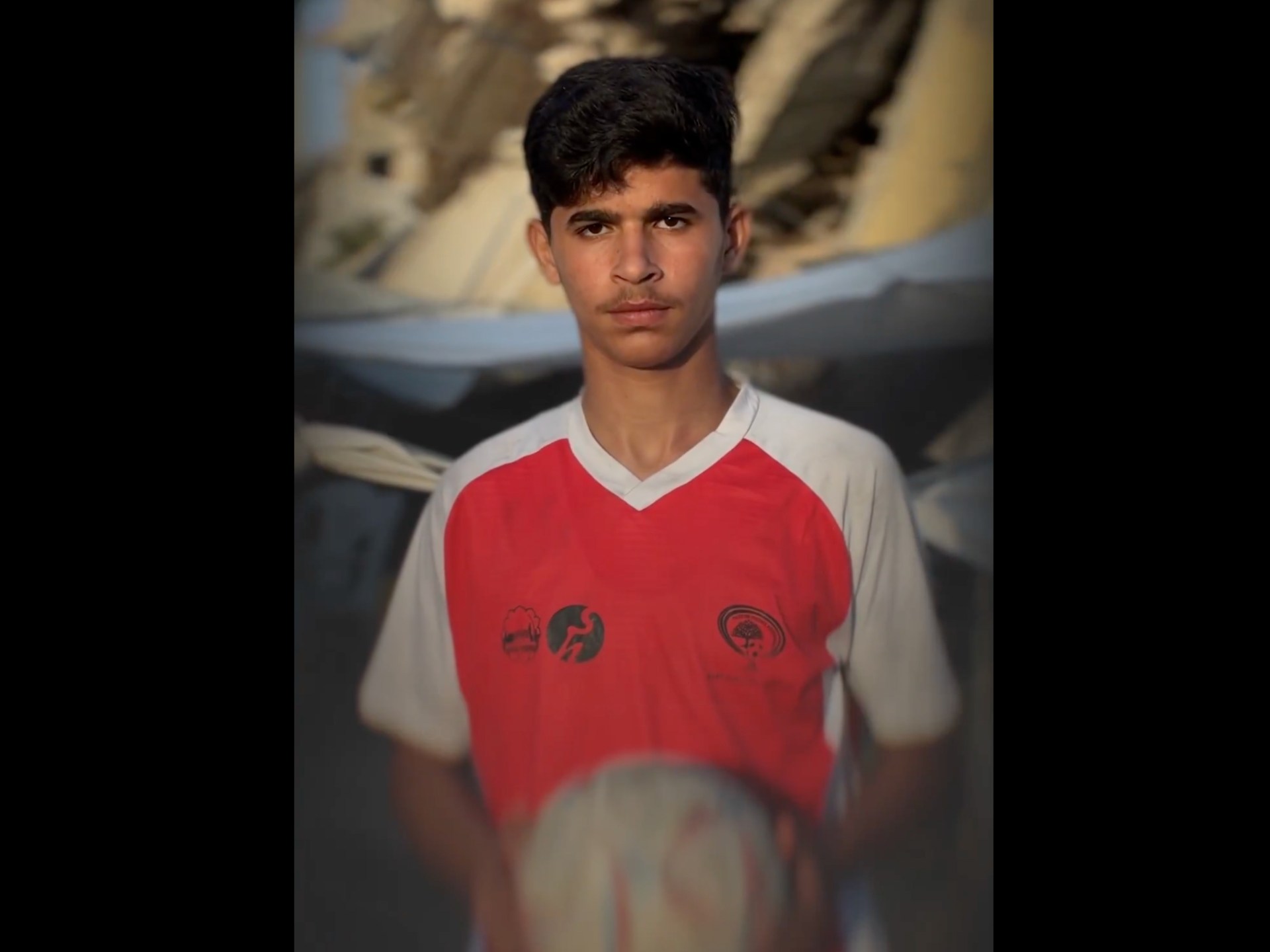
Mohammed Eyad Azzam, 16, says he was a “spoiled” child until his immediate family was killed in an Israeli airstrike in Gaza, leaving his elderly grandmother as his sole caregiver.
On the morning of October 11, 2024, Mohammed was at home with his parents and siblings in the Jabalia refugee camp in northern Gaza when, without warning, Israeli warplanes attacked and the high-rise building where his family lived collapsed.
“I was sitting safely with my parents and two older brothers…we were buried under the rubble for about 10 minutes,” Mohammed told Al Jazeera. “It was pure agony.”
Mohammed’s grandmother managed to dig him out of the wreckage of the house. The next thing he remembers was waking up on a ventilator at his neighbor’s house. “I miraculously survived,” he said.
Due to relentless Israeli bombing, Mohammed was unable to give his parents and two brothers a proper funeral at a cemetery, so instead he buried them in a small temporary plot of land.
The teenager became an adult overnight and now lives among thousands of other displaced people in the Shati refugee camp in northern Gaza, where he spends his days building fires and carrying containers of heavy water for his grandmother.
“My life has turned from happiness to sadness. Before, I was spoiled, but now I am responsible for everything,” he said.
In the midst of all the hardships Muhammad faced, he found one way to escape the daily chaos. It’s soccer.
psychological lifeline
Before the war, Mohammed was a promising player for Qadamat Jabalia Football Club. However, after Israel’s genocidal war in Gaza, the club ceased to function, the pitch was destroyed and many of its former teammates were killed.

However, against all odds, the Palestinian Football Association (PFA) recently organized a tournament for players born in 2009 on one of the last remaining plots of land in Gaza suitable for hosting soccer matches.
For Mohammed, lacing up his shoes is one of the few ways he can escape the despair of a life without his parents and siblings, but the pitch still brings back haunting memories of what he lost before Israel began its genocidal war in Gaza in October 2023.
“It eliminates boredom and releases our negative energy,” he explained.
“Most of my teammates have brothers and fathers who cheer them on and encourage them. I don’t have anyone to cheer me on right now. I miss them as much as I miss the ocean and the fish.”
Decline of sports in Palestine
Mustafa Shayam, head of media for the Palestinian Football Association in the enclave’s southern provinces, said Mohammed’s emotional trauma was symbolic of Israel’s systematic destruction of the Gaza Strip’s sports infrastructure.
“Muhammad is one of the tens of thousands of talented children who have lost their families, clubs, academies and education,” Siyam told Al Jazeera.

The statistics are staggering. According to the PFA, the Israeli attack killed 1,113 people involved in the sports sector, including more than 560 football players, coaches and administrators.
Additionally, 265 sports facilities have been destroyed or damaged in the past two and a half years, and all 56 football clubs in Gaza, from Beit Hanoun in the north to Rafah in the south, have been severely affected.
Muhammad’s club, Qadamat Jabalia, was also destroyed and the site was temporarily turned into a detention and interrogation center by Israeli forces during the invasion of Gaza.
A frantic commute to the pitch
With main stadiums either bombed out or turned into shelters for displaced families, the PFA now holds youth tournaments on the only three remaining small pitches in Gaza City: Palestine Stadium, Hadamat Nuseyrat and Ittihad Shabab Deir Al-Balah, but getting to these matches remains a life-or-death challenge for young footballers.

“We have to walk three to four kilometers through tents and rubble to reach the pitch,” Mohamed said. “You’re mentally exhausted before you even step on the field.”
Mr Siyam admits young people face significant risks when heading to local pitches, but says their tenacity and love for the sport means football will survive in Gaza.
“The security situation remains extremely dangerous. Players walking from their tents to the pitch are at risk of sudden air strikes, but the determination of the players and the association will push us to restart.” “This work sends a message to the world that young Palestinians can rise from the rubble.”
“Double standards”
As Gaza’s football community struggles to survive, Palestinian sports officials have expressed deep frustration with the international community, particularly the sport’s governing body FIFA, over a lack of support and solidarity.
Shyam highlighted the clear double standard when FIFA moved swiftly to suspend Russia and ban Russian clubs in the wake of Moscow’s 2022 invasion of Ukraine, but took no action against Israel.
“Unfortunately no decision has been taken regarding Palestine. FIFA’s position is very weak,” he said.
FIFA has not imposed any sanctions on the Israeli Football Association, despite the targeting and killing of prominent athletes such as national team player Suleiman Obaid and Israeli settlement clubs playing in occupied Palestinian land.
Due to the lack of action from FIFA, the PFA is now seeking justice through the International Sports Court.
respect dreams
While the PFA waits for a permanent cease-fire to rebuild Gaza’s dilapidated sports infrastructure and for Israel to open the enclave’s borders to allow local talent to join the Palestinian national team, young players like Mohammed are clinging to the game to keep the memories of their loved ones alive.

Mohamed added: “I never could have imagined that I would be in a situation where I would be completely alone,” adding that stepping onto a dirt pitch would help keep his father’s legacy alive.
“My current dream is to become a famous professional football player,” the 16-year-old said quietly. “Because it was my dream and it was also my mother and father’s dream. May God have mercy on them. My father is the one who enrolled me in the club and my mother is the one who has always supported me.”
