

Abuja —
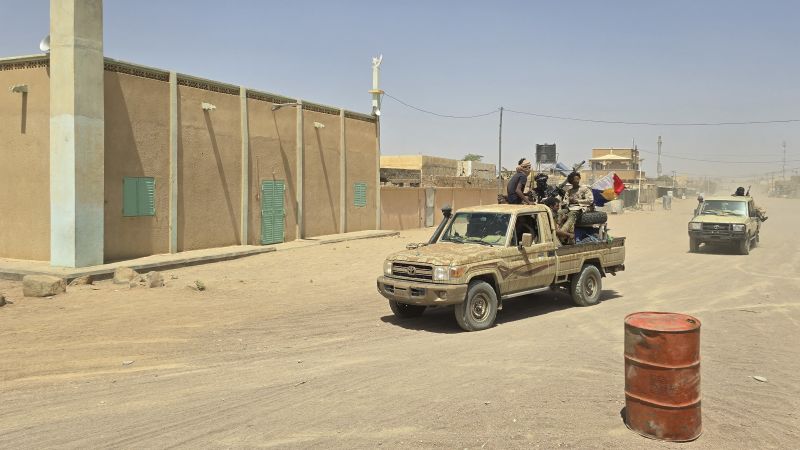
When Russian troops withdrew from Kidal, a strategic stronghold in northern Mali last month, they retreated under the jeers of rebels sent to quell them, but it wasn’t just territory that they surrendered.
Observers characterized the withdrawal of the Kremlin-backed Afrika Korps as a humiliating blow to Moscow’s prestige as a key security partner in Africa’s Sahel region, widely considered the world’s worst terror-prone region.
The attack, the boldest in more than a decade, has plunged Mali further into chaos since April 25, when armed groups linked to al-Qaeda and the northern separatist Tuareg rebels launched simultaneous attacks. Their rare alliance enabled a swift operation that took control of several military bases across northern Mali.
Faced with a siege in the desert town of Kidal, the Afrika Korps (now operating under the Russian Ministry of Defense, replacing the Wagner Group) negotiated a safe passage agreement with the militants to evacuate personnel. The episode reflected recent security failures of Syria’s Bashar al-Assad regime, Venezuela’s Nicolas Maduro regime, and the Iranian leadership, and highlighted the growing limits of Russia’s ability to protect its allies.
Kidal, about 1,000 miles northeast of the capital Bamako, was captured by Malian troops and Russian mercenaries in 2023, ending nearly a decade of rebel rule.
The victory symbolized Russia’s superiority over Western efforts in Africa and highlighted Russia’s growing influence in the Sahel region, where anti-Western sentiment is on the rise. The Sahel extends over 3,000 miles across Africa beneath the Sahara Desert and includes large areas of Senegal, Mauritania, Mali, Burkina Faso, Niger, Nigeria, Chad, Sudan, Cameroon, and Gambia.
Russia entered the area after Western forces participating in anti-terrorism operations in parts of the Sahel between 2022 and last year were removed by various governments in the region.
Mali, a former French colony long ruled by a rebellion, is now ruled by a military junta after successive coups in 2020 and 2021. After severing ties with the French military and U.N. peacekeepers, the regime turned to Russia for security assistance.
However, Kidal’s downfall exposed the fragility of that strategy.
On April 26, the Front for the Liberation of Azawad (FLA), a predominantly Tuareg separatist organization, declared on social media that it had reached an agreement with the Russian military for a permanent eviction from Kidal, declaring that the town was “now free.”

A video soon surfaced online showing Tuareg fighters mocking a convoy of Russian vehicles fleeing the base.
The crisis was further deepened by the assassination of Mali’s Minister of Defense Sadio Camara, a Russian-trained officer and a key architect of Mali’s Moscovization. He was killed in a suicide car bombing at his home near Bamako. Jamaat Nusrat al-Islam al-Muslim (JNIM), an al-Qaeda affiliate, claimed responsibility for the attack on Kamara’s home.
JNIM is now threatening a complete blockade of Bamako and urging Malians to revolt against the military regime and adopt sharia law, and the regime’s promises to “neutralize” these threats with Russian support appear unconvincing.
As Western influence in Africa declines, Russia has become the first choice for beleaguered leaders seeking security assistance without Western human rights conditions. However, Moscow’s approach is primarily transactional and resource security.
The scale of Africa’s pivot to Russia was underlined at the 2023 Russia-Africa Summit in St. Petersburg, where President Vladimir Putin announced military cooperation agreements with more than 40 countries.
But Russia’s military presence in Africa was pioneered much earlier by the Wagner Group, which operated in troubled countries such as Libya, Mozambique, and the Central African Republic (CAR).
In the Central African Republic, one of the world’s poorest countries and where Wagner structures have persisted since 2018, companies linked to its leader Evgeny Prigozhin (now deceased) secured gold and diamond mining concessions, a CNN investigation has found.
Central African governments credit “Russian instructors” with training their troops and helping prevent complete state collapse, but these victories remain fragile as armed rebels continue to control parts of the country.
The transition from Wagner to the Afrika Korps has not stopped rising insecurity in military-led Sahel countries such as Mali, Burkina Faso and Niger.

Analysts claim that few of Russia’s promises have been fulfilled. “The only victory for the Russians[in Mali]was the conquest of Kidal in 2023,” said Ulf Lessing, head of the Sahel program at the Konrad Adenauer Foundation, a German think tank based in Mali.
Heni Nsaibya, a senior analyst at the Armed Conflict Location and Event Data Project (ACLED), a crisis monitoring group, added that the Kremlin’s security model is a surface-level solution to deep-rooted crises in the Sahel region.
He told CNN that while rapid military support could be provided, it “does little to address the underlying drivers of militancy in the region, including weak governance, corruption, socio-economic marginalization, ethnic tensions and a lack of state legitimacy.”
As Kidal returns to rebel hands, Bakary Sambé, director of the Timbuktu Institute, a Senegal-based think tank, says this signals a “serious reputational decline” for Putin in Africa.
“Kidal’s fall from grace and the humiliating and photographed withdrawal of Russian troops have seriously damaged Moscow’s reputation and ambitions in Africa,” Lessing added, suggesting that confidence in the Afrika Korps could decline.
Lessing argued that the perception that Russian troops would withdraw under pressure could hinder future partnerships.
Still, analysts warn that Russia remains vital to Mali’s leadership. Nsaybia said its presence strengthened the country’s military capabilities and helped stabilize the regime, at least temporarily.
Russian forces have suffered heavy casualties in Mali, including the death of several Wagner fighters in a deadly ambush in 2024.
Russia’s Defense Ministry said the situation in Mali “remains difficult” and said the African Corps had withdrawn from Kidal, while preventing widespread collapse by thwarting an April 25 coup attempt.
He warned that extremist groups remain active and are regrouping.
Meanwhile, Tuareg representatives have called on Russian troops to withdraw completely from Mali, predicting the junta’s eventual collapse.
Due to the deteriorating security situation, Mali’s military government faces a strategic dilemma.
“The regime’s survival cannot be bet on a single external partner, especially one that failed to stop the most massive single-day attack the country has suffered since 2012,” said analyst Sambé.
There are signs that Mali and its regional allies will diversify their security partnerships.
Mali is part of the Alliance of Sahel States (AES), along with Burkina Faso and Niger. The alliance was initially formed as a political bloc in response to regional sanctions imposed after their respective coups. However, the AES evolved into a mutual defense agreement.
The three countries have also increased defense procurement from countries such as China and Turkey, suggesting a broader search for alternatives.
However, options remain limited.
Russia remains the only partner willing to send direct combat troops to front-line operations linking Mali and Moscow, a key element for the regime fighting the rebellion, Lessing said.
“In the end, Mali has no choice but to cooperate with Russia,” he concluded.
