

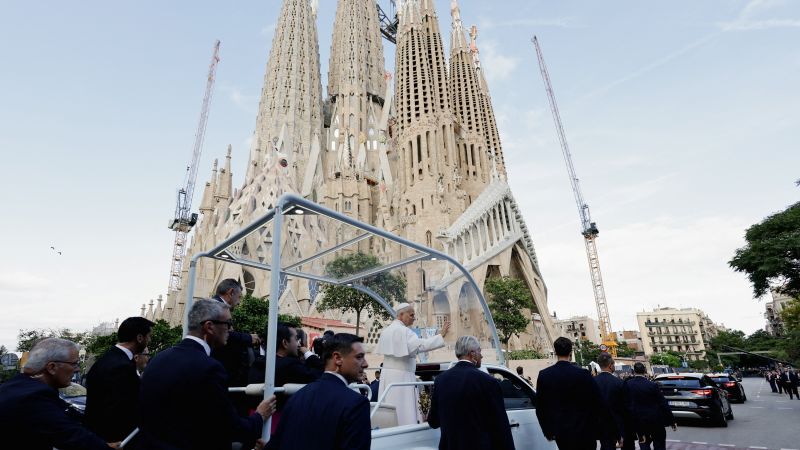
Antoni Gaudí, the architect of Barcelona’s most visited tourist attraction, the Sagrada Familia church, died in 1926 after being hit by a tram and mistaken for a beggar by onlookers without prompt medical treatment.
Today, exactly 100 years since the architect’s death, Pope Leo XIV visited the iconic cathedral to celebrate Mass and inaugurate the tower that will make it the tallest church in the world.
Gaudi died knowing that his masterpiece was unfinished. The blessing of the Tower of Jesus Christ marks a major step in the 144-year journey to completion of this extraordinary religious structure that attracts millions of visitors annually. According to the cathedral, it is visited by more Americans than Spaniards.


“The Sagrada Familia cathedral is more than just a monument; it is a work in progress,” the first American-born pope said during a homily at a mass attended by thousands of people, including Spain’s king and queen. “The fact that it is imperfect is not a flaw, for it is a mark of aspiration. It does not signify a shortcoming, but rather expresses a promise that we wish to keep consistently.”
Upon arriving at the Sagrada Familia, the Pope was greeted by the King and Queen of Spain, then went to the crypt and visited Gaudi’s tomb. After Mass, he blessed the new tower atop the church. A blind girl named Valentina used a model with Braille inscriptions to explain the Tower of Jesus to the Pope.
After the blessing, the cathedral and tower were lit up, followed by fireworks and drone lights of Gaudi’s face in the night sky.
In his sermon, Leo said, “It is faith that shapes stones,” praising Gaudí as an “architect inspired by faith” who designed a building that could be described as a “spiritual pilgrimage.” The Vatican put Gaudi on the path to sainthood and declared him “Venerable” in April last year, an important step on the path to canonization.
On Wednesday, the Catholic spiritual leader also told worshipers, “We cannot believe in Jesus and promote war. We cannot believe in Jesus and kill innocent people. We cannot believe in Jesus and abandon those who are suffering, those who are crying, those who are running from misery.”
The pope sharply criticized the joint U.S.-Israel attack on Iran, rebuked world leaders who invoked religious language to rationalize war, and voiced opposition to the administration’s crackdown on immigration.

Gaudi’s main inspiration for Sagrada Familia was the natural world and religious rituals and imagery. Peter Stanford, author of Gaudí: Divine Architect, says that the towers of Sagrada Familia are often compared to “dripping candles.” However, Stanford University, writing in the Catholic publication The Tablet, said that Gaudí’s disciples actually took inspiration from the “castels”, human towers where people overlap in religious festivals, a Catalan tradition.
A masterful blend of color, architectural genius, and geometric patterns, the building features detailed carvings of trees, flowers, and fruit. The 18 towers represent various Biblical figures, including the apostles, the evangelists, and the Virgin Mary, while the three facades depict the life, death, and final judgment of Jesus.

Construction work on the cathedral was delayed due to a lack of funds, partly due to the Spanish Civil War and Gaudí overshooting his budget and refusing to compromise on the design.
In July 1936, at the start of the Spanish Civil War, a group of anti-clerical anarchists stormed the cathedral, setting fire to the crypt and Gaudi’s workshop, and destroying much of Gaudi’s plans. The lost information was reconstructed by Gaudí’s collaborators and helped future generations of architects. Chief architect Jordi Fauri, who is currently overseeing construction, said Gaudí gave his successor a design logic aided by the use of digital modeling software, 3D printing and industrial robots.

By visiting the cathedral and blessing the new tower, the Pope will follow in the footsteps of Pope Benedict XVI, who consecrated the Sagrada Familia in 2010.
