

tel aviv —
Israeli Prime Minister Benjamin Netanyahu was huddled with his security ministers in a bunker late Sunday night, bracing for a possible Iranian ballistic missile, when his phone rang.
President Donald Trump was on the phone, relaying news of a memorandum of understanding between the United States and Iran.
This was the second telephone conversation between the two leaders that day.
In the first article, Axios said President Trump was “upset” by Israel’s recent attack on Beirut and told Israeli leaders that Prime Minister Benjamin Netanyahu “has no judgment whatsoever.” In a second message, President Trump said the war they jointly started in late February is effectively over.
When President Barack Obama signed the nuclear deal with Iran in 2015, Prime Minister Netanyahu forcefully rejected it in public. He spoke to Congress knowing he had Republican support, denouncing both the deal and the president who promoted it. This time, the Israeli prime minister has said little publicly about the people behind the deal.
The new agreement is a scenario that Israeli officials have been fearing for weeks. The reopening of the Strait of Hormuz could lead to the easing of economic sanctions against Iran, while also delaying talks on an issue that has been Israel’s declared war objective. The memorandum provides economic respite for the regime Netanyahu had hoped to overthrow, while leaving the thorny subject of Iran’s nuclear program and ballistic missile arsenal for later discussion.
After President Trump released the memorandum, Prime Minister Netanyahu finally made his comments publicly, hours after other Israeli politicians had already spoken. At a press conference Monday night, Prime Minister Netanyahu barely mentioned the deal throughout his eight-minute opening statement.
Perhaps even more surprising is that he barely mentioned Trump in his opening remarks, instead of touting his relationship with Trump, as he has done regularly over the years.
Later, when asked about the deal, he said: “President Trump and I may disagree. … I have a responsibility to Israel’s security interests and it needs to be done wisely.”
Iran has also demanded a complete withdrawal of Israeli forces from southern Lebanon, which Israel has said it is unwilling to comply with, and the deal could come with new restrictions on Israel’s ability to fight Hezbollah.
On Monday, a senior U.S. official told reporters that withdrawal was “not a condition of the deal.”
“If Iran is unable to control Hezbollah and attacks Israeli positions or Israeli towns, Israel has the right to defend itself and respond,” the official said.
Prime Minister Netanyahu has so far avoided direct confrontation with President Trump in public, but people across the political spectrum in Israel are far less restrained. Netanyahu’s own far-right coalition partners, Finance Minister Bezalel Smotrich and National Security Minister Itamar Ben Gvir, called it a “dangerous deal” and declared that they did not believe Israel would be bound by it.
Former Prime Minister Naftali Bennett, who is seeking to oust Netanyahu, called this a “dangerous turn in Israel’s security.” Former Israeli army chief of staff Gadi Eisenkot, another leading candidate for prime minister, called this a “disastrous result” of a lack of strategy and courage.
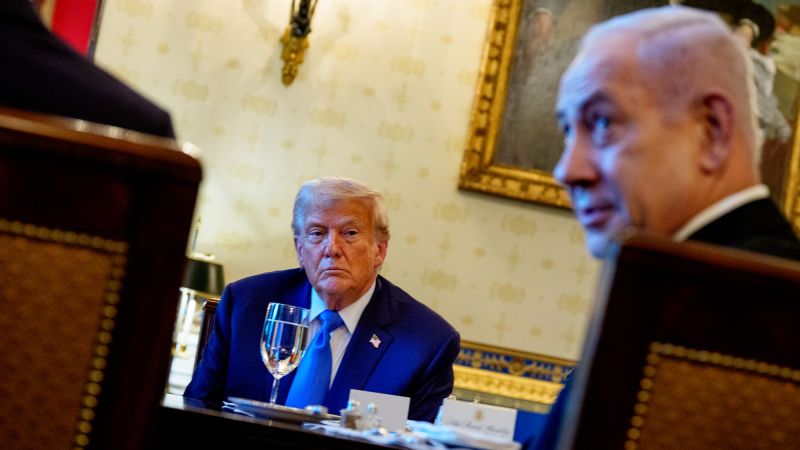
Prime Minister Netanyahu’s silence reflects not only a sensitive moment in foreign policy, but also how central Trump is to his campaign strategy. Sources told CNN that Netanyahu’s political team had envisioned a clear electoral trajectory months ago: a quick victory over Iran, a triumphant return to the White House in September, a last-minute return visit by Trump to Israel, and a flood of presidential images that would sweep Netanyahu through election day in October.

Rather, discussions about ending the war are straining relations between the leaders of the two countries. A series of public disagreements exposed President Trump’s pressure on Israel to end the war and limit its actions in Lebanon. Sources say Netanyahu’s outspoken calls for an Israeli ceasefire and announcements on Truth Social about nuclear negotiations, as well as recent comments to ABC News questioning whether he still wants to “continue” in politics, all caught the Israeli prime minister off guard.
Nadav Strauchler, a political consultant who previously worked with Prime Minister Benjamin Netanyahu, said these are “testing times” but not a breaking point.
“I’m not in a big hurry to praise the relationship,” he said, adding that relations could be restored in about four months before the October election and predicted that Trump would remain a key figure in the campaign.
“Trump has been angry with Prime Minister Netanyahu and other leaders in the past, but things are trending back toward normal,” Strauchler told CNN. “Until the past two weeks, there was very little daylight between them,” he said. “President Trump still respects him and hasn’t closed the door. There are still 60 days left to affect the final nuclear deal. As long as the candles are lit and the windows are open, Netanyahu will try to sneak in through the chimney.”
On Channel 14, the pro-Netanyahu television network, this shift in mood is easy to track. There, a host who once called Trump the greatest gift to the Jewish people now denounces Trump as a “loser” who has weakened both Israel and America. One Likud official privately compared him to Japan’s defeated emperor.
“Trump is currently extremely unpopular within Prime Minister Netanyahu’s base,” the person said, but noted that the change could still be temporary in the run-up to the October election.
The numbers tell the same story. A recent poll released last week by the Israel Democracy Institute found that the share of Jewish Israelis who think Israel’s security is a central consideration for President Trump has plummeted from 64% in March to 41% this month, the lowest level since late 2024.
“Trump stocks are falling. It’s not a crash or collapse, but the trend is downward,” right-wing political analyst Matty Touchfeld wrote in Maariv newspaper last week. He reported that Prime Minister Netanyahu’s campaign is currently looking for a new message, as the “Stronger Together” campaign featuring both leaders “is not having the same impact as originally hoped.”
Opposition leaders are also paying attention to this change. A person familiar with their plans told CNN that if Trump endorses Netanyahu, his opponents plan to use it against him as evidence that Netanyahu has “turned into a poodle and abandoned Israel’s security interests.” Opposition parties have sent messages to Trump’s associates asking them not to support Prime Minister Netanyahu or actively participate in the election campaign, the person said.
But Netanyahu’s camp still believes this is only a temporary obstacle. Israeli officials have told CNN that Netanyahu is secretly seeking a one-on-one meeting with the US president, a claim denied by Netanyahu’s office. Such a meeting would allow Prime Minister Netanyahu to convey his concerns about the new Iran deal to President Trump. And that would be the political currency Netanyahu wanted to trade: a sign of how close he is to President Trump.
