

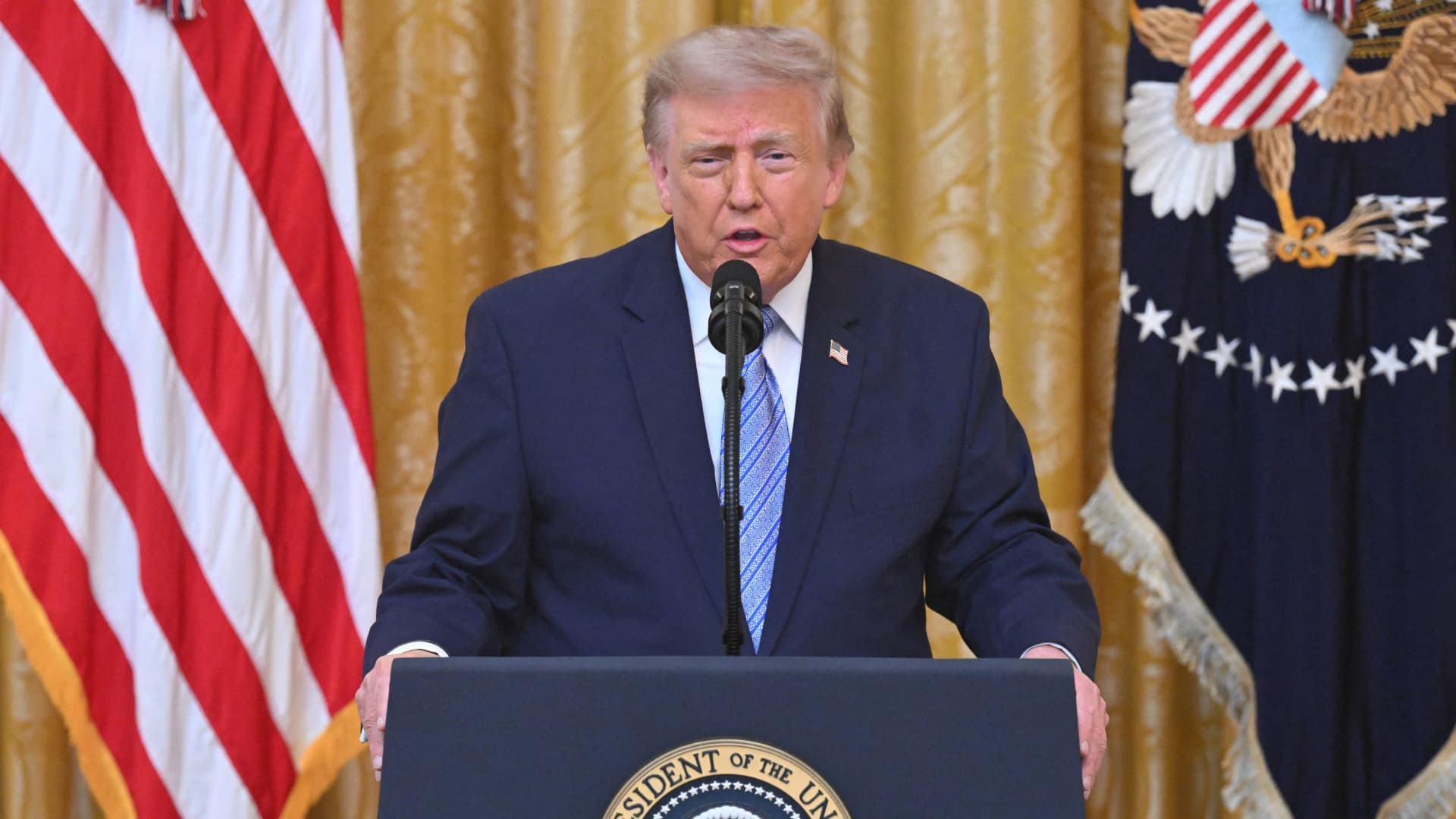
U.S. President Donald Trump addresses the nation in the East Room of the White House on July 16, 2026 in Washington, DC.
Saul Loeb | via Reuters
President Donald Trump raised questions about the security of the U.S. election system and voter information in an address to the nation Thursday night, alleging widespread interference by China in the 2020 cycle, among many other claims that were quickly disputed by fact-checkers.
Trump, who has long falsely claimed that his loss to former President Joe Biden in the 2020 presidential election was “rigged” due to widespread fraud, claimed in a prime-time speech that newly declassified information revealed “shocking vulnerabilities in our election infrastructure.”
The roughly 25-minute prime-time address came as the president and his allies work to impose major changes to U.S. elections through redistricting ahead of November’s midterm elections, adding procedures for Americans to vote and casting doubt on the effectiveness of the country’s electoral system. Polls show Democrats are favored to take back the House as President Trump’s popularity slumps, and Trump has expressed concerns about the investigations he could face if Democrats control one or both chambers of Congress.
President Trump claimed Thursday that documents posted on the White House website show that China has “illegally obtained 220 million U.S. voter files” since 2020, when Trump was president.
Other files show the “deep state” was working to cover up “the scope of China’s nefarious election interference,” Trump said, arguing that China did not want Trump to be re-elected in 2020.
But in early January 2021, President Trump was shown classified information he had collected about foreign threats to the 2020 election, according to a declassified assessment by the U.S. intelligence community.
“We assess that China did not engage in interference activities and considered but did not engage in influence activities aimed at changing the outcome of the U.S. presidential election,” the report said.
Intelligence officials later added that they assessed that “Beijing did not interfere with election infrastructure, including vote counting and transmission of election results.”
This contradicts Mr. Trump’s assertion in a speech Thursday that China’s interference efforts “included attempts to manufacture illegal ballots” against Mr. Biden.
President Trump also repeatedly called on the Republican-led Congress to pass the SAVE America Act. The controversial bill cracks down on non-citizens who interfere in U.S. elections, including requiring people to show a photo ID to vote and proof of citizenship to register. Opponents say the bill would disenfranchise voters, especially low-income people and people of color.
President Trump also claimed that an investigation by the Department of Homeland Security found that approximately 278,000 noncitizens were “registered to vote in federal elections.”
But President Trump did not say how DHS conducted its review. And it did not claim that these non-US citizens actually voted in US elections. It is already illegal for them to do so, and documented instances of non-citizens voting are extremely rare.
Federal law already requires citizenship to vote in U.S. elections, and data shows very few noncitizens vote.
But President Trump has made election legislation a top priority for the next election. He even refused to sign any other legislation until the SAVE America Act reached his desk. And his allies in the House are delaying other measures from reaching the president as they rush to pass an election bill that doesn’t have the votes to pass Congress.
President Trump’s Republican Party faces major challenges as it seeks to maintain its majorities in the House and Senate beyond the midterm elections. The party that controls the White House has historically underperformed in midterm elections, and Democrats are aiming to take advantage of polls showing Americans’ negative views about the economy, the Iran war and Trump himself.
President Trump’s campaign
People vote during the primary election at the Brooklyn Museum on June 23, 2026 in New York, USA.
Eduardo Munoz | Reuters
Mr. Trump has sought to use every means at his disposal to contest the election results he opposes.
After losing the 2020 election, Trump and his allies filed dozens of lawsuits challenging state counts, but none of them overturned the results or presented any credible evidence of fraud to overturn the election.
Efforts to overturn the 2020 results culminated in the Capitol riot on January 6, 2021. A mob of Trump supporters stormed the heart of the U.S. government, forcing lawmakers to temporarily evacuate their chambers for safety. President Trump has since pardoned or commuted the sentences of virtually all defendants involved in the riot.
In late January, the FBI searched election offices in Georgia, the top target of President Trump’s attempts to overturn the 2020 election, seeking records related to the 2020 election. Trump’s then-Director of National Intelligence, Tulsi Gabbard, was also seen at the scene of the attack.
After Gabbard announced her resignation in May, Trump nominated Bill Pelt, the head of federal housing regulation, to replace her.
MS NOW previously reported that Pulte, who has earned a reputation as Trump’s loyal attack dog, was expected to take part in the president’s speech.
Meanwhile, the Justice Department has filed lawsuits in numerous states seeking access to detailed voter registration data. The Justice Department argued it needed the information to ensure compliance with federal election laws. More than a dozen such lawsuits have been dismissed by federal judges.
