

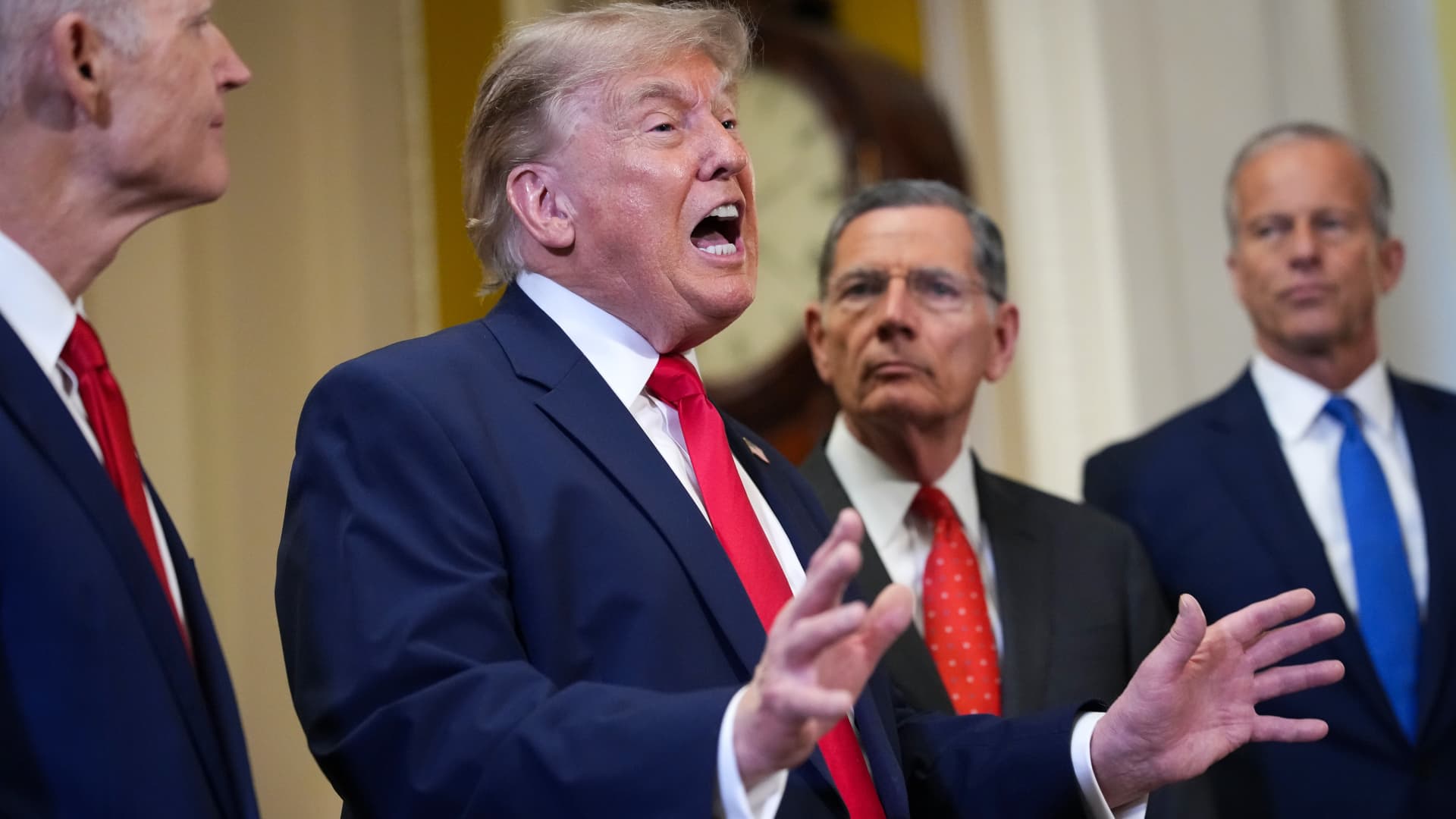
President Donald Trump and Senate Majority Leader John Thune (R.S.D.) speak to reporters on their way to a luncheon with Senate Republicans at the Capitol in Washington, June 24, 2026.
Saul Loeb | AFP | Getty Images
President Donald Trump has turned a string of victories for Republican candidates into a political headache for his own party, complicating the party’s efforts to show voters they can govern ahead of Congress’ July 4 recess, critics say.
Over the past two weeks, President Trump has delayed his choice for director of national intelligence, effectively derailed negotiations over a major foreign surveillance program that has expired, and on Wednesday canceled plans to sign a bipartisan affordable housing bill at the last minute.
He has repeatedly pressed Senate Republicans to override the filibuster to clear the way for passage of a voter ID and non-referendum bill that lacks the votes needed to pass. And with complaints that Congress has been kept in the dark and demands from the White House to pay for the $87.6 billion war, it has become difficult for some Republicans to defend even the Iran peace deal. And President Trump has often returned to his failed reflection pool renovations in recent public remarks.
The aftermath spread throughout the Capitol. The Senate entered its Fourth of July recess early following the dysfunction and left town Wednesday night.
Meanwhile, the House of Representatives is paralyzed as hardliners assume Trump’s role and refuse to vote on Republican priorities until the SAVE America Act is passed. Members of the House of Representatives also returned to their constituencies early, but their return is scheduled for next week.
A bipartisan housing bill that was supposed to be a Republican victory on Wednesday and could curb private equity and boost housing supply and affordability has turned into a mess.
The episodes are not identical. But they point to a pattern of Republicans coming closer to victory. Trump turns it into a test of loyalty. Victory is another battle.
Some Republicans are now saying so publicly.
“He’s been destructive,” Rep. Don Bacon (R-Nebraska) said of President Trump’s response to the housing bill. “He had a good contract that he could have signed, but he couldn’t win.”
Bacon said Trump appears to be acting “on a whim” and “positionally,” complicating a bill that “was a victory for Congress and for Trump.”
“That was a mistake,” Bacon told CNBC on Thursday.
The White House responded to a request for comment Thursday, referring to comments the president made in the Oval Office Wednesday night. After meeting with NATO chief Mark Rutte, President Trump defended his decision to suspend the housing bill and slammed Democrats who opposed the SAVE America Act. “We’re doing a good job” on affordability, he said, adding his administration is “bringing prices down significantly.”
Rep. Brian Fitzpatrick (R-Pennsylvania), who also sponsored the housing bill that passed with overwhelming bipartisan support, said Republicans’ frustrations are genuine.
“Eighty-five percent of voting members of the House of Representatives supported it. And 90% of voting senators supported it,” Fitzpatrick told CNBC. “You don’t get that in the name of a post office, let alone a comprehensive package of affordable housing.”
Fitzpatrick said the episode was “another example of the president using New York’s real estate strategy as leverage to extract other concessions.”
“Of course it’s frustrating,” Fitzpatrick said.
Sen. Bill Hagerty (R-Tenn.) attends a press conference in support of the SAVE America Act, which would require proof of U.S. citizenship to register to vote and a photo ID to cast a ballot, at the U.S. Capitol in Washington, March 18, 2026. March 18, 2026.
Nathan Howard | Reuters
rift in parliament
Not all Republicans are angry about the president’s recent actions. House Speaker Mike Johnson (R-Louisiana) has been particularly supportive of the president, meeting with him at the White House on Thursday afternoon. Late Thursday, he sent the housing bill to the White House, which procedurally means it could automatically become law without Trump’s signature, veto or no signature.
Conservative members of the House of Representatives also joined Mr. Trump in saying they would refrain from supporting any legislation until the Senate passes the Save America Act, a conservative election bill introduced by the House in February.
“The president did the right thing yesterday by not signing the bill unless the SAVE Act was attached,” Rep. Ralph Norman, R-S.C., said Thursday morning at a Freedom Caucus press conference, referring to the housing bill. “Personally, I don’t think we should enact any more legislation until the Senate reconvenes. Ironically, the Senate has been out of session for two weeks.”
Rep. Anna Paulina Luna (R-Fla.), who sponsored the Save America Act and is leading the Republican blockade of the House chamber, similarly proposed attaching the bill to larger, must-pass legislation such as the Foreign Intelligence Surveillance Act or the National Defense Authorization Act.
However, doing so could jeopardize both laws.
Key provisions of FISA, the spying bill that would allow the United States to monitor people outside the United States, even if they are communicating with Americans, expired earlier this month amid Democratic opposition to President Trump’s interim pick for director of national intelligence, Bill Peult.
Mr. Prut heads the Federal Housing Finance Agency and is a staunch ally of President Trump. His position at the top of the FHFA to investigate President Trump’s opponents has raised concerns among Democrats and some congressional Republicans.
In response to those concerns, President Trump appointed Jay Clayton, the U.S. attorney for the Southern District of New York, as permanent DNI, and lawmakers sought to speed up the nomination process. But hours before Mr. Creighton was scheduled to testify before Congress last week, Mr. Trump posted on Truth Social that Mr. Clayton should stay home in a further attempt to force a vote on the SAVE America Act.
Democrats, meanwhile, see President Trump’s handling of the housing bill as proof that he doesn’t care about affordability, making it a top priority ahead of the 2026 midterm elections, when Republicans are looking to secure slim majorities in both houses of Congress.
“Voters have seen time and time again that he doesn’t care,” Rep. Susan DelBene (D-Wash.), chair of the Democratic Congressional Campaign Committee, told CNBC. “That’s why they’re demanding better representation, and that’s a big reason why we take back the House.”
Brittany Martinez, a former aide to House Speaker Kevin McCarthy (R-Calif.) and executive director of Principles First, an alternative to the Conservative Political Action Conference, said Trump’s recent actions lacked “strategic discipline.”
“Republicans had room to talk about affordability and housing issues that voters actually care about, but instead we’re talking about President Trump canceling the housing vote, muddying the waters around his own intelligence agency nominations, and creating more instability in the FISA negotiations,” Martinez told CNBC.
“If Republicans continue to ignore or downplay the affordability crisis without addressing it, voters will notice,” she says.
“Because the Democrats don’t control either party in Congress, Trump doesn’t have a strong opponent, so he seems to be picking fights within the party,” said Matt Dallek, a professor at George Washington University who studies the modern conservative movement.
“When it comes to middle-of-the-road messaging, Republican infighting could cause the party to lose focus and lose sight of its real prize: control of Congress,” Dallek said.
National Guard members patrol near the fence around the Lincoln Memorial Reflecting Pool in Washington, June 23, 2026.
Tyler M. Andrews | Washington Post | Getty Images
vanity project
The problem is not limited to the Capitol. Mr. Trump has spent much of his political capital reshaping Washington’s most visible civic spaces around his image.
President Trump has focused attention on the reflecting pool in front of the Lincoln Memorial in recent weeks, following controversy over the addition of his name to the Kennedy Center and the construction of the White House ballroom, which he ordered before falling into legal trouble.
President Trump personally pushed for renovations to the reflecting pool ahead of the nation’s 250th anniversary, ordering its bottom to be painted a color he called “Stars and Stripes Blue.” The project was intended to be a showcase of patriotism and a visible symbol of national rebirth.
On the contrary, it created a new political headache. After renovations were completed more than $4 million over budget, according to a federal contract, the pool suffered from algae blooms that made the new coating appear to peel off. President Trump blamed unspecified vandals, claimed people damaged the liner, said arrests had been made, and ordered the pool to be fenced off.
“This is a waste of taxpayers’ money…how much more money will it take to fix a problem that never existed in the first place,” Martinez said on MS NOW on Tuesday. “He can’t fix the algae, so they’re handcuffing him and threatening him.”
Democrats have also used the episode to question the administration’s competency and demand answers about contracts, costs and project execution.
—Emily Wilkins contributed to this report.
