

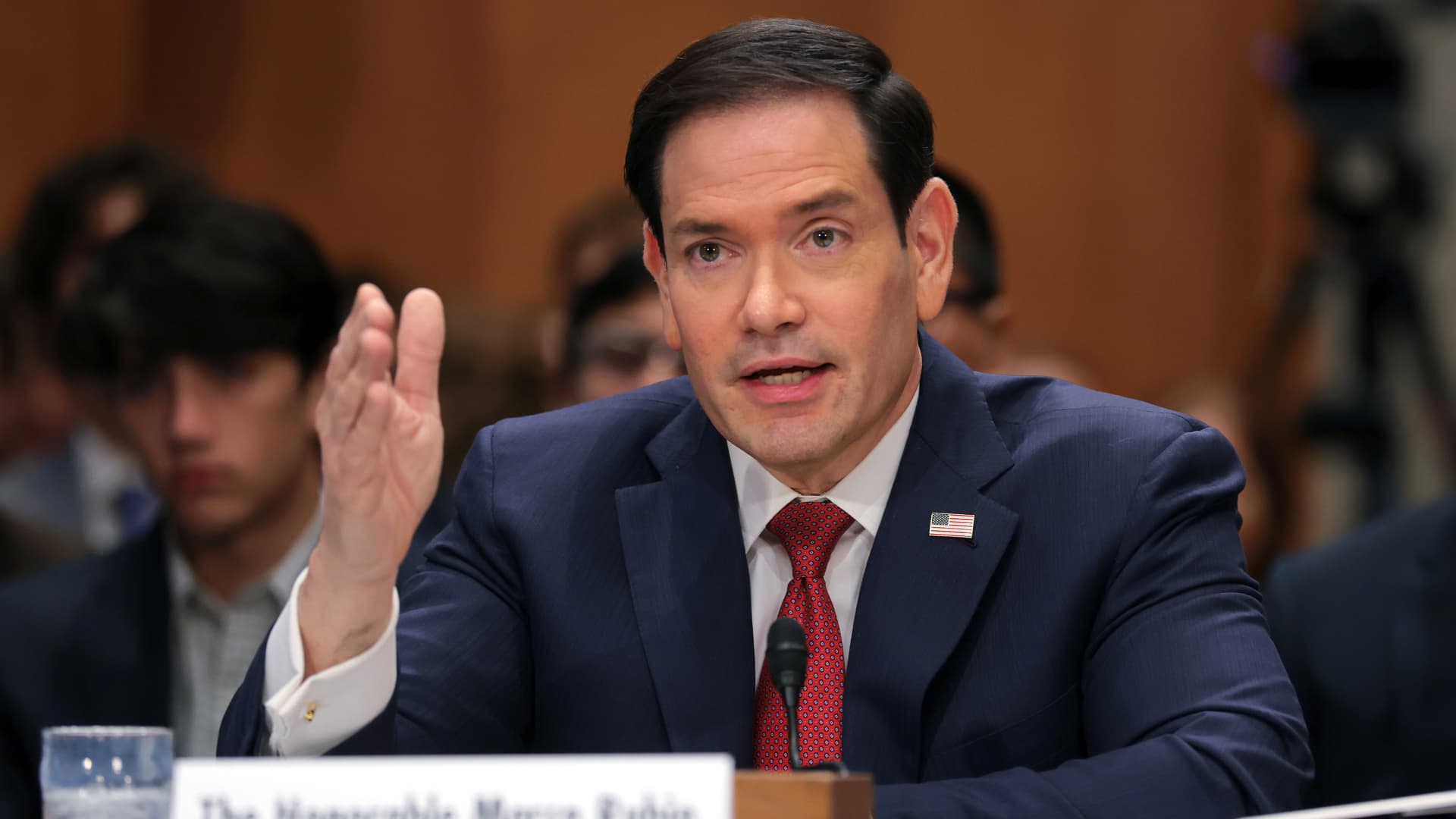
U.S. Secretary of State Marco Rubio testifies during a Senate Foreign Relations Committee hearing at the Dirksen Senate Office Building on June 2, 2026 in Washington, DC.
Anna Moneymaker | Getty Images
President Donald Trump and Secretary of State Marco Rubio said Tuesday that the United States continues to negotiate a cease-fire agreement with Iran, despite claims to the contrary by Iranian state media.
And Rubio told the Senate Foreign Relations Committee that as part of those talks, Iran “could potentially negotiate aspects of its nuclear program.”
Iran’s Fars News Agency reported on Tuesday morning, citing sources, that Iran and the United States stopped exchanging messages several days ago.
State news agency Tasnim reported on Monday that Iranian negotiators would stop exchanging messages with the United States through intermediaries and that Iran would move to completely close the Strait of Hormuz, a key choke point for oil shipments.
“Fake news reports that the Islamic Republic of Iran and the United States stopped speaking days ago are false and false,” President Trump said in a post on Truth Social Tuesday afternoon.
“The conversations between us have been ongoing, including four days ago, three days ago, two days ago, one day ago, and today,” Trump wrote.
“No one knows where they’re going to go, but as I said to Iran, ‘It’s time to come to some kind of deal. We’ve been doing this for 47 years and we can’t let it go on any longer!'”
But on Monday, when asked about the possibility of ending talks with Iran, President Trump said in a phone interview with CNBC: “I’m not concerned about it at all. There’s no way I would be concerned about it.” Trump said negotiations were “starting to get very boring.”
He also said Iran had not told him it would stop negotiations.
“We are currently negotiating,” Rubio said in testimony before the Foreign Relations Committee.
“I say talks because talks with Iran are different and very different than talks with Switzerland. Unfortunately, it requires the use of an intermediary,” Rubio said.
“But what we have in front of us is a prospect that could happen today, could happen tomorrow, could happen next week, and certainly for the first time in my memory, they agreed to negotiate aspects of their nuclear program that just a month ago, exactly a year ago, they refused to even mention, let alone enter into a discussion about,” Rubio said.
“There is no guarantee that we will end up with an agreement that is acceptable to the Senate and the American people,” he said. “But we will be able to involve them in a process that really tests the proposition of how far they want to go.
Rubio, who also serves as President Trump’s national security adviser, appeared on the panel to give his first public testimony on the Iran war since U.S. and Israeli airstrikes began on Feb. 28.
He defended Trump’s decision to go to war, saying Iran was trying to build a “conventional shield” of missiles, drones and naval assets around its nuclear program.
Rubio explained Iran’s stance: “If you come and do something about our nuclear program, we will overwhelm you with our missiles, we will overwhelm you with our drones, we will overwhelm you with our navy.”
Rubio said Iran is seeking “immunity,” which Trump rejects.
He said Operation Epic Fury was a “huge success” and had dramatically reduced Iran’s ability to make missiles and drones, but acknowledged that Iran “still[has]a lot of drones” because they are “easy to make.”
Rubio said the reopening of the Strait of Hormuz remains central to de-escalation.
“We need to announce that we will no longer fire at commercial vessels that are passing by or that are in danger of being shot,” Rubio said.
He said Iran must declare the straits open, stop collecting tolls, help clear mines and pledge not to fire on commercial ships.
The hearing comes amid growing concerns in Congress about the war, its economic impact, and President Trump’s authority to continue the conflict without approval from lawmakers.
The committee’s top Democrat, Sen. Jeanne Shaheen (D.N.H.), accused the administration of circumventing Congressional oversight.
“When we talked to voters, they wanted economic relief at home, not regime change in Havana or Caracas or Tehran,” Shaheen said.
He said the administration’s war powers notice was not “consultation” but “an attempt to avoid answering this committee and Congress about this war.”
The State Department’s budget hearings expanded beyond Iran, with Democrats pressing Mr. Rubio on whether the administration was pursuing regime change across multiple countries.
Rubio is scheduled to appear before several House and Senate committees this week as lawmakers grill him about Iran, Venezuela, Cuba and the administration’s broader foreign policy.
