

manila, philippines —
Philippine security officials said on Monday that they had discovered cyanide on a Chinese fishing boat that was sailing around a disputed atoll in the South China Sea.
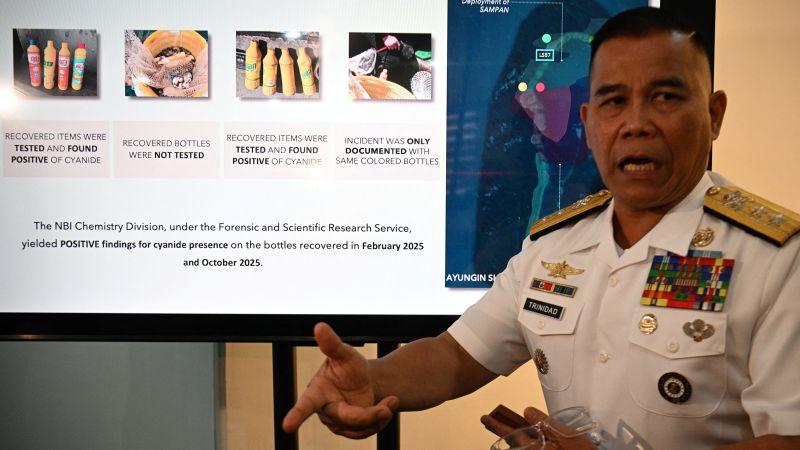
Authorities said laboratory tests confirmed the presence of a highly toxic substance in bottles seized by the Philippine Navy during an operation at No. 2 Thomas Shoal last year.
Officials warned that the cyanide could have seriously affected marine life and weakened coral reefs that support warships that Manila has grounded on the atoll to strengthen its maritime claims.
“We would like to emphasize that the use of cyanide at Ayungin Reef is a form of sabotage aimed at killing the local fish population and depriving naval personnel of a vital food source,” National Security Council spokesman Cornelio Valencia told a news conference, using the atoll’s Philippine name.
Valencia added that cyanide could damage coral reefs and “ultimately compromise” the stability of warships.
China’s Foreign Ministry dismissed the Philippine claim as a “stunt”.
“The Philippine side illegally harassed Chinese fishing boats conducting regular fishing, robbed fishermen of their daily necessities, and staged the so-called cyanide stunt. Their story has no credibility,” Foreign Ministry spokesperson Guo Jiakun said on Monday.
The shoal, located within the Philippines’ 200 nautical mile exclusive economic zone and 1,300 kilometers (808 miles) from mainland China, is called Ren’ai Reef.
The Philippines has accused China of interfering with the ship’s mission to resupply its troops, including during an incident on June 17, 2024, in which a Filipino sailor lost a finger in a riot. China has denied allegations of aggressive behavior during the fighting and accused the Philippines of illegally invading its territorial waters.
A tentative agreement was reached for a resupply mission for ships stranded after the June collision.
China and the Philippines held high-level talks last month over the South China Sea, exploring preparatory steps for oil and gas cooperation and maritime confidence-building measures, including communication between coast guards.
The Philippine Department of Foreign Affairs said in a statement on Monday that the coast guard’s cooperation would be limited and “we do not envisage cooperation in sensitive operational areas,” adding that joint patrols were not discussed.
China claims almost all of the South China Sea, including areas claimed by Brunei, Malaysia, the Philippines, Taiwan and Vietnam.
China rejects a 2016 ruling by the International Court of Arbitration that found the Chinese government’s sweeping claims had no basis under international law. More than $3 trillion in shipping traffic passes through our waterways annually.
