

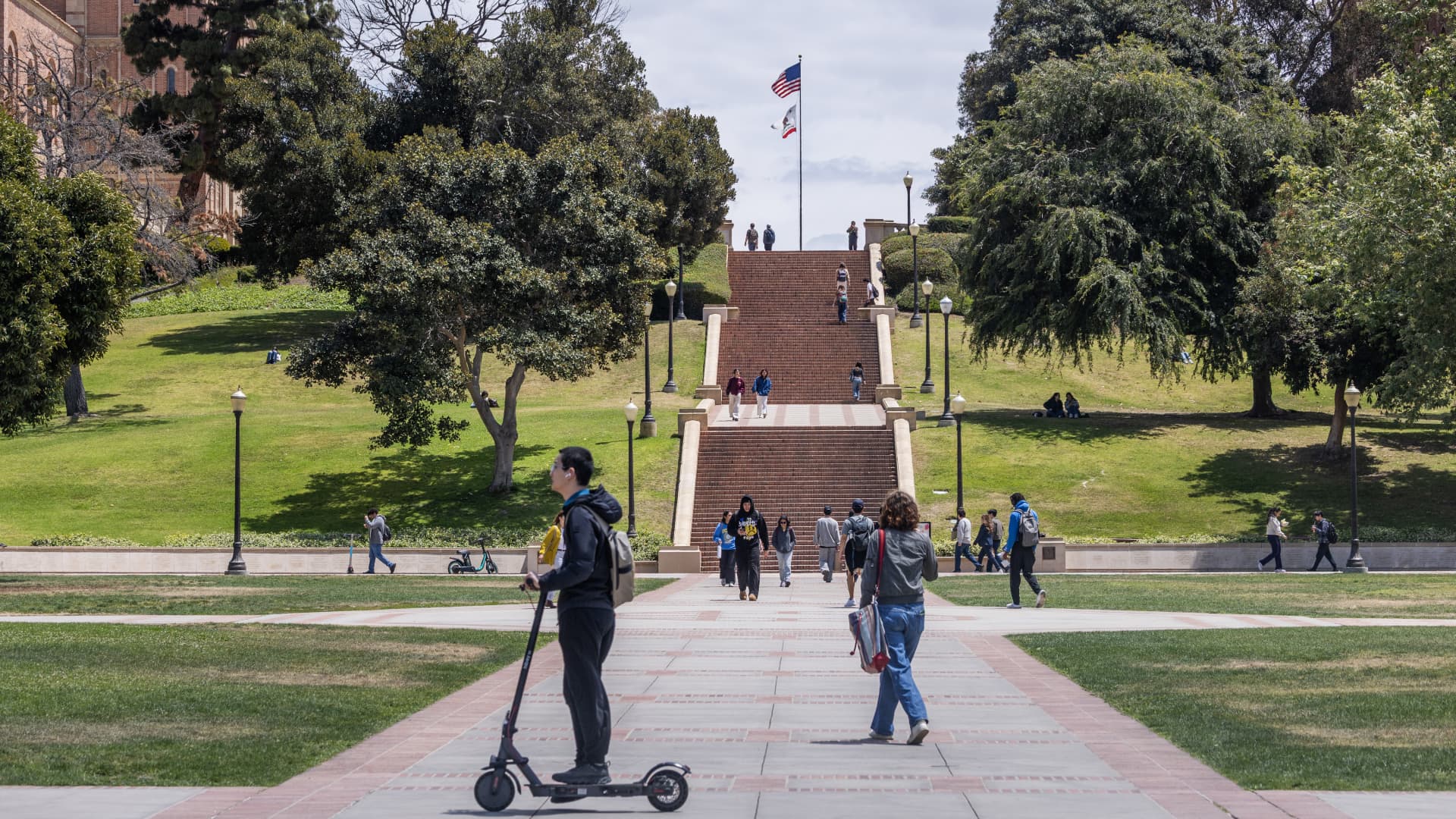
Yance Steps of UCLA on Tuesday, May 5, 2026 in Westwood, California.
Myung Jeong Chun | Los Angeles Times | Getty Images
A coalition of 25 states and the District of Columbia sued the Trump administration this week over new limits on federal student loans. Experts say the lawsuit comes at a critical time for students pursuing careers in health care fields such as nursing, social work, physical therapy and occupational therapy.
Legislation enacted by President Donald Trump’s One Big Beautiful Bill Act limits the amount of federal loans students can take out for graduate school to $100,000 over a lifetime starting this year, and sets lifetime loan limits at $200,000 for professional programs such as medicine, dentistry and law school, according to rules finalized in late April by the U.S. Department of Education.
“Higher education is expensive and our health care system is already under tremendous strain,” New York Attorney General Letitia James said in a statement Tuesday announcing the lawsuit. “This rule will lock talented people out of important jobs and leave communities with fewer health care providers they desperately need.”
The Education Department said the new loan limit is much-needed to curb the soaring cost of tuition, which has outpaced inflation and other household spending and has skyrocketed in recent decades. Rising tuition costs are making college and graduate school out of reach for some, while others are saddled with crippling student loan debt.
“After decades of allowing student loan borrowing to go unchecked without giving schools a reason to control costs, Congress’ common-sense loan caps are already giving colleges an incentive to lower tuition costs,” Education Undersecretary Nicholas Kent told CNBC in an email.
“Clearly, Democratic governors and attorneys general are more concerned about the bottom line of educational institutions than they are about the affordability of postsecondary education for American students and families,” Kent said.
shortage of nurses
For students pursuing careers in nursing and other high-demand fields, “the path forward is increasingly uncertain, impacting not only individual borrowers but also the workforce pipeline that these communities rely on,” said Megan Walter, senior policy analyst at the National Association of Student Financial Aid Administrators, a financial aid organization.
The American Nurses Association, a professional advocacy group, said the new rules could lead to fewer registered nurses across the country at a time when demand for medical professionals is soaring. The aging of the baby boomer generation is driving large-scale, long-term demographic change, increasing the need for health services and workers, research has found.
Demand for registered nurses is expected to grow faster than the number of full-time workers over the next decade, according to a report released in December by the federal government’s National Center for Health Care Workforce Analysis. Assuming that population decline, graduation, and labor force participation rates remain unchanged, a shortfall of 3% is projected by 2038.
“If this rule goes into effect, it will have a direct and devastating impact on health care across our country,” Jennifer Mencik Kennedy, president of the American Nurses Association, said in a statement.
Morsa Images | Digital Vision | Getty Images
Higher education expert Mark Kantrowitz calculates that about 20% of nursing students will end up borrowing more than the new loan limits allow. Compared to other graduate degrees, “nursing programs tend to be more expensive because they require a lot of hands-on training,” he said.
Also on Tuesday, Sens. Jeff Merkley (D-Ore.) and Roger Wicker (R-Mississippi) introduced legislation that would classify post-baccalaureate nursing degrees as “professional degrees,” which would allow nursing students to qualify for higher federal student loan limits.
“It is imperative that Congress address America’s nursing shortage,” Wicker said in a statement. “This bill would make nursing a more attainable profession by expanding loan limits for nursing students.”
Tuition discount
But some experts say the new rules could put pressure on schools to cut costs, with some nursing programs already cutting tuition to increase access.
Other graduate schools are also starting discounts on tuition fees starting next fall.
For example, Purdue University and the University of California, Irvine have reduced business school tuition by up to 40% to stay below federal loan limits for graduate business degrees. For a limited time, Johns Hopkins University is offering a 50% discount on master’s degree tuition for the Maryland university’s Class of 2026.
NASFAA’s Walter said that while some agencies have responded quickly, it may take longer for real progress to occur across the board.
“These processes take time, and students are currently making admission decisions,” Walter said. “Budget cycles and operational realities don’t move that quickly, so it can take years to make meaningful changes to program pricing.”
Meanwhile, higher education experts also say the federal loan cap could push more students into the private loan market to cover costs, often resulting in higher interest rates and fewer protections.
According to NerdWallet, federal student loan interest rates currently range from 6.39% to 8.94%, while private student loan interest rates can reach as high as 23%.
“This rule will result in many students relying on more expensive private loans, taking on unsustainable debt, delaying the completion of their education, or abandoning these programs altogether,” the attorney general said in a release announcing the lawsuit.
— CNBC’s Camaron McNair contributed reporting.
Correction: This article has been updated to reflect statements from Sen. Roger Wicker. “It is imperative that Congress address the nursing shortage across the United States. This bill would make nursing a more attainable profession by expanding loan limits for nursing students.” An earlier version misattributed the quote.
Subscribe to CNBC on YouTube.
