

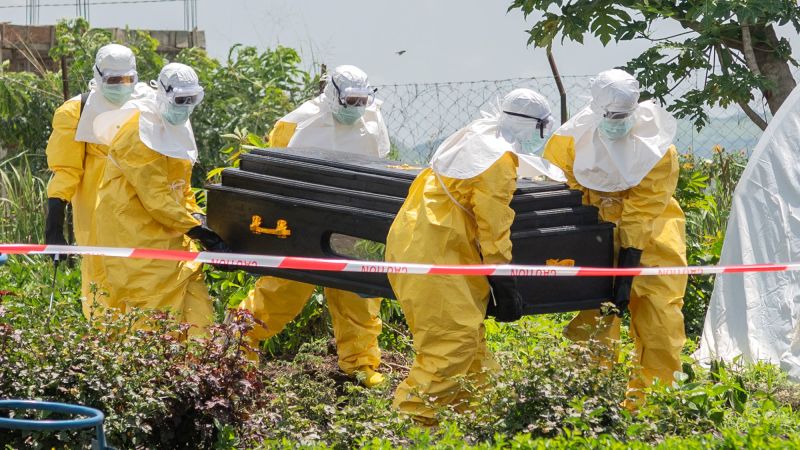
As a deadly Ebola outbreak tears through northeast Democratic Republic of the Congo, many first responders are turning a critical eye on events that preceded the crisis: layoffs of health workers funded by the United States, shortages of critical medical supplies and a steep reduction in American support for global aid programs.
The World Health Organization says more than a hundred deaths are thought to be linked to this outbreak, with nearly 600 suspected cases so far and it’s warning that “we know the scale of the epidemic in DRC is much larger.” It also said this strain of the virus – for which there is no specific vaccine or treatment – could have been circulating for months before it was detected.
There are several reasons for this delay, WHO says: the unusual strain of the virus, weak health infrastructure in the rural area where it originated and ethnic conflict in the region that hampered testing. But the tardy response has also shed an uncomfortable light on the real-world costs of the Trump administration’s cuts to foreign aid and its withdrawal from WHO, the global health body tasked with managing outbreaks of this kind.
While the Trump administration is keen to point blame elsewhere, aid workers and experts said US funding cutbacks and layoffs in multiple areas have hampered the world’s ability to respond to Ebola.
The Trump administration’s cuts are four-pronged: It withdrew funding from WHO, dissolved the US Agency for International Development (USAID), made cutbacks at the US Centers for Disease Control and Prevention, and is in the process of reducing the total health aid it gives to DRC and Uganda, the countries at the center of the epidemic. All of those moves have weakened global health systems that are vital for effective responses to outbreaks like this one, experts told CNN.
“When you add up all of those elements, it’s hard to see how there could not have been an effect on the surveillance and response capacities in these countries,” said Josh Michaud, associate director for global and public health policy at KFF, a nonprofit health policy research and polling organization.

In one specific example, the International Rescue Committee, which has humanitarian responders on the ground in the DRC, said US funding cuts contributed to delayed detection of the virus.
“Weakened disease surveillance systems following severe health funding cuts in eastern DRC are contributing to the rapid escalation of the latest Ebola outbreak,” the IRC said in a statement. Heather Reoch Kerr, the group’s country director for DRC, added: “Years of underinvestment and recent funding cuts have left many health facilities without adequate protective equipment, surveillance capacity, or frontline support needed to respond quickly and safely.”
A senior State Department official claimed on Tuesday that none of the changes under the Trump administration hampered its efforts to respond to the outbreak. This official said that it had responded swiftly once the outbreak was identified by the WHO and that “the Ebola management programs carried over” and funding awards carried over after the dismantling of USAID.
“There was no specific person or program associated with USAID in this region that would have detected this or contributed to a detection framework here,” the official told reporters. They claimed that “numerous staff who have worked on these issues” were retained from USAID.
The CDC’s incident manager for the Ebola response, Dr. Satish Pillai, said Tuesday that the CDC has worked in the area for decades, with 100 staff in Uganda and nearly 30 staff members in DRC. The agency said it has also brought hundreds of people into the emergency response that it launched this week.

Health officials now say the first death thought to be linked to this outbreak occurred in Ituri Province in northeast Congo on April 20. But the outbreak wasn’t officially declared until May 15, after a delay in detection since testing for the rare Bundibugyo strain couldn’t be carried out locally. Samples had to be transported more than a thousand miles away to a lab in Kinshasa for confirmation, according to humanitarian workers in the region.
US Secretary of State Marco Rubio on Tuesday blamed the World Health Organization for being “a little late to identify this thing,” while acknowledging the other complicating factors. “It’s a little tough to get to it, because it’s in a rural area, so it’s kind of confined in a hard to get to place in a war-torn country, unfortunately,” he said.
But experts note that the cutoff of US funding to WHO prompted staff reductions at the global organization, and no other donor country has filled those WHO funding gaps. (Other countries, including the United Kingdom, Germany and Canada, also cut foreign aid in 2025 for global health and development.)
Despite the State Department comments, two former USAID officials told CNN that many of the people with experience responding to outbreaks of viruses like Ebola, as well as the relationships with local health officials, were fired in the dismantling of USAID.
One of the former USAID officials, who worked in the DRC, noted that although USAID didn’t have programs in the Ituri Province, it still could have helped to serve as “the glue” to coordinate health officials, NGOs and donors.
“You can have a ton of experts come in … but if you can’t actually get people out or pay health workers or supply them with the things that they need, there’s a real limitation there, and that’s what we lost with USAID,” the former official explained.

The IRC said emergency responders are already on the back foot, having to prioritize airlifting basic protective equipment – like gloves, masks and hospital gowns – to healthcare facilities. In the past, those facilities would have had supplies already stocked.
Before last year, the US government funded a range of the organization’s outbreak preparedness activities in eastern DRC, but the IRC said much of that funding ended in March 2025. IRC’s Vice President for emergencies, Bob Kitchen, acknowledged that the US is now mounting an emergency response but “with a very small checkbook.”
Speaking from the Democratic Republic of Congo, Greg Ramm of the nonprofit Save the Children summed up the gravity of the situation: “None of us have enough funding.”
Ramm and other experts have warned that many more people will die if the broader health system collapses, which is why it’s critical that people with Ebola seek treatment and that health facilities remain open to treat other diseases like malaria and malnutrition.
On Tuesday, the State Department said that it “mobilized an initial $23 million in bilateral foreign assistance to immediately bolster each country’s own response, supporting surveillance, laboratory capacity, risk communication, safe burials, entry and exit screening, and clinical case management” and would fund “up to 50 treatment clinics, and associated frontline costs being established in Ebola-affected regions of the DRC and Uganda.”
The CDC is leading the US response to the outbreak, alongside WHO and national health authorities in the affected countries.
“We are incredibly short-staffed across the board,” one CDC expert working on the response told CNN, noting that numerous CDC experts have been fired, quit or retired without being backfilled over the past year and a half.
The agency’s global staffing and public health infrastructure around the world have taken a hit. That’s in part because much of the CDC’s global work is funded through the President’s Emergency Plan for AIDS Relief program – but the State Department has withheld roughly $700 million from the CDC for the PEPFAR program this year, according to health policy analyst sources. Some malaria funding has also been withheld, sources said. has also been withheld, sources said.

“They have been relentless in the last year – the political leadership and State Department – about stripping money away from CDC, saying that we have too many staff overseas,” the CDC source told CNN.
The source explained that money for the HIV/AIDS program helps pay for public health teams and infrastructure, like labs and surveillance systems.
The same staff and systems that help stop HIV epidemics are also those that often halt other epidemics, the source said, adding: “Our funding and our teams in east Africa, central Africa are definitely depleted.”
Asked about withheld funding, a State Department spokesperson disputed it and said, “PEPFAR funds for HHS and CDC to support US health foreign assistance programs continue to flow from the Department of State.”
Previous responses to Ebola outbreaks also relied heavily on USAID partners, according to infectious disease physician Dr. Fiona Havers, formerly an epidemiologist at the CDC who was deployed to Liberia during the Ebola outbreak in 2014. For example, USAID contract workers handled setting up clinics, importing ambulances, contacting people with suspected cases and staffing isolation facilities.
But last year, the Trump administration canceled thousands of foreign aid work contracts, as it dismantled USAID and folded the few remaining programs under the State Department.
“It’s not just the funding piece. … All of those aid groups have had their programs shut down, their clinics closed, the community health workers fired,” Havers told CNN. “Those groups are no longer available, or available in much more diminished capacity” to pivot to the Ebola response.

The former USAID officials said there has been a loss of goodwill between the US government and the local health authorities and partners on the ground because of the way funding was so suddenly cut last year.
“In DRC, we were the largest health donor, and we really had a convening power, and people looked to us, but they also relied on us for management and oversight,” the first former USAID official said. “We lost all respect and credibility.”
The second former official recalled when Elon Musk quipped last year that he had “accidentally canceled” funding to fight Ebola during an outbreak in Uganda, which he then claimed had been “immediately” restored. The former USAID official said that the cancellation of that funding meant that “everything stalled while the outbreak continued” in 2025. A year on, almost everyone on the USAID team that worked on that most recent outbreak has been fired, the former official said.
The Trump administration’s exit from WHO also means the US no longer receives information through those official reporting channels, although informal contact has continued.
“Withdrawing from the WHO just means that the US government and CDC are generally more out of the loop with information flows,” Havers added. “They’re not part of the conversation in the same way that they were, and I think that makes America less safe.”
The senior State Department official lambasted WHO for the delay in identifying the outbreak and praised the US response so far, which they said has also included the deployment of Disaster Assistance Response Teams to the DRC and Uganda.
Although the US government is mobilizing emergency funding for Ebola right now, health policy analysts told CNN that there are expected to be further cuts to global health programs in the future.
CNN has reported that the Trump administration plans to redirect $2 billion in funding intended for global health programs to cover the cost of closing USAID, according to a copy of the congressional notification obtained by CNN. That plan includes $647 million in funding reductions for global health security.
