

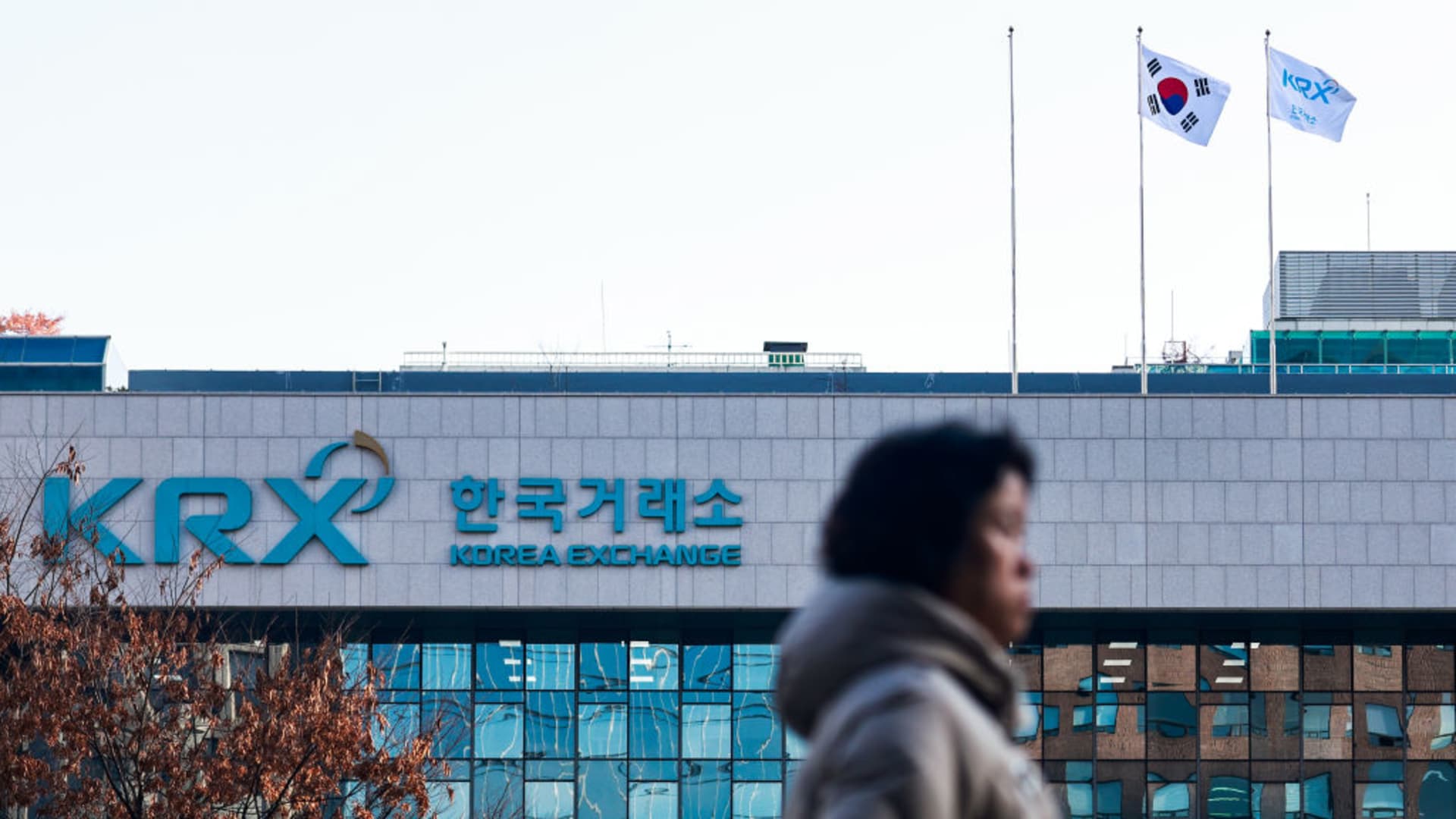
SEOUL, SOUTH KOREA – DECEMBER 09: People walk past the Korea Exchange (KRX) building as stock markets across Asia are affected by the escalating political turmoil over President Yun Seok-Yeol’s role in martial law on December 9, 2024 in Seoul, South Korea. December 9, 2024 in Seoul, South Korea. Korea Composite Stock Price Index (KOSPI), Hong Kong’s Heng San Index, Shanghai Composite Index, as well as stocks from the following countries. In response to the political crises in South Korea and Syria, the indexes of Australia, China, India, and Thailand declined. (Photo by Daniel Ceng/Anadolu, Getty Images)
Anadolu | Anadolu | Getty Images
Index provider MSCI kept South Korea classified as an “emerging market” in its latest review on Tuesday, while extending its assessment of Indonesia’s status until November.
The decision dashed hopes that Seoul could be included on MSCI’s developed markets watch list, an important step before the market is upgraded to developed market status.
For Indonesia, the extension comes after MSCI raised concerns about market access earlier this year and froze the country’s stocks from its index in January, citing investability concerns.
MSCI said it would continue to assess the reforms introduced by Indonesian authorities, but if these measures prove insufficient, the index provider would “consider a range of options to appropriately respond to the Indonesian market,” including possible downgrade to frontier market status.
Following the review, Indonesia’s financial regulator reportedly said it would “ensure that the reforms that have been and are currently being rolled out are comprehensively understood by the global investment community.”
korea discount
In the case of South Korea, MSCI said the Korean won’s limited convertibility in offshore currency markets remains a key barrier to reclassification.
Index providers also cited restrictions on investment products with strict investor identification systems, restrictions on in-kind transfers and off-exchange trading, and restrictions governing the use of exchange data.
While MSCI acknowledged the measures announced by South Korean authorities to address these concerns, it said, “Investors are being told that the fundamental issues have not been fully resolved.”
The country is preparing to start 24-hour trading on the dollar-won spot market on July 6, the latest step in opening up its foreign exchange market to foreign investors.
The Seoul government has been seeking to join MSCI’s developed market category for many years. Analysts previously told CNBC that the upgrade could help resolve the so-called “Korea discount,” a term referring to the low valuations often assigned to Korean stocks relative to their global peers.
South Korea’s Ministry of Finance said the country was not added to the watch list this year because some reforms are still underway and the results of completed measures will take more time to show.
The ministry said it will continue to pursue foreign exchange and capital market reforms, adding that if changes continue according to South Korea’s needs and schedule, inclusion in MSCI’s developed market index will also continue.
Benson Woo, Bank of America’s chief Korean economist, said on CNBC’s “Squawk Box Asia” that the decision was not unexpected as South Korea still lacks currency supply and resources to hedge.
Woo said the South Korean government would make further reforms, but added that the path to developed market status would be a “multi-year” process.
“This won’t happen overnight, but it certainly increases the likelihood of it happening in the next review.”

