

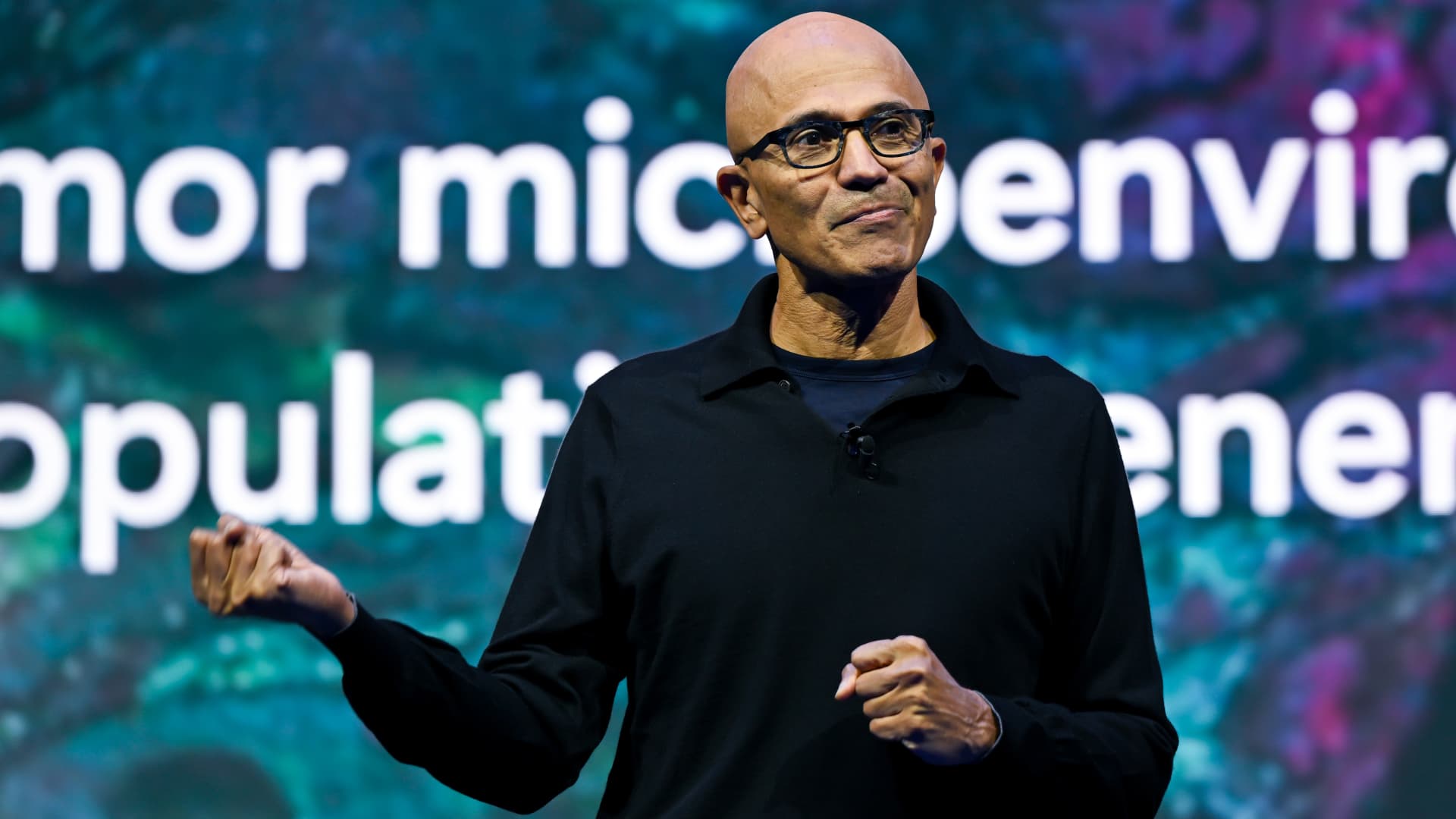
Microsoft CEO Satya Nadella speaks at the Microsoft AI Tour event in Munich, Germany on February 25, 2026.
Sven Hoppe | Picture Alliance | Getty Images
microsoft CEO Satya Nadella told employees Wednesday that Anthropic’s restrictions on requests users can submit to Anthropic’s high-end artificial intelligence model, Fable, are meaningless.
“When you use Fable, when you get rejected for some random reason, you feel like the last time you used a creation tool that was so editorially controlled,” Nadella told engineers working on Microsoft’s Copilot AI software, according to a copy of his remarks provided to CNBC. “That doesn’t make sense.”
Microsoft declined to comment. An Anthropic spokesperson did not respond to a request for comment.
According to the support page, when end users ask questions of Fable, such as some aspects of large-scale model creation, Anthropic may send responses from older versions. Some criticized the rejection on social media.
When Anthropic announced Fable 5 in early June, it said it was looking to reduce false positives for blocked requests. Three days after its introduction, Anthropic blocked access to Fable to comply with U.S. government export control directives, and on July 1, the company reinstated the model, stating that “the new safeguards will flag a slightly higher percentage of benign requests than previous Fable safeguards.”
Nadella’s comments come as executives look to cash-efficient models that don’t come from the most well-funded labs but can handle software development and other tasks in-house.
On Thursday, Chinese startup Moonshot AI announced an open source model that surpasses recent releases from Anthropic and OpenAI.
The comments from Microsoft’s top executives express criticism of a valued partner and customer.
Anthropic’s Claude Code software development tool is popular among programmers and those with less technical talent. In November, Microsoft announced it would invest $5 billion in Anthropic after the company agreed to spend $30 billion on Microsoft’s Azure cloud. This year, Microsoft announced Copilot Cowork, a business productivity assistant that leverages the startup model.
Investors worry that Microsoft could face disruption from its rapid software creation model as it allocates tens of billions of dollars each quarter to data center expansion. Stocks have fallen 17% since the beginning of the year, while the Nasdaq Composite Index has risen 11%.
Recently, Nadella has argued that companies should be able to cost-effectively develop custom models and leverage their internal data without leaking it to other organizations, such as those in the model-building business. In a blog post on Sunday, he said: Palantir CEO Alex Karp told CNBC that technology organizations “want to know they own the means of production.”
Microsoft offers a Foundry service where developers can adopt more than 11,000 models, including models from Anthropic and OpenAI.
“There is no way that only two companies in the world have token capital and other companies are borrowing it,” Nadella told the engineers. “It doesn’t make economic sense.” The token measures the compute usage of the AI model.
Microsoft worked closely with OpenAI through a series of investments, but after OpenAI CEO Sam Altman was abruptly fired and reinstated in 2023 with little notice to Nadella, the two companies drifted and began competing with each other.
OpenAI announced in April that it was moving its model beyond Azure to become the leader in cloud infrastructure. Amazon web service. Microsoft also announced a series of internal models in June, including one for coding. OpenAI’s commercial investments were worth $135 billion as of October.
Nadella also said it’s good to see Microsoft merging products for consumers and corporate employees. In March he announced his earlier. snap Executive Jacob Andreou will be in charge of co-pilots across both categories.
Unification “probably should have been done from the beginning,” he said. Microsoft announced in April that its work-focused Copilot has more than 20 million paid seats, representing 4% of its cloud-based Office customer base.
WATCH: Microsoft sees accelerated growth in coming years, says Wolfe’s Zukin

