

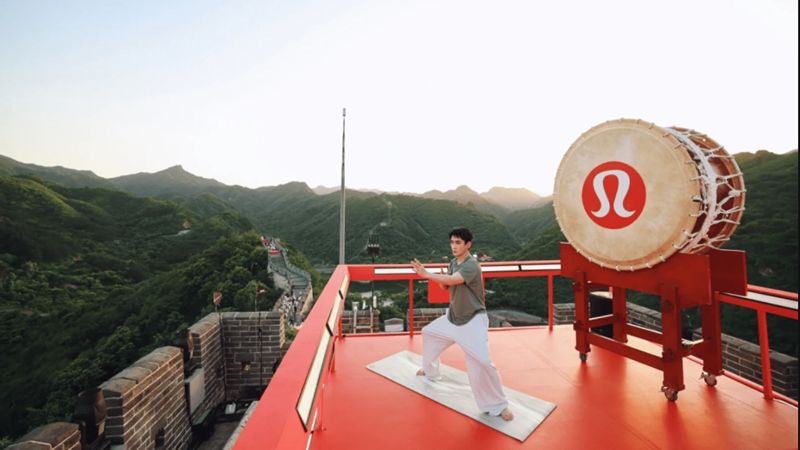
Activewear brand Lululemon is causing an uproar in China after causing an online uproar after a Japanese drum appeared to appear by mistake at a promotional event held on the Great Wall of China.
The consumer backlash forced Lululemon to apologize and cancel the campaign, the latest example of how quickly Western brands can become stranded in a country where nationalism is on the rise under strongman leader Xi Jinping.
It all started with a yoga festival hosted by Lululemon on the Great Wall of China on May 30, according to the Chinese state-run tabloid Global Times.
Billed as an event promoting Chinese culture and health, more than 2,000 guests practiced yoga in the sun on mats atop the ancient stones of China’s most iconic landmark, according to a now-deleted press release from the brand.
One of the notable guests was Zhu Yilong, a Chinese actor known for his roles in popular films and TV shows such as “The Guardian,” “The Tale of Minglan,” and “Light Up the Stars.” At the festival, he joined a drum troupe and performed on what was initially called a traditional Chinese drum, the Global Times reported.
However, the drum’s provenance soon came into question, with social media users and musicians claiming it looked similar to a Japanese drum.
Both types of drums are traditionally large, made of wood and cowhide skin, and sometimes attached to the body with metal studs, rings, or ropes. And they have a common history. Many of the early Japanese drums were introduced to Japan through China and Korea. However, since then they have evolved to serve different culturally specific purposes.
Chinese percussionist Xu Yan told his social media followers that the shape and style of the drums used on the Great Wall are similar to Japanese drum performances. “We should never confuse them,” he said in a Weibo video.
Others argued that the work was a reminder of Japanese imperialism and wartime atrocities, and was particularly sensitive to national symbols such as the Great Wall of China.
The drum drama went viral last week, garnering more than 50 million views on Chinese social media site Weibo by Monday, according to the Global Times. Chu’s studio issued an opinion Tuesday, calling on Lululemon to “examine the entire process, consider and analyze the issues, and follow up.”
Zhu and his team have “always been committed to promoting traditional Chinese culture,” the statement added.
Lululemon responded to the controversy on Tuesday, saying the event was “intended to unwaveringly honor Chinese culture.”
“Due to the limitations of our expertise, we were not initially able to fully identify potential disputes. We are fully aware that we need to be more careful and thorough in the initial planning and review process for drum performances,” it said, apologizing to both Mr. Zhu and the public.
The party has “learned a deep lesson” and vowed to take a “tougher stance” on future events.
Lululemon has since removed all content related to the event from its website and social media. The HIIKO drum and flute troupe, which performed with Zhu, issued its own apology on Tuesday, saying that “all external promotion and use of the controversial taiko has been suspended.”
However, many Chinese social media users are still dissatisfied with this statement. “In a landmark location with strong symbolic meaning, such as the Great Wall of China, every detail should stand up to scrutiny,” one Weibo post said.
This isn’t the first time a foreign brand has caused controversy, made a geopolitical misstep or found itself at the center of consumer anger in China.
In 2021, H&M, Nike and other major Western apparel brands faced boycotts in China over their stance on the alleged use of forced labor to produce cotton in China’s western Xinjiang region. PVH, the parent company of Calvin Klein and Tommy Hilfiger, also bans direct or indirect sourcing from Xinjiang and was placed on a blacklist of Chinese companies last year during the trade war with the United States.
And in 2019, luxury brands Coach, Givenchy and Versace formally apologized for selling T-shirts that did not identify Hong Kong as part of China, while appearing to imply that Taiwan is an independent country, which China’s ruling Communist Party claims as its own territory, even though it has never ruled it.
But Japan is a particularly thorny topic given the long history of hostility between the two countries. In the 20th century, the Imperial Japanese Army invaded, occupied, and committed atrocities in China, a key sore point in China’s so-called “century of humiliation” at the hands of foreign powers.
Anti-Japanese sentiment has been simmering in the country ever since, gaining momentum in recent years as ultranationalism flourished under Xi’s government, especially on China’s heavily regulated internet. Calls for boycotts of Japanese products often arise as old grievances resurface.
Just earlier this year, China imposed broad restrictions on some Japanese products, trampling one of Beijing’s so-called “red lines” after Japan’s prime minister suggested that Tokyo might respond militarily if China moved to seize Taiwan by force.
