

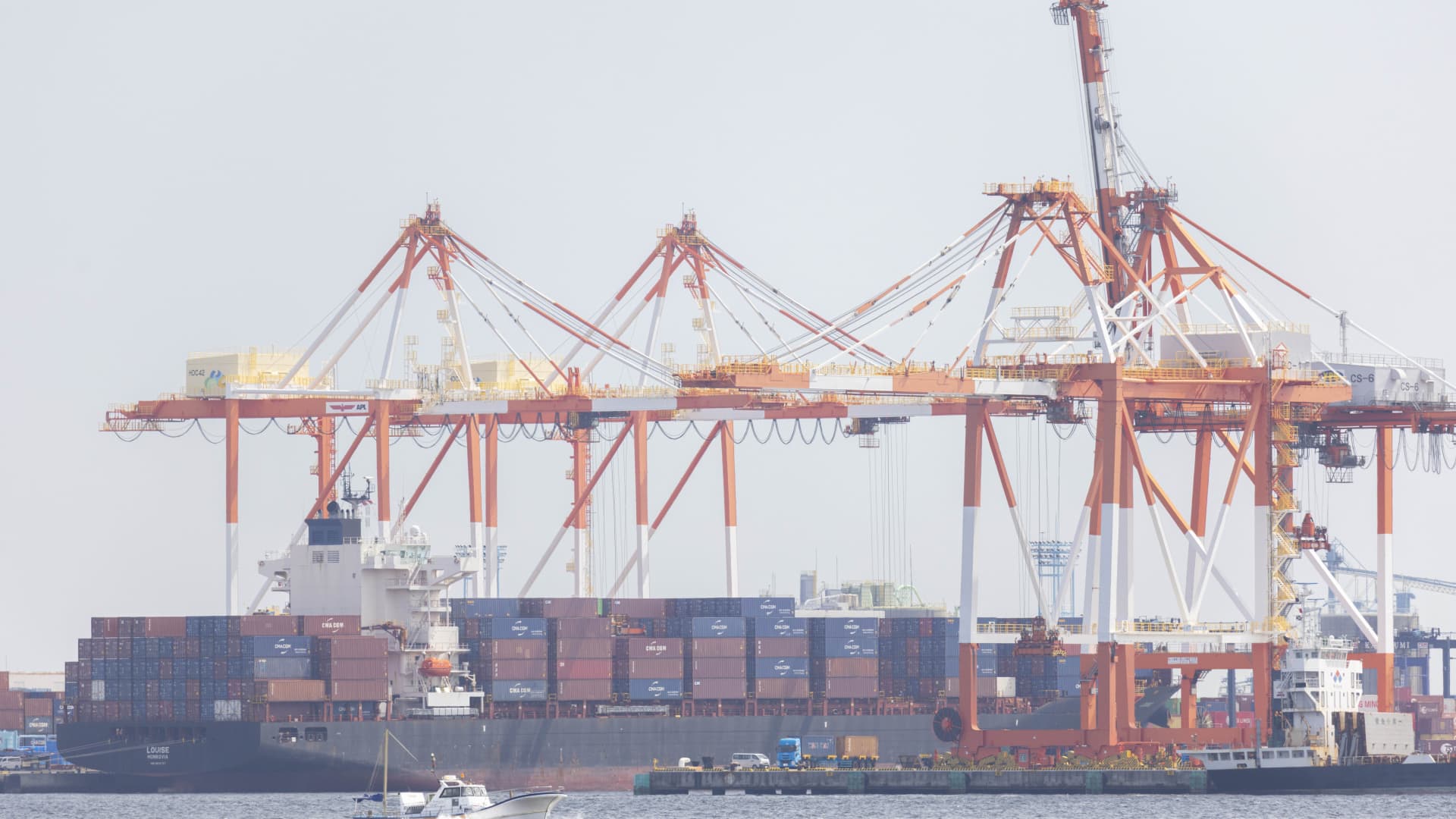
Yokohama, Kanagawa, Japan – 2025/08/28: A loaded container ship is anchored in Tokyo Bay.
Sopa Images | Light Rocket | Getty Images
Japan’s exports rose 4.2% year-on-year in September, halting a decline for the first time in four months, as shipments to Asia showed solid growth, partially offsetting a decline in exports to the United States.
Meanwhile, exports fell short of Reuters’ median estimate of 4.6% growth.
Shipments to Asia increased 9.2% year-on-year, driven by a 5.8% increase in exports to mainland China, Japan’s largest trading partner. Exports to the United States, Japan’s second largest trading partner, fell by 13.3%.
Japan’s semiconductor exports drove overall growth in September, increasing by 12.6% year-on-year in value terms.
Japan’s exports had fallen into negative territory as it grappled with U.S. tariffs, with auto shipments to the world’s largest economy taking a big hit. In September, the number of automobiles shipped to the United States decreased by 24.2% in value terms, but this was slightly lower than the 28.4% decrease in August.
The Japanese government signed a trade agreement with the United States in July that lowered export tariffs to the United States to 15% from the 25% originally proposed by President Donald Trump. The 15% tariff went into effect on August 7th.
Imports in the world’s fourth-largest economy rose 3.3% from a year earlier, reversing a 5.2% decline in August and beating the 0.6% rise expected in a Reuters poll.
Hirofumi Suzuki, chief currency strategist and head of research at Sumitomo Mitsui Banking Corporation, told CNBC that exports are actually “not as strong as they appear on the surface,” citing last year’s low levels. He expects external demand to continue to recover, boosting export growth, but warned that trade tensions between the U.S. and China are clouding the outlook.
Japan’s trade figures were released a day after Sanae Takaichi became the country’s first female prime minister after months of political turmoil following the election defeat of former Prime Minister Shigeru Ishiba’s ruling Liberal Democratic Party.
Mr. Takaichi’s immediate easing policy and large-scale fiscal stimulus are likely to weaken the yen, make Japanese products more competitive and benefit the benchmark’s leading exporters. Nikkei Stock Average It hit an all-time high on Tuesday.
Suzuki of Sumitomo Mitsui Banking Corporation said, “Although the yen was at a fairly low level against the dollar last year, we have yet to see a significant jump in exports.Policy factors such as tariffs seem to have a greater impact on exports than foreign exchange rates.” The yen hit a low of nearly $150 against the dollar in September, compared to $147 in the same month last year.

Since Mr. Takaichi took office as part of the Liberal Democratic Party in September, the market has been pricing in the so-called “high market trade,” with the Nikkei average hitting a new record high and the yen depreciating by more than 150 yen.
The country’s economy has held up better than expected, with second-quarter GDP revised upward to 0.5% from the previous quarter’s initial forecast of 0.3%. Analysts polled by Reuters had expected growth of 0.1%.
