

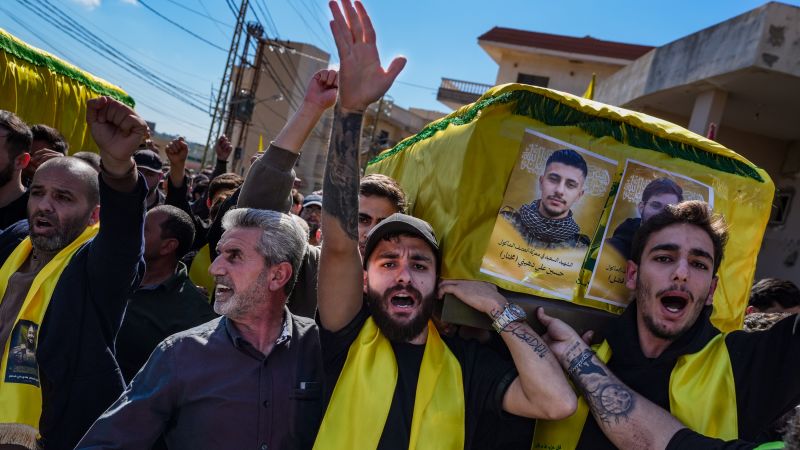
Bekaa Valley, Lebanon —
Not long ago, Hezbollah was declared nearly defeated.
Israel’s devastating military and covert operations have brought the organization closer to its “death,” regional experts say. The fall of Syrian President Bashar al-Assad has also ousted a key regional ally that had helped supply the group with weapons and supplies.
Israel killed longtime leader Hassan Nasrallah in 2024. Lebanon and Israel held direct negotiations mediated by the United States for the first time in decades. The Lebanese government was working to completely disarm the group.
Now, with the US and Israel’s decision to attack Iran, the group appears bolder and more relevant than ever.
Now streaming: CNN has rare access to interrogations of Hezbollah fighters in Lebanon. Upgrade to see the full report.
“What the Israelis have done completely restores Hezbollah’s basis for resistance,” Nicholas Branford, an analyst with the Beirut-based Atlantic Council, told CNN.
“Hezbollah has suffered many attacks and suffered many casualties on the front lines, but we understand that their morale is high and they are prepared for a long war.”
A recent ceasefire agreement between Israel and the Lebanese government has done little to stop the fighting.
The latest agreement reached in Washington on Wednesday calls for Hezbollah to immediately stop firing, withdraw from the south and eventually disarm. Both Israel and Hezbollah violated previous agreements.
Israel has continuously attacked Lebanon since a ceasefire in November 2024, accusing Hezbollah of not withdrawing from the border area. But Hezbollah refrained from counterattacking. The situation changed on March 2, when the United States and Israel began a war with Iran and Hezbollah fired rockets into northern Israel.
“When the Israeli-American war resumed against Iran, we felt this was the appropriate window to respond,” Ibrahim al-Moussawi, a Hezbollah member of the Lebanese parliament, told CNN in Beirut.
According to the Lebanese government, Israel used this as a springboard for a major offensive, invading the south, displacing 1 million civilians and killing more than 3,000.
This returned Hezbollah to its most comfortable position: asserting its obligation to protect the Lebanese people.
“That’s not what we want to do,” Moussawi insisted. “We’re forced to do it. We’re obligated to do it because the government hasn’t done its job.”
Although Israeli attacks reduced the group’s rocket-launching capabilities, it adapted, using explosive drones controlled via fiber-optic cables to bypass Israeli defenses in southern Lebanon, Hezbollah’s stronghold, and attack missile defense squadrons and troops stationed in the country.
Fifteen Israeli soldiers have been killed since a tenuous ceasefire was agreed in mid-April.


But its most powerful advantage is undoubtedly its ability to elicit formidable loyalty from many young Lebanese Shiite Muslims.
These fighters rarely speak to Western media. But in a remote field in the Bekaa Valley on the country’s eastern border, a 30-year-old man who had just returned from southern Lebanon gave an interview to CNN.
The meeting was fraught with danger. Despite the cease-fire agreement between Israeli and Lebanese leaders, Israel continues to occupy swaths of southern Lebanon and carries out daily attacks on suspected Hezbollah targets across the country, including in the central Benkaa Valley. Late last month, Israeli forces crossed the Litani River and advanced further into southern Lebanon, in what Israeli officials say is an effort to ensure security in northern Israel.
Hezbollah said it was attacking Israeli forces in response to the Israeli Defense Forces’ continued occupation.
“Civilians are being killed. They are trying to take our land,” a fighter said of the Israelis. “They are planning to occupy our land to achieve their goals. God willing, we will not let them do that.”
An arms smuggler from Becker, who requested anonymity because he feared for his life, told CNN that the fall of the Assad regime in Syria has made his job even more difficult. But the weapons are almost certainly still passing through. Syrian authorities regularly boast that they have seized weapons destined for Lebanon.
A Hezbollah fighter said the idea of him laying down his arms was fanciful. “Every time a leader is killed, a new one is born. And every time we lose someone and are replaced by someone else, we grow stronger and more steadfast.”

For many Shiite Lebanese, Hezbollah is literally the “Party of God” and is known simply as “The Resistance.” For the US government and the European Union, it is a designated terrorist organization.
But it is more than just an armed organization. The group emerged from the Israeli occupation of Beirut in 1982, with Iranian sponsorship. As it took root in Lebanese daily life, it rejected its original goal of establishing an Islamic state and entered the fray of a fractured Lebanese democracy in which the president was a Christian, the prime minister a Sunni Muslim, and the speaker of parliament a Shiite Muslim.
Hezbollah currently has 15 members in the country’s 128-seat parliament. Among them is Moussaoui, who was educated in Britain.
“We stopped for 15 months,” he told CNN about the Hezbollah-Israel war, referring to the November 2024 ceasefire that ended on March 2. “The Israelis continued to invade, so there was only one point where we had to respond to all these aggressions.”

Despite Israeli airstrikes in Lebanon continuing for 15 months after the 2024 ceasefire (which Israel says was in response to Hezbollah’s alleged violations), the group’s decision to fire missiles at Israel on March 2 in response to the assassination of Iran’s supreme leader has proven highly controversial.
The government, which was responsible for security in southern Lebanon under the terms of a ceasefire with Israel, blamed Hezbollah for the attack.
Lebanese Prime Minister Nawaf Salam stated on March 2, “The Lebanese state declares its absolute rejection, without leaving any ambiguity or room for interpretation, of any military or security activity initiated from Lebanese territory,” and “immediately prohibits all security and military activities of Hezbollah as being outside the law.”
In the weeks since then, the government has expressed its determination to prevent Lebanon from descending into civil war.
“We want to avoid a conflict with Hezbollah, but believe me, we will not be intimidated,” Salam said during a visit to Paris in April. “Not by Hezbollah, not by those who are blowing the heat and cold of civil war.”
Lebanese President Joseph Aoun told CNN’s Christiane Amanpour in a rare interview on Friday that “the Lebanese people are paying a price” for Iran’s interests in the region. “They deserve to see their homes destroyed every five to 10 years,” he said.
The collapse of Lebanon’s government has further fueled fears of civil war and sectarian violence. For 15 years, from 1975 to 1990, a deadly civil war tore the country apart and upset its delicate balance.
Moussaoui denied that the group was acting above the state, but argued that the weakening of the Lebanese army had forced him to respond to Hezbollah.
“If they had done their job from the beginning, we would not have been involved,” he said, denying responsibility for Israel’s anger and the devastation it caused.
“Absolutely not,” he said. “They are not waiting for excuses. The responsibility lies with the international community. The responsibility lies with the United States.”
It is difficult to know exactly where Hezbollah stands with the Lebanese people. The group is unpopular among many in the country’s sizable Christian minority. But support remains prominent among the country’s Shiites and Beirut’s southern suburbs, which were most affected by Israel’s bombing of the south.
When Hezbollah responded to the Iran war by attacking Israel on March 2, there was a general reaction even among Shiites: “What the hell?” said Branford, a Beirut-based analyst.
“But within a few weeks, they realized that Hezbollah was fighting back and inflicting casualties within the Israeli army.” In short, the group was “fulfilling its original purpose of resisting the Israeli occupation.”
However, there are signs that some Shiite Muslims are becoming more comfortable speaking out against Shiite actions. In a poll last year by the Lebanese newspaper An-Nahar, 75% of respondents said they considered Israel an enemy, but an even larger number, 79%, said they viewed Iran’s role in supporting Hezbollah negatively.
Among them is Mona Jahami, a schoolteacher who fled the southern city of Tire to northern Lebanon. She told CNN that as a result of her Facebook abuse against Hezbollah, she received threatening voice notes from supporters of the group.
“In 2024, my house was almost destroyed,” she said at a cafe in Beirut’s picturesque downtown. “It took us a year to rebuild and start everything over again. We haven’t even taken a deep breath. Then there’s another war.”

She has no illusions about who dropped the bomb on her hometown. “Israel is a very hostile and aggressive country,” she said. But while she has little influence there, some may heed her warnings closer to home.
“There is a ferocious lion,” she said. “I say to you, ‘Keep your hands away from the lion. The lion may bite you. You will be bitten… You keep teasing the lion, so he bites you. And more than that, you release the lion on everyone around you. This is what Hezbollah has done.
“Let the lion stay in its place.”
Rayhana Zaiter and Rami Aycha contributed to this report.
