

Perhaps no other country is more obsessed with birds than New Zealand. Birdsong announces 7 a.m. on public radio, residents call themselves Kiwis (after the flightless bird), and each year one species is voted Bird of the Year.
So the discovery last week of two birds infected with the deadly H5N1 avian influenza strain shook the nerves. Millions of birds have died from the strain around the world, and bird lovers fear it could threaten the extinction of some of the South Pacific country’s most treasured natural monuments.
The remote islands of New Zealand, one of the last large human-inhabited land masses, have been free of predatory mammals for millions of years. It was a bird paradise that brought many impressive and unique species to the country, from the kakapo, a cheeky flightless nocturnal parrot, to the takahe, a colorful, almost dinosaur-like terrestrial creature.
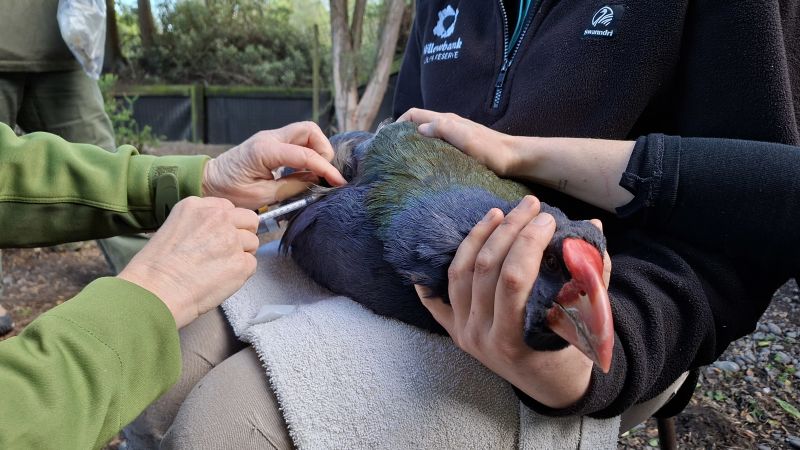
In an unusual move that most countries have never tried, New Zealand is now rushing to vaccinate 300 breeding pairs of five endangered native species to protect them from the virus.
“These birds are important to us because they are only found in New Zealand and nowhere else in the world,” the country’s biosecurity minister, Andrew Hoggard, said last week.


The highly contagious H5N1 avian influenza first made its home in Europe in 2020, carving out a deadly path around the world. It has also infected mammals such as foxes, polar bears, tigers, and sea lions, and in rare cases humans.
No one yet knows what will happen to New Zealand’s native birds if an outbreak occurs.
Mary van Andel, chief veterinary officer at the Department for Primary Industries, warned: “Some species may not be noticed at all, and others may die in large numbers.”
Anticipating the arrival of the pathogen, New Zealand had been testing thousands of birds regularly over the last year.
Only two infected birds have been found, both alive, but the country appears to be already at war. Some poultry producers have kept free-range chickens indoors, the country’s oldest zoo has canceled penguin encounters and the public has been warned not to touch or move carcasses of wild animals.
Oceania was the only region in the world free of the deadly strain of bird flu until an infected seabird was discovered on the coast of Western Australia last month. In both Antipodean countries, the virus was first discovered in the same species of sub-Antarctic seabird, the great skua, an aggressive scavenger with a tendency to attack like a crow.
The absence of predatory mammals for so long set New Zealand on a different evolutionary path. There, a select group of native birds, including kiwi, kakapo, takahe and weka, did not need to fly and felt fine just roaming the forest floor.
More than a fifth of native species have become extinct since the arrival of mammals that killed humans and birds about 700 years ago. Among those lost was the Haast’s eagle, once the largest eagle on Earth, and its prey, the towering South Island Giant Moa (a wingless ostrich-like creature that, at 3.6 meters tall, was the world’s tallest bird).
According to a 2017 government report, more than half of the 93 existing endemic species are currently considered to be “critically endangered” (on the verge of extinction).

Some are thought to be prehistoric creatures, such as the takahe, kiwi, and kakapo. The Kakapo is the only flightless parrot on Earth, and is a bird that became world famous after a British documentary in which a bird called Sirocco attempted to mate with a zoologist’s head. (The bird’s comically aggressive bobbing motion in the video is widely thought to have inspired the spinning, blinking “party parrot” emoji.)
Bird flu is a major concern for the fate of the kakapo. That’s because most of the Kakapo, of which there are only 235 in total, live in a small island reserve off the wild coast of Rakiura/Stewart Island.
“There are a lot of seabirds that come in there that may come into contact with the kakapo…and that’s a higher risk for that particular species,” Ash Murray, biosecurity manager at the country’s Department of Conservation, told CNN.
The virus is primarily spread through the faeces and saliva of infected birds, putting seabirds and other species that gather in large groups at greater risk. The same goes for scavengers like eagles and hawks, which feed on rotting corpses.
However, it is notable that the list of birds to be vaccinated does not include the iconic national bird, the kiwi. Murray said that’s because there are more kiwis – around 70,000 – and many of them live in the wild and don’t usually gather in large groups. Two of the rarest varieties, Lowy and Haast’s Tokoeka kiwiwis, could be part of the next stage of the vaccination programme.

At the Oamaru penguin colony, where tourists gather at sunset to watch hundreds of native little blue penguins come ashore after a day’s fishing, the virus can be carried on footwear, so visitors are now being asked to wash their shoes with disinfectant on arrival.
“We initiated these measures to protect the birds,” said Dr. Philippa Agnew, Oamaru Penguins science and environmental manager.
A penguin colony in a picturesque coastal town on the South Island is home to around 700 penguins, and another nearby is home to another 500. Having this many locations in one place increases the risk.
“Little penguins are only found in New Zealand and Australia… so the level of impact is really unknown,” Agnew said. It is known that penguins die in large numbers from this virus overseas, but not in large numbers.
The colony is also home to a population of New Zealand fur seals who lounge around rocks frequented by flocks of seabirds. Agnew is “definitely concerned” about them, too. “It would be very upsetting to see seals and sea lions lost,” she told CNN.
In June, scientists revealed that an estimated 13,000 seal pups on the subantarctic islands of Heard and Macdonald in southwestern Australia had been wiped out by a virus. This is equivalent to three-quarters of the pup population living there. Drone footage they collected showed large numbers of dead seals strewn across the island’s grayish volcanic coast.
More than 200,000 fur seals live in New Zealand’s waters, and the population is only just recovering after European seals drove millions to the brink of extinction in the early 1800s. But authorities are far more concerned about the fur seal’s larger relative, the New Zealand sea lion, whose adult population is thought to number fewer than 5,000.
“That’s pretty rare,” Murray said. “So we’re monitoring that species closely.”

Worldwide, the species most affected by pathogens in raw numbers is the humble chicken. Once infected poultry has a nearly zero chance of survival, governments around the world have launched genocide campaigns on infected farms to slow the spread of the disease. At least 174 million chickens are killed in the United States alone.
New Zealand’s biosecurity minister has warned that the country could follow a similar path if a large-scale outbreak occurs. Grocery stores are already warning the public not to panic as this could lead to shortages of eggs and chicken on supermarket shelves.
And authorities are certainly not panicking about the arrival of bird flu. Coming in last place means the country will have years to plan, which Murray called a “huge advantage.”
Now all you have to do is manage it.
“It will be here forever…it will help our species best adapt to that new threat,” he said.
